In a land of deep forests and wide plains, where rivers moved slowly beneath mist and the nights were lit by cold, watchful stars, there lived a king whose orchard was the pride of his realm. The trees there were ancient and carefully tended, their branches heavy each year with golden apples that gleamed like captured sunlight. These apples were not only a symbol of wealth but of the kingdom’s prosperity itself, and the king guarded them closely.
Yet each year, without fail, a strange thing occurred.
As autumn ripened the fruit and the air grew sharp with frost, the apples began to vanish from the orchard. No tracks were found, no branches broken, no guards disturbed. Only a faint glow lingered in the darkness, and the apples were gone by morning.
The king grew troubled. He summoned his three sons and spoke gravely.
“Whoever discovers the thief and protects the orchard shall earn my favor,” he said, “and with it, honor beyond measure.”
The eldest son, proud and confident, took the first watch. He stood beneath the apple trees as the night deepened, but before midnight his eyes grew heavy. He slept, and by dawn, more apples were gone.
The second son tried next, swearing vigilance. Yet he too was overcome by weariness, and the orchard was robbed again.
At last, the task fell to the youngest son, often overlooked and quietly observant. He did not boast, nor did he rely on strength alone. When night came, he wrapped himself in a cloak and waited patiently, watching the darkness rather than fighting it.
Near midnight, the air began to shimmer.
The Firebird Appears
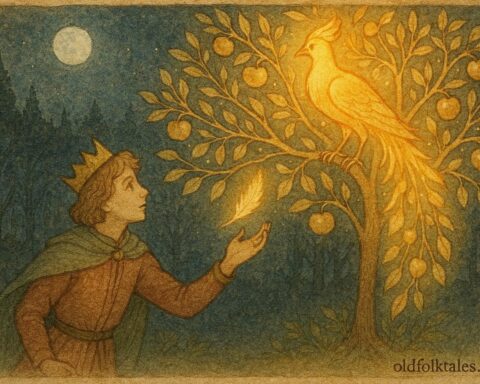
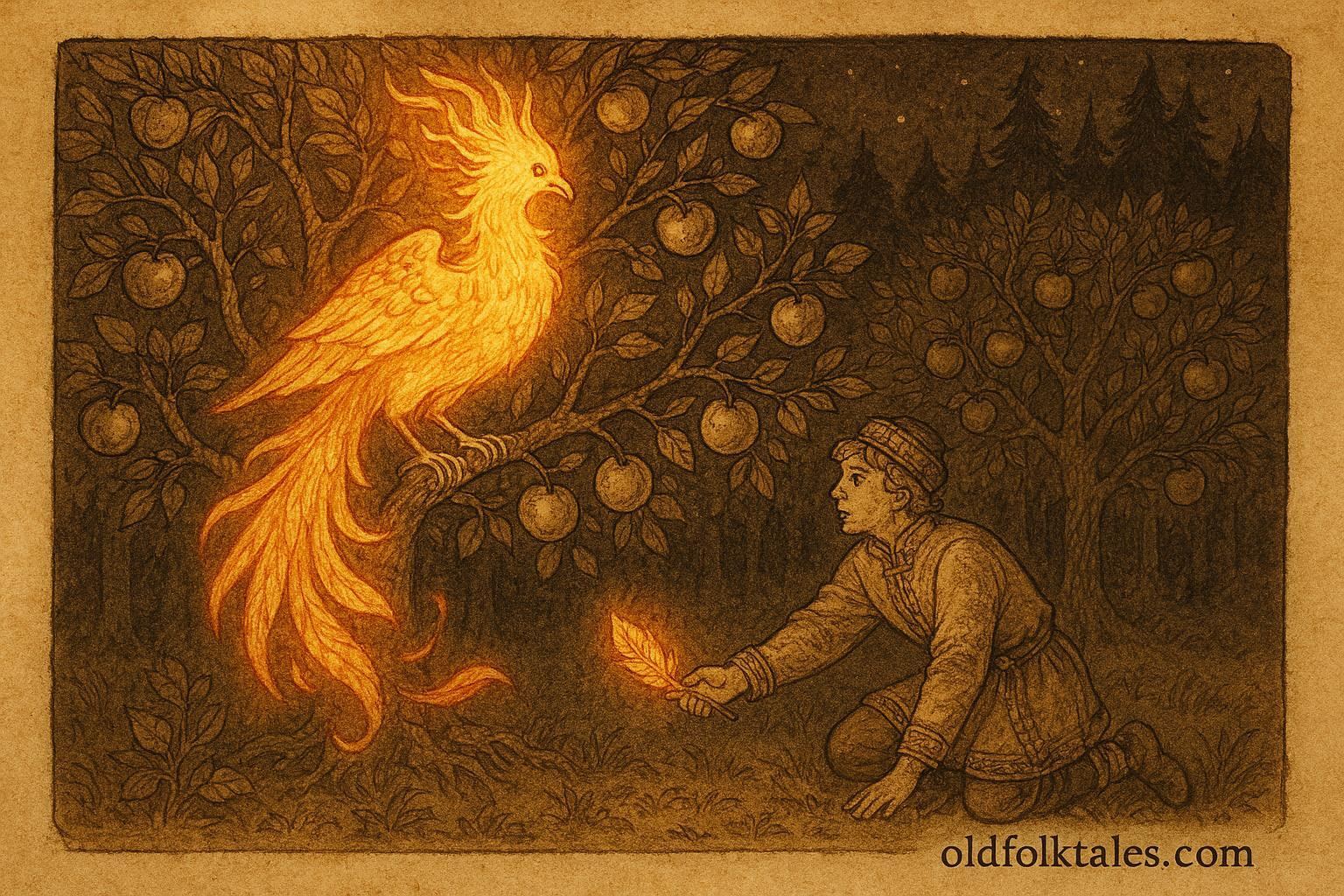
From the forest edge emerged a creature of radiant beauty, the Firebird. Its feathers glowed with living fire, casting warm gold and crimson light upon the orchard. Each movement sent sparks into the night, and its wings whispered like flames fed by wind.
The young prince stood frozen, filled with awe and fear. The Firebird perched upon an apple tree, plucked a golden apple with ease, and prepared to depart.
Summoning his courage, the prince leapt forward and seized the bird’s tail. The Firebird cried out, a sound sharp and sorrowful, and with a violent pull escaped his grasp, leaving behind a single feather glowing brighter than any torch.
The Firebird vanished into the darkness.
The prince held the feather in his trembling hand. It pulsed with warmth, neither burning nor cooling, alive with strange power. Though he sensed danger in it, wonder outweighed caution.
At dawn, he brought the feather to his father.
The Feather’s Burden
The king gazed upon the feather in astonishment. Its light filled the hall, casting flickering gold across stone walls and carved beams.
“This is no blessing,” the king said after a long silence. “Such wonders invite great peril.”
He ordered the feather locked away, yet news of it spread quickly beyond the kingdom. Travelers whispered, envoys listened, and soon word reached distant lands.
Before long, a powerful neighboring ruler sent word demanding the Firebird itself, not merely a feather, as proof of loyalty.
The king’s court fell silent. The task was impossible, and refusal meant war.
Heavy with guilt, the youngest son stepped forward.
“It was my hand that took the feather,” he said. “Let my feet bear the cost.”
Reluctantly, the king allowed him to go, providing only a horse and modest supplies. The prince set out alone, carrying the burden of his choice.
Trials of the Journey
The road was long and filled with hardship. Forests thickened, paths vanished, and hunger gnawed at him. One night, exhausted, he dismounted to rest, and when he awoke, his horse was gone, devoured by a great gray wolf that stood before him.
The prince grieved, but he did not curse the beast. Instead, he spoke calmly, accepting fate.
Moved by this humility, the wolf spared him and offered its aid. It carried the prince across vast distances, faster than any horse, warning him of dangers ahead and guiding him wisely.
With the wolf’s help, the prince reached the land where the Firebird was kept, imprisoned in a golden cage by a mighty ruler. The wolf warned him to take the bird without touching the cage, but temptation clouded judgment. The prince grasped the cage, alarms rang, and he was seized.
Only through further trials, service, and sacrifice, each harder than the last, did he continue onward, betrayed by those he trusted, tested by impossible commands, yet always aided by the wolf when humility returned to him.
Betrayal and Redemption
At last, the Firebird was freed, glowing once more beneath the open sky. The prince set out homeward, weary but hopeful. Yet near the border of his father’s land, his elder brothers found him.
Seeing the Firebird and the glory earned through hardship, envy consumed them. While the prince slept, they killed him and took the Firebird for themselves.
The wolf returned, discovering the betrayal. With sorrow and resolve, it fetched the Living Water and the Dead Water, ancient forces of Slavic legend. With the Dead Water, the prince’s wounds were sealed. With the Living Water, life returned to his body.
Restored, the prince returned quietly to the kingdom.
The Firebird’s Light
When the brothers presented the Firebird, their lies soon unraveled. Truth emerged, as it always does, and the youngest son stepped forward, alive and steadfast.
Justice was done. Betrayal was punished, and the Firebird, no longer a symbol of greed, was honored and released.
The glowing feather that had begun it all was finally understood, not as a prize, but as a warning.
Step into the enchanted forests and mystical realms of the Slavic imagination
Moral Lesson
The tale of The Firebird’s Feather teaches that desire for power carries responsibility. Wonder without wisdom leads to suffering, but humility, courage, and moral growth transform danger into redemption.
Knowledge Check
-
What is the Firebird in Slavic folklore?
A magical bird of light and fire symbolizing wonder, danger, and temptation. -
Why did the prince’s journey begin?
Because he kept the Firebird’s feather, which drew dangerous attention. -
What role does the wolf play in the story?
A supernatural helper who rewards humility and moral behavior. -
What lesson does the feather represent?
That power and beauty bring responsibility and consequences. -
How is betrayal shown in the tale?
Through the elder brothers’ envy and attempted theft of glory. -
What is the story’s cultural meaning?
It reflects Slavic values of humility, endurance, and moral justice.
Source: Compiled by Mikhail Federowski, Belarusian Folk Tales (1897)
Cultural Origin: Eastern Slavic folklore, Belarusian tradition