In the heart of Kraków, where the Vistula River curves gently past stone embankments and the city’s old walls once stood watch against the world beyond, rises the twin-towered silhouette of St. Mary’s Basilica. Its uneven towers dominate the Main Market Square, their brick faces catching the light of dawn, noon, and dusk alike. For centuries, these towers have marked time, faith, and vigilance for the people who live beneath them.
Every hour, without fail, a trumpet melody pours from the taller tower, floating above the rooftops and market stalls. It is a tune both familiar and unsettling, for it ends abruptly, cut short in mid-phrase, as though the trumpeter’s breath were suddenly taken away.
This melody is called the hejnał mariacki, and its broken ending is no accident.
It is a memory preserved in sound.
Kraków in an Age of Watchfulness
Long ago, when Kraków was the royal capital of Poland and its streets were still shadowed by wooden houses and defensive walls, the city lived under constant awareness of danger. Trade caravans passed through its gates, bringing wealth and news from distant lands, but also rumors of invasion.
The eastern horizon, in particular, was watched with care.
In those days, the towers of St. Mary’s Basilica served not only God, but the city itself. From their heights, sentries scanned the plains beyond Kraków, alert for dust clouds, torchlight, or movement that did not belong.
Among these sentries was the hejnalista, the trumpeter.
The Duty of the Trumpeter
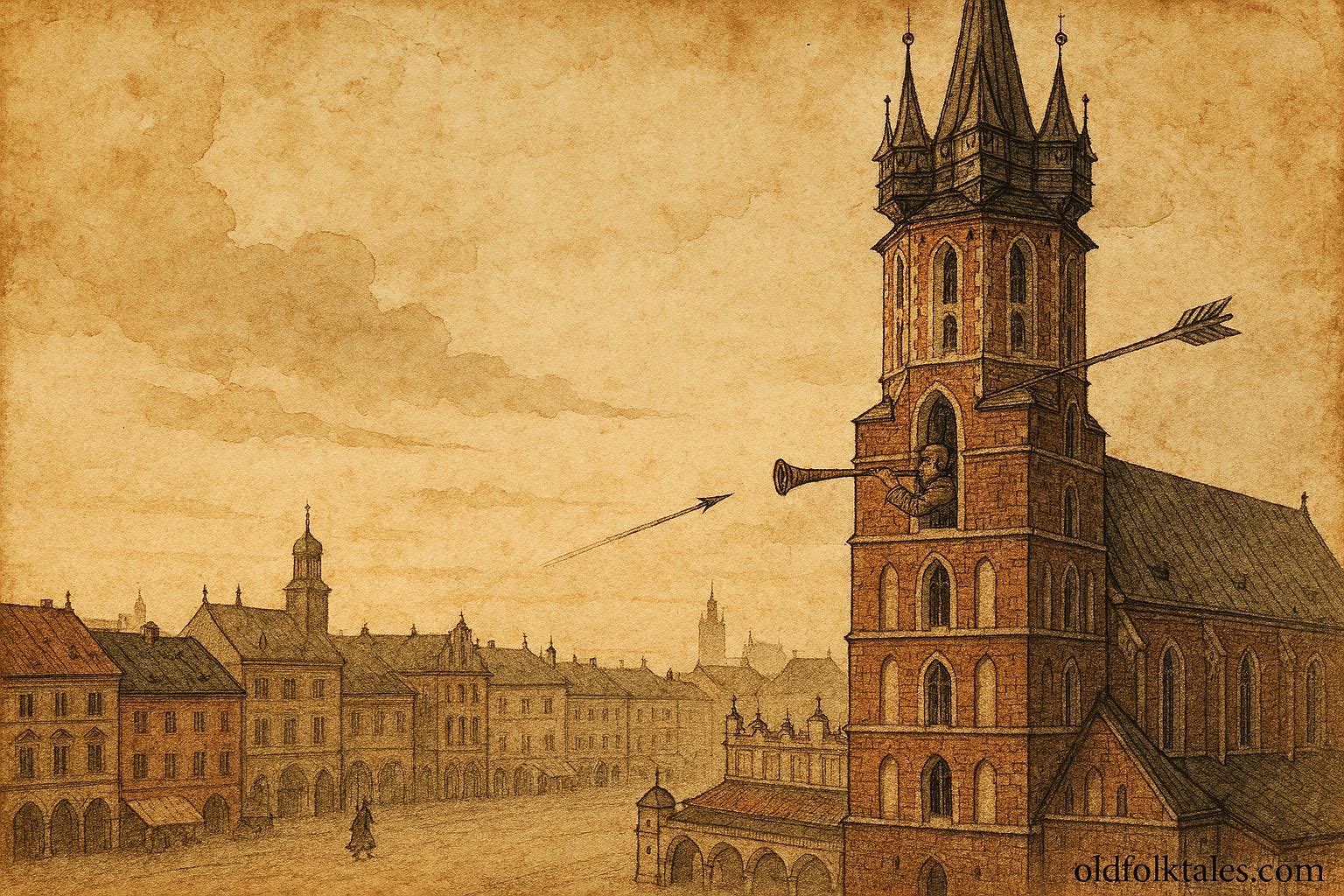
The trumpeter’s task was precise and sacred. At regular intervals, he climbed the narrow stone stairs of the taller tower, carrying his brass instrument polished by years of careful use. From the open window high above the square, he played the hejnał in four directions, east, south, west, and north, so that all quarters of the city might hear it.
The melody served several purposes. It marked the passing of hours, guided travelers, and reminded citizens that the city was awake and guarded. Most importantly, it was the sound of warning.
If danger approached, the trumpet would cry out before enemy boots touched Kraków’s soil.
The trumpeter understood this responsibility deeply. He was not a soldier clad in armor, but his role was no less vital. His breath, his vigilance, and his courage formed the city’s first line of defense.
The Morning of the Attack
On one fateful morning, as the city stirred awake and merchants prepared their stalls in the Main Market Square, the trumpeter took his place as usual. The air was clear, and the horizon appeared calm.
Yet beyond the fields and forests to the east, unseen by those below, danger was already moving.
As the trumpeter scanned the distance, he noticed a subtle change, movement that did not belong to shepherds or travelers. A glint of metal caught the light. Shapes advanced with unnatural speed and purpose.
The city was under threat.
Without hesitation, the trumpeter raised his instrument to his lips and began the hejnał.
The Broken Call
The melody rang out across Kraków, clear, urgent, unmistakable. It carried over rooftops and through streets, echoing off stone and timber. People froze mid-step. Heads turned upward. Guards at the gates sprang into motion.
But the warning came at a cost.
From the advancing force, an archer spotted the tower. An arrow was loosed, slicing through the air with deadly precision. It struck the trumpeter in the throat just as the melody reached its highest note.
The sound ended instantly.
The final note was never completed.
The trumpeter fell, his trumpet clattering against the stone floor, but the alarm had already been sounded. The city had been warned in time.
The City Responds
Thanks to the broken call, Kraków’s defenders were able to act. Gates were secured, citizens sought shelter, and guards prepared for defense. Though the details of the battle faded into legend, what endured was the knowledge that the city survived because one man fulfilled his duty without hesitation.
The trumpeter did not live to see the outcome, but his sacrifice became inseparable from the life of the city itself.
In the days that followed, the people of Kraków mourned. The tower window from which the call had sounded became a place of quiet reverence. The melody that once guided daily life was now bound forever to a single, unrepeatable moment.
A Ritual Preserved
Rather than alter the tune, the city chose remembrance.
The hejnał continued to be played, but always stopping at the same point where the trumpeter’s life had ended. The unfinished melody became a living memorial, not carved in stone, but carried on breath and brass.
Hour after hour. Day after day. Century after century.
As Kraków grew and changed, its wooden houses replaced by stone, its walls dismantled, its role shifting with the tides of history, the trumpet call remained unchanged. It echoed through fires, invasions, partitions, and rebirth.
Even when Kraków ceased to be the political capital of Poland, it remained a spiritual one, and the broken call continued to define its heart.
Sound as Memory
To those unfamiliar with the story, the sudden ending of the melody feels startling. To the people of Kraków, it is grounding.
The broken call teaches that vigilance is not abstract, it is personal. That civic duty may demand everything. That a city is not protected by walls alone, but by the willingness of its people to act when needed.
Each trumpeter who climbs the tower today understands that he is not merely performing a tune. He is standing in the place of another, continuing a promise made long ago.
The breath that fills his lungs joins the breath that was once cut short.
The Living Legend
Today, the hejnał mariacki is played every hour, broadcast across Poland and beyond. Yet it has never lost its meaning. The melody does not fade into background noise; it commands attention, even in a modern world.
Because it is not just music.
It is a warning remembered, a sacrifice honored, and a reminder that communities endure through vigilance and selflessness.
As long as the towers of St. Mary’s Basilica rise above Kraków, the broken trumpet call will continue, unfinished, unforgettable, and eternal.
Moral Lesson
The legend teaches that true heroism often acts without expectation of reward. Vigilance, duty, and selflessness protect communities more powerfully than walls or weapons. Memory, when preserved through ritual, keeps sacrifice alive across generations.
Knowledge Check
-
What is the hejnał mariacki?
A traditional trumpet call played hourly from St. Mary’s Basilica in Kraków. -
Why does the melody end abruptly?
Because the original trumpeter was killed by an arrow while sounding an alarm. -
What was the trumpeter’s role in the city?
To mark time and warn Kraków of approaching danger. -
Where is the hejnał played from?
The taller tower of St. Mary’s Basilica in Kraków. -
What does the broken melody symbolize?
Sacrifice, vigilance, and civic duty. -
Why has the tune never been completed?
To preserve the memory of the trumpeter’s final act.
Source: Polish urban oral tradition. Recorded by Ambroży Grabowski, 1830s–1840s.
Cultural Origin: Kraków, Lesser Poland