Once, in a village that sat between windswept plains and endless forests, there lived a young soldier who had fought in distant wars. He was poor, neither noble nor learned, yet he carried a sharp mind beneath a rough coat and a courage that shone brighter than any medal. His comrades had long called him clever, though others laughed and called him reckless.
In time of peace, he returned to his village with little more than his sword, a worn pack, and the knowledge of the wider world. It was there, in quiet fields and at market stalls, that he first heard the stories of Death, a force so certain and unyielding that no man, no king, no hero could escape it.
Explore the warmth and wit of Mediterranean storytelling, where love and wisdom intertwine
The soldier, however, was not afraid, not entirely. If Death came, he thought, perhaps she could be tricked.
The First Encounter
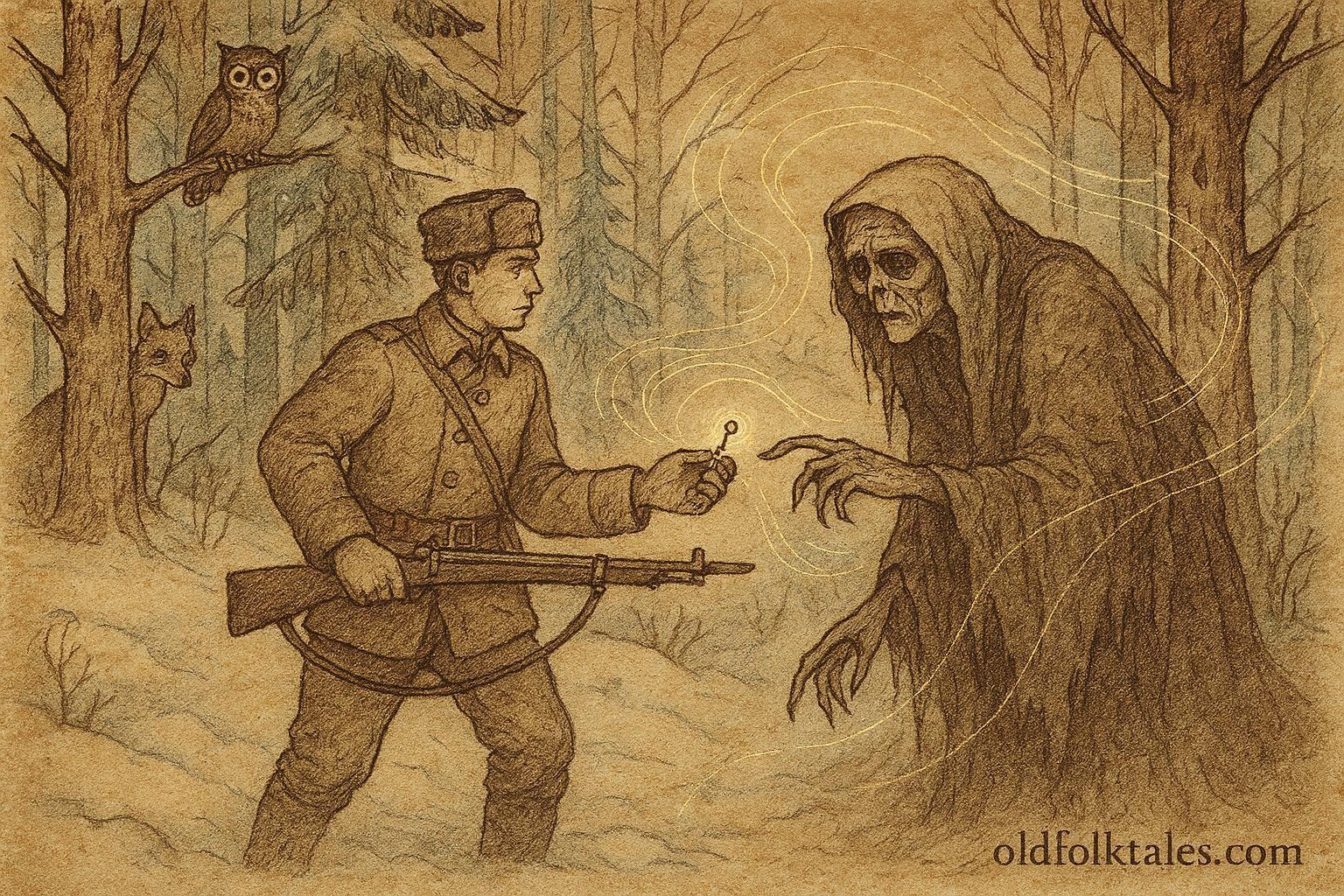
It happened on a frost-laden morning. Snow had crusted over the earth, and the trees were bare as bones. The soldier trudged along the road, whistling, when suddenly the wind stilled, the birds vanished, and a shadow detached itself from the woods.
It was Death, personified as a thin old woman with eyes like dark hollows, her hands gnarled like frozen branches. She smiled, a terrible smile. “At last, I have found you,” she said, voice like cracking ice.
The soldier, though taken aback, did not flee. “Ah,” he said, rubbing his chin, “I suppose you’ve come for me? Well, I am in no hurry.”
Death tilted her head. “I do not bargain. I do not wait. You are mine.”
“But,” the soldier said, “I am but a poor man, and I have a task unfinished. Perhaps I might earn a little time?”
Death laughed. “Time is mine to give or take.”
The soldier bowed, low and sly. “Then perhaps you would grant me a single boon. Teach me how to hold life in my hands for a short while, that I may see the world once more before you claim me.”
Outwitting Death
Surprised by his audacity, Death agreed, but on one condition: the soldier must perform a task impossible for ordinary men. He must carry a sack that would never empty, containing the measure of life itself, and return it without spilling a single thread of time.
The soldier, thinking quickly, nodded. He lifted the sack with ease, holding it close to his chest. Every step was careful, measured, as if the ground itself had eyes. When a strong wind tried to tear it from him, he leapt into a hollow, letting the wind pass harmlessly. When snow threatened to soak the sack, he covered it with his cloak. And when the trees bent low to strike him, he dodged and danced with the patience of a man who knew that cleverness could outweigh strength.
At last, he returned the sack to Death untouched. She stared at him, astonished. “You are clever beyond measure,” she said. “Very well. I grant you a gift.”
With that, Death handed him a small, polished key. “This opens the measure of time. Use it wisely or the world itself will rebuke you.”
The Power of Life and Time
From that day forward, the soldier could grant life or delay death. He helped those who begged honestly, and he saved lives that others might have mourned too soon. Villagers whispered tales of his cleverness. Those who had fallen ill rose again, and the soldier’s fame grew.
Yet, even as he performed miracles, he noticed that the world began to shift. Animals lingered too long, old men grew stubborn with unnatural strength, rivers swelled with unchecked rains. Life, when stretched beyond its measure, created imbalance.
The soldier, who had never sought to rule the world, realized that even cleverness had limits.
Death Returns
One evening, as the sun dipped behind the hills and the forest shadowed the fields, Death appeared again. Her eyes were colder than ever. “You meddle with the order,” she said. “You have delayed what cannot be delayed. Time bends for no man.”
The soldier bowed. “I only meant to aid, not to challenge,” he said. “But if balance demands it, I will return what I hold.”
Death nodded, though her gaze was wary. “Very well. One final game,” she said. “Outwit me now, or all your cleverness will end.”
The Final Trial
She summoned a field of invisible threads, each representing a life. The soldier could only touch one thread at a time. If he chose wrong, death would claim not him, but an innocent in his village. The threads twisted and shifted, and the wind whispered names in the cold twilight.
The soldier remembered every kindness he had shown, every creature he had spared, every act of patience and humility. Slowly, he traced the thread connected to a sick child whose life had already lingered at the edge. Gently, he guided it back to balance. Then another, and another, until the field of life no longer wavered.
Death watched silently, for the soldier’s wisdom lay not in cleverness alone, but in humility, respect, and moral insight.
At last, she spoke. “You have learned the true measure of life, soldier. Not cleverness, nor trickery, nor pride can change what is meant to be. Go, and take what lessons you may, but meddle no longer.”
With that, Death vanished, leaving the soldier standing alone in the quiet forest, the snow settling softly at his feet.
Return to the Village
The soldier returned home, carrying neither sack nor key, but enriched by knowledge of life’s limits and the proper respect for its measure. He shared his tale only with those who would listen with understanding, teaching that cleverness alone cannot defy nature indefinitely.
Villagers remembered him not only as the man who tricked Death, but as one who understood that life is a delicate balance. He married, raised children, and lived quietly, always mindful that each breath, each day, is a gift, neither to be hoarded nor squandered.
Discover Polish, Russian, Ukrainian, and Belarusian folktales where magic and morality meet
Moral Lesson
This folktale teaches that cleverness can delay fate, but no man may escape the natural order forever. Wisdom, humility, and respect for life’s measure are greater than trickery or pride. Life’s balance must be honored, and even the cleverest must reckon with death in time.
Knowledge Check
1. Who is Death in this Russian folktale?
A personified figure, often an old woman, who enforces the natural order of life and mortality.
2. How does the soldier first trick Death?
By carrying the impossible sack of life carefully, showing patience, cleverness, and humility.
3. What gift does Death give the soldier?
A key allowing him temporary control over life and time.
4. Why does the world begin to imbalance?
Because delaying or granting life unnaturally disrupts nature’s order.
5. What is the ultimate lesson of the story?
Cleverness cannot override mortality; respect for life’s natural balance is paramount.
6. How does the soldier succeed in the final trial?
Through humility, moral discernment, and careful guidance of life without pride or selfishness.
Source: Russian oral folktale tradition, collected in 19th-century folk collections, 19th century
Cultural Origin: Russian folk culture