In a quiet village of central Ukraine, where wide fields of grain met dark stretches of forest and rivers moved slowly under open skies, there lived a poor but honest couple. They worked the land with their own hands, planting what they could and trusting the seasons to be kind. Their home was simple, their meals modest, yet they lived with patience and faith.
One year, after a long and difficult winter, the woman planted peas beside the house, hoping they would grow quickly and provide food before the next harvest. She tended them daily, loosening the soil, pulling weeds, and watering them with care. One morning, as she bent to inspect the vines, she noticed a single pea pod unlike the others, larger, rounder, and glowing faintly green in the sunlight.
Discover the moral heart and wild spirit of the north through timeless Nordic storytelling
When she touched it, the pod split open.
From inside stepped a small boy, no larger than a loaf of bread, yet alive and breathing, with bright eyes and a steady gaze.
The woman cried out in fear, but the boy spoke gently.
“Do not be afraid, Mother. I am your son. I was born of the pea you planted.”
Astonished and trembling, the woman wrapped the child in her apron and carried him inside. Her husband listened in silence as she told the tale, then crossed himself and nodded.
“If he is sent to us,” he said, “we will raise him as our own.”
They named the boy Kotygoroshko, meaning Little Pea.
The Growth of the Pea-Born Child
Kotygoroshko grew faster than any child the village had known. In a matter of days, he stood taller than the table; within weeks, he was as strong as a grown man. By the time a month had passed, he could lift stones that took three men to move, and split oak logs with his bare hands.
Yet for all his strength, Kotygoroshko was gentle with his parents and respectful to elders. He listened more than he spoke and worked without complaint. The villagers whispered about him, some with awe, others with fear, but none could deny his courage.
One evening, as Kotygoroshko returned from the fields, he found his parents weeping.
“What troubles you?” he asked.
His mother wiped her eyes.
“A terrible serpent has come from beyond the forest,” she said. “It has already taken your brothers and sisters, your older siblings, from us. It dragged them away to its lair, and no one who goes after them ever returns.”
Kotygoroshko’s face hardened.
“Then I will go,” he said simply.
His parents pleaded with him to stay, but he would not be moved.
“Strength was given to me for a reason,” he said. “If I do not use it to protect my family, it is worth nothing.”
The Journey Begins
Kotygoroshko prepared for his journey. From the blacksmith, he took an iron mace heavier than any tool ever forged. He tested it once against a boulder, which cracked in half. From his mother, he took bread and a blessing.
He set out at dawn, following the road into the forest where the trees grew thick and the light dimmed. Birds fell silent as he passed. The deeper he went, the darker the air became, until the ground itself seemed uneasy beneath his feet.
Soon he came upon a ravine split open like a wound in the earth. From its depths rose the stench of smoke and scales.
The serpent lived below.
The Battle with the Serpent
Kotygoroshko descended into the ravine, calling out boldly.
“Serpent! Come forth and face me!”
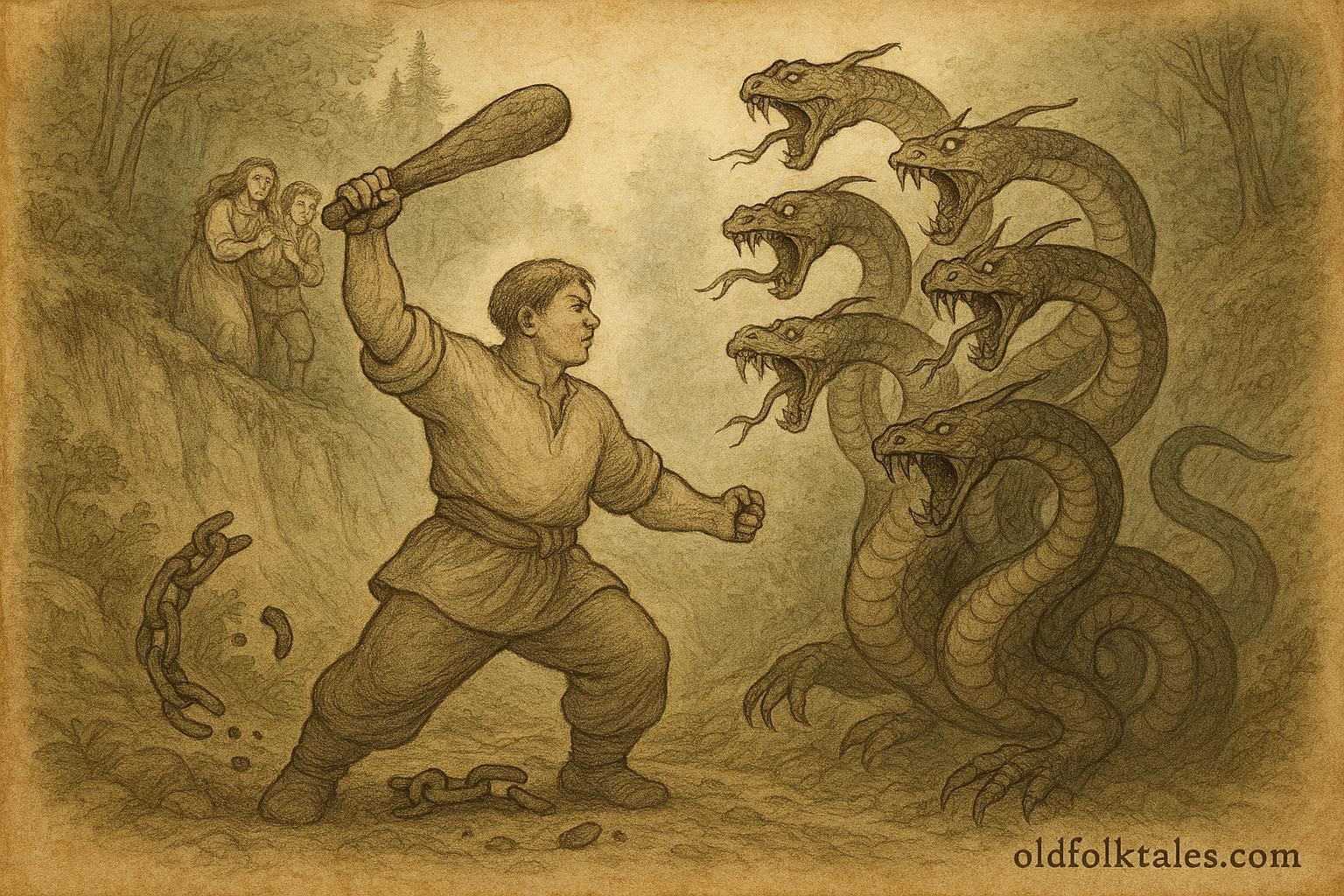
The earth trembled. From the shadows rose the serpent, huge, many-headed, its scales black as burned iron, its eyes glowing with malice. Around it lay broken weapons and the bones of those who had tried and failed.
The serpent laughed.
“You are small,” it hissed. “I have eaten warriors twice your size.”
Kotygoroshko planted his feet.
“I was born from a pea,” he said, “but I was not born to kneel.”
The serpent struck, but Kotygoroshko met it head-on. The battle shook the ravine. The serpent’s tails crushed stone; Kotygoroshko’s mace rang like thunder. Again and again, they clashed, until at last Kotygoroshko struck the serpent’s final head and drove it into the ground.
With a final roar, the serpent fell silent.
The Rescue
From a nearby cave came faint voices.
Kotygoroshko followed them and found his brothers and sisters chained in darkness, weak but alive. He broke their bonds as if snapping reeds and carried them back into the light.
They wept with joy at the sight of him.
“You came for us,” they said. “We thought no one would.”
Kotygoroshko smiled.
“Family does not abandon family.”
Together, they returned toward the village, but the journey was not yet over.
Betrayal on the Road
As they traveled, Kotygoroshko sent his siblings ahead while he cleared the path. Unknown to him, fear and envy crept into their hearts. They had lived under the serpent’s shadow and had grown afraid of Kotygoroshko’s power.
When Kotygoroshko approached a deep pit, they pushed him from behind.
He fell into darkness.
Believing him dead, they returned home and claimed the victory as their own.
Return from the Depths
Kotygoroshko did not die.
At the bottom of the pit, he found hidden springs and old forces of the earth. Drawing on his strength and will, he climbed back up, tearing handholds into solid stone.
When he emerged, wounded but unbroken, he did not curse his siblings. Instead, he walked home silently.
The village fell quiet when they saw him.
His parents ran to him, and the truth came out.
Justice Restored
Kotygoroshko confronted his siblings, not with violence, but with words.
“You feared what you did not understand,” he said. “But fear does not excuse betrayal.”
Ashamed, they begged forgiveness.
Kotygoroshko forgave them, but the village remembered the lesson.
From that day on, Kotygoroshko was honored as a protector of the people. Though born from a humble pea, he became a symbol of justice, courage, and the strength hidden in ordinary things.
Moral Lesson
This folktale teaches that true strength does not come from birth or status, but from courage, loyalty, and moral resolve. Even the smallest beginnings can give rise to great heroes when guided by justice and compassion.
Knowledge Check
1.Why is Kotygoroshko’s birth significant?
It symbolizes hidden potential arising from humble origins.
2. What does the serpent represent in the story?
Chaos, evil, and destructive power threatening family and community.
3. Why does Kotygoroshko go on his quest?
To rescue his abducted siblings and restore justice.
4. What lesson is shown through the siblings’ betrayal?
Fear and envy corrupt, but forgiveness restores balance.
5. How does Kotygoroshko differ from traditional heroes?
He combines immense strength with humility and mercy.
6. What cultural values does the story reflect?
Family loyalty, justice, and respect for moral strength.
Source: Collected and published by Ukrainian ethnographers including Mykhailo Drahomanov, 1876
Cultural Origin: Central Ukrainian heroic folklore with Slavic mythological roots