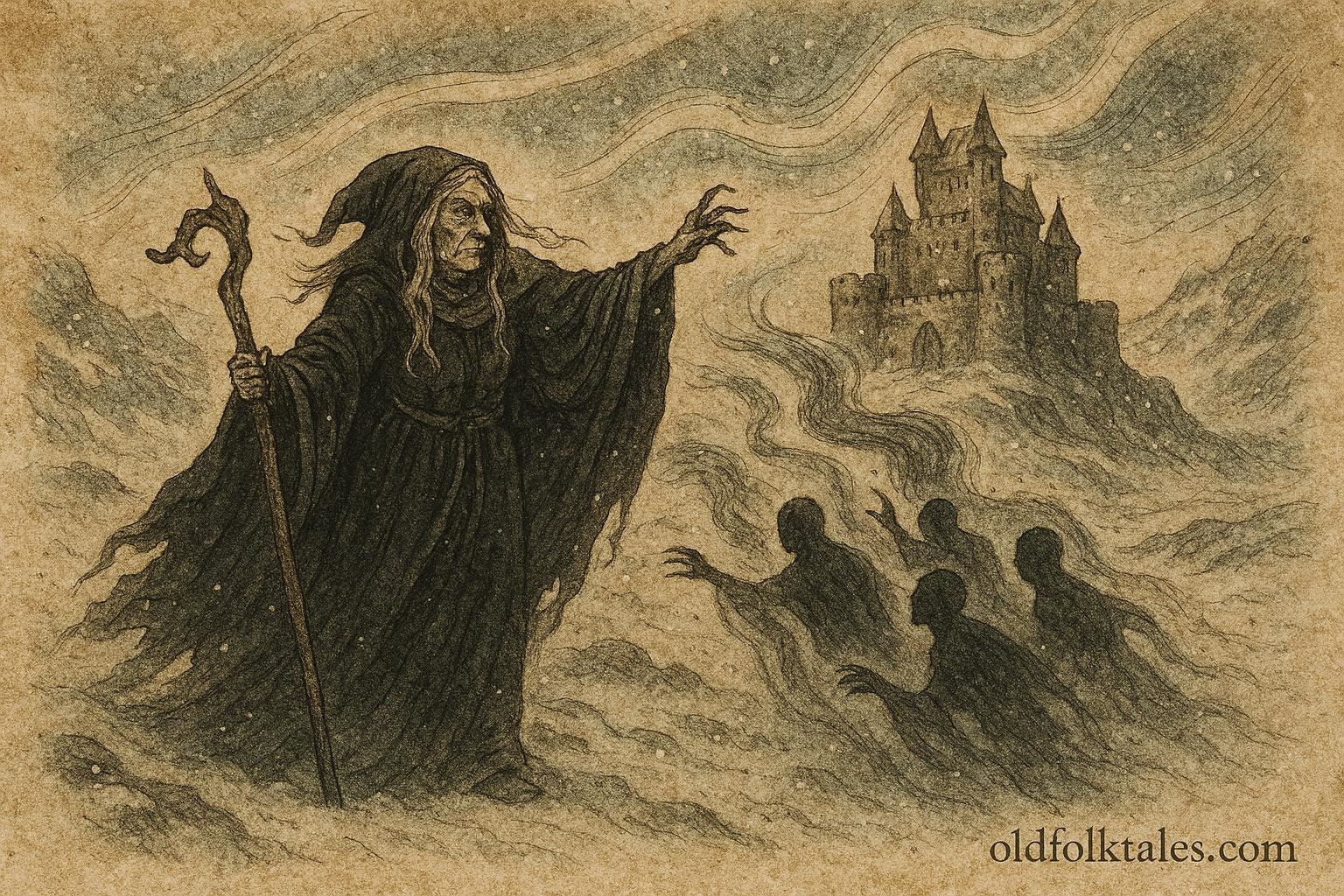
Beyond the last birch forests of Kalevala, beyond rivers that freeze before the moon has finished its cycle, lies Pohjola, the Northland. It is a country where the earth is locked in stone for most of the year, where crops struggle, and where the sky itself seems heavier, pressing low upon the land. Over this realm rules Louhi, Mistress of the North.
She was already old when the oldest songs were first sung. Her age is not counted in years but in winters. Her back is bent not from weakness, but from carrying the weight of power too long held. Her eyes, pale and piercing, have watched generations rise and vanish like frost patterns on glass.
Louhi does not sit upon a gilded throne. Her hall is built of dark timber and stone, hardened by wind and cold. Ravens circle above it. Wolves pass without fear. The North itself recognizes her as its keeper.
The Nature of Her Rule
Pohjola survives because Louhi rules it without softness.
She knows that mercy alone cannot preserve life in the North. Hunger, cold, and sickness stalk the land like living beings. Louhi commands them as one commands wild dogs, not to destroy blindly, but to keep balance.
She summons storms to protect her borders. She sends frost to remind the land of its limits. She knows the secret names of illnesses and the words that bind them, just as she knows the words that release them.
The people of Pohjola fear her, but they do not rebel. They understand that without her strength, their land would be devoured by chaos or conquered by the warmer South.
Mistress of Ancient Magic
Louhi’s magic is not learned from books. It is inherited from the land itself.
She speaks spells older than iron. She sings runes that twist the wind and darken the sun. With her spindle, she spins fate as women spin wool, slowly, deliberately, without haste.
When she calls the spirits, they answer. Frost gathers in the air. Shadows lengthen. Even fire grows hesitant in her presence.
Yet Louhi is not reckless with her power. Every spell costs something. Every curse has consequences. She knows this law better than any hero who dares to challenge her.
Encounters with the Heroes of Kalevala
From the South come the heroes, Väinämöinen, Ilmarinen, Lemminkäinen, and others whose names echo through song. They come seeking what the North holds: power, knowledge, wealth, and the secrets of creation.
Louhi never refuses them outright.
Instead, she tests them.
She sets tasks that cannot be solved by strength alone: forging impossible objects, crossing deadly waters, surviving enchanted trials. She watches closely, not merely to see who succeeds, but how they attempt to succeed.
Those who rely only on force fail.
Those who rely only on cleverness fail.
Those who forget humility fail.
Louhi values endurance, patience, and respect for unseen forces, virtues shaped by northern survival.
The Sampo and the Balance of Power
When the forging of the Sampo brings wealth and prosperity to Pohjola, Louhi guards it fiercely. She understands that abundance changes the world, and that too much light can be as dangerous as too much darkness.
When the heroes attempt to steal it, Louhi unleashes her full power. She raises storms that shatter ships, sends darkness across the sea, and transforms herself into monstrous forms not out of cruelty, but desperation.
To lose the Sampo is to weaken Pohjola. To weaken Pohjola is to invite extinction.
Louhi as Mother and Matron
Louhi is also a mother, though not a gentle one. Her daughters are both prizes and pawns in the struggles between North and South. She uses marriage not as romance, but as diplomacy and strategy.
In this, Louhi reflects an ancient truth: love does not erase duty. Power does not allow softness when survival is at stake.
Yet even here, her actions are not without complexity. She protects her bloodline as fiercely as she protects her land.
The Southern View and the Northern Truth
In southern songs, Louhi is often named a villain, a witch, a deceiver, a hoarder of blessings meant for others. But northern stories tell a different truth.
They say:
Without Louhi, Pohjola would be nothing but frozen ruins.
Without her will, winter would devour everything.
Without her vigilance, the South would take without asking.
Louhi does not oppose heroes because she hates them.
She opposes them because power must be earned, and because balance must be preserved.
Symbol of the Unforgiving World
Louhi is winter given voice.
She is the storm that teaches preparation.
She is the frost that punishes carelessness.
She reminds humanity that nature does not exist to comfort, it exists to endure.
Moral Lesson
This tale reflects the moral ambiguity of power and the Finnish understanding of nature as a living force. Louhi teaches that strength can protect as much as it destroys, and that not all opposition is evil, some exists to preserve balance.
Knowledge Check
-
What land does Louhi rule?
Pohjola, the frozen northern realm. -
Why do heroes seek Louhi?
For power, knowledge, or magical rewards. -
How does Louhi maintain authority?
Through magic, cunning, and control of nature. -
Is Louhi purely evil? Why or why not?
No, she protects her land and represents natural balance. -
What does Louhi symbolize?
The harsh, powerful forces of northern nature. -
Why is she feared and respected?
Because survival in the North depends on strength and order.
Source: Kalevala, compiled by Elias Lönnrot, 1835
Cultural Origin: Finland, Karelian and Northern Finnish folklore