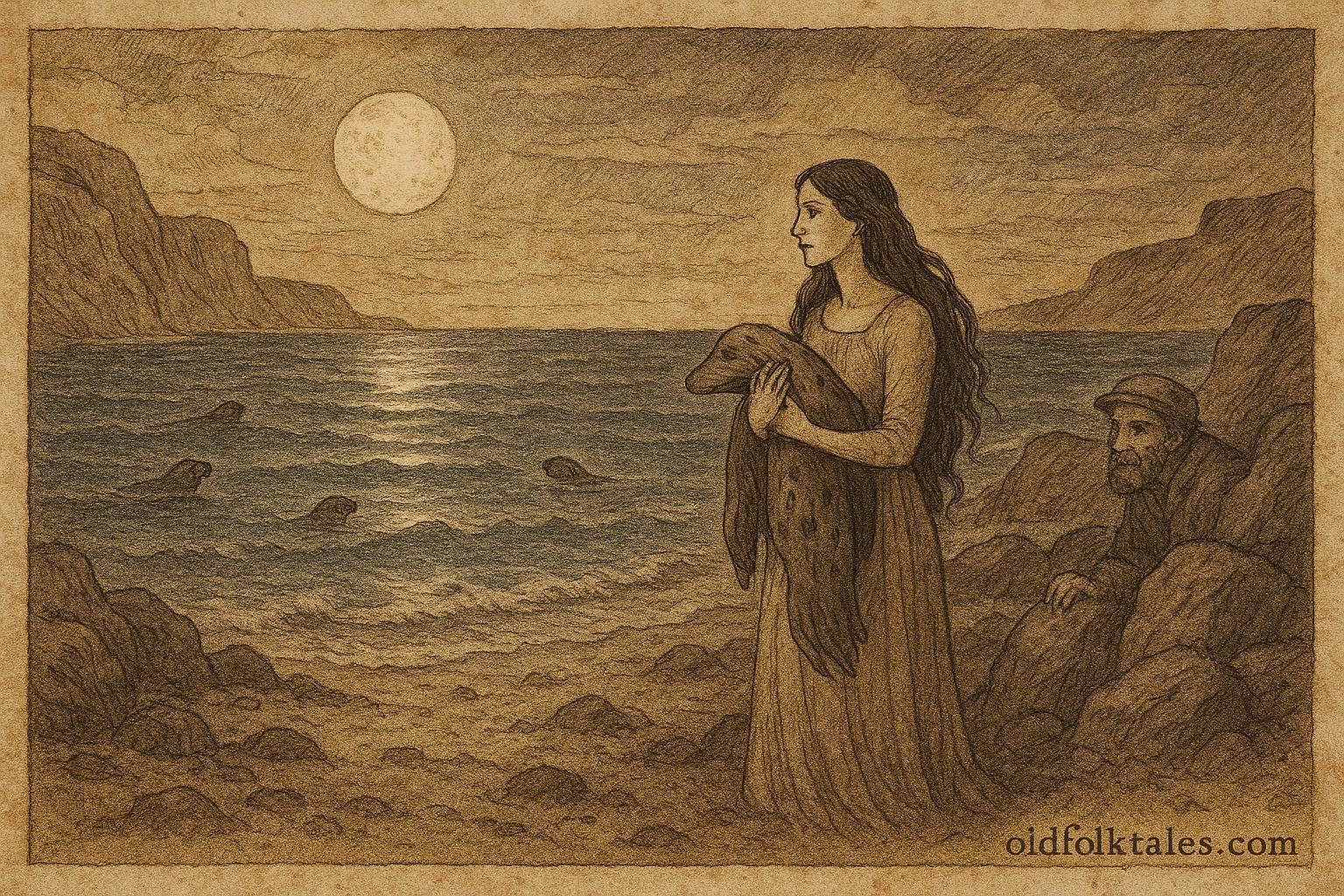
Along the ragged coast of the northern seas, where cliffs rise sharply from dark water and the wind carries the taste of salt far inland, there lived fishing communities who understood the ocean not merely as water, but as a living power. It fed them, threatened them, and whispered secrets in the long twilight hours.
Among these secrets was the old belief in selkies, beings who lived as seals beneath the waves but could shed their skins to walk upon land as men and women of rare beauty. The people spoke of them quietly, with respect and fear, for to cross the boundary between sea and shore was never without consequence.
It was in one such village, isolated by stone and spray, that the story of the Seal Woman unfolded.
The Fisherman and the Hidden Skins
One summer evening, as the sun dipped low and painted the sea with pale gold, a fisherman walked the shore alone. He had come not to cast nets, but to think, for his life was quiet and solitary, marked only by tides and seasons.
As he rounded a curve of black rock, he heard laughter, soft, musical, unlike any human voice he knew.
There, upon a stretch of sand usually claimed by seals, stood a group of women dancing. Their sealskins lay folded nearby, glistening like wet silver.
The fisherman froze. He knew at once what he was seeing.
A selkie woman stood apart from the others, her hair dark as deep water, her face turned toward the horizon. Something in her stillness drew him. Without fully understanding why, whether from desire, fear, or a desperate wish to change his lonely fate, he crept forward and stole her sealskin, hiding it among the rocks.
When the dancers returned to the shore and reached for their skins, panic spread. One by one, they vanished into the sea, except for the woman whose skin was gone.
She searched the rocks in silence, then turned slowly toward the fisherman.
Her eyes held no anger, only sorrow.
A Life on Land
Without her sealskin, the selkie woman could not return to the sea. The fisherman led her to his home, where she lived as a human woman, bound by circumstance rather than choice.
In time, she became his wife.
She learned the rhythms of land life: tending the hearth, mending nets, watching seasons change without the comfort of tides. She bore him children, whom she loved deeply and cared for with gentleness.
Yet always, she walked the shore.
When storms rose, she stood watching the waves, her face filled with longing so deep it frightened those who saw it. At night, she sang songs no one understood, melodies shaped by currents and moonlit waters.
Though she fulfilled her duties, her heart never left the sea.
The Seals That Watched
Sometimes seals gathered near the shore, lifting their heads as if listening. The selkie woman would pause, her breath catching, her body remembering what her life could not.
The fisherman noticed these moments and felt unease. He hid the sealskin more carefully, burying it beneath boards and stone, knowing, perhaps too late—that love born of captivity is never secure.
Years passed.
The children grew, playing along the same shore where their mother once danced free.
The Discovery
One day, while searching for fishing tools, the selkie woman discovered a hidden bundle beneath the floorboards.
She did not need to open it to know.
Her hands trembled as she unfolded the sealskin, still cool, still alive with the scent of the sea. Memory surged through her, of cold depths, swift currents, and a home older than any village.
She wept, not only for herself, but for the life she had lived, and the children she loved.
When night fell, she wrapped herself in the sealskin once more.
The Return to the Sea
She walked silently to the shore, the moon lighting her path. The fisherman followed too late, calling out, but she did not turn back.
At the water’s edge, she looked once toward land, toward the life she had lived but never chosen. Then she slipped into the sea.
A seal rose briefly among the waves and gazed back, eyes filled with sorrow and memory.
Then she was gone.
What Remained
The fisherman never married again.
The children grew, carrying the sea in their hearts. It was said that seals followed their boats, watching protectively, and that storms spared them when others were lost.
The selkie woman did not forget her human family, but the call of the sea could not be denied.
Moral Lesson
Love cannot thrive where freedom is stolen. To bind nature is to invite loss. True belonging answers to the deepest call of the heart.
Knowledge Check
1. What is a selkie in Scandinavian folklore?
A selkie is a seal that can shed its skin to become human on land.
2. Why is the selkie woman trapped on land?
Her sealskin is stolen, preventing her return to the sea.
3. What does the sea represent in the selkie legend?
Home, identity, freedom, and the natural world.
4. Why does the selkie woman return to the ocean?
She recovers her sealskin and answers her true nature.
5. What lesson does the selkie story teach?
Love without freedom leads to sorrow and loss.
6. Where does the Seal Woman legend originate?
Coastal Scandinavia and North Atlantic folklore.
Source: Scandinavian and North Atlantic oral tradition, recorded by 19th-century folklorists
Cultural Origin: Coastal Scandinavia (Norway, Sweden, with Icelandic influence)