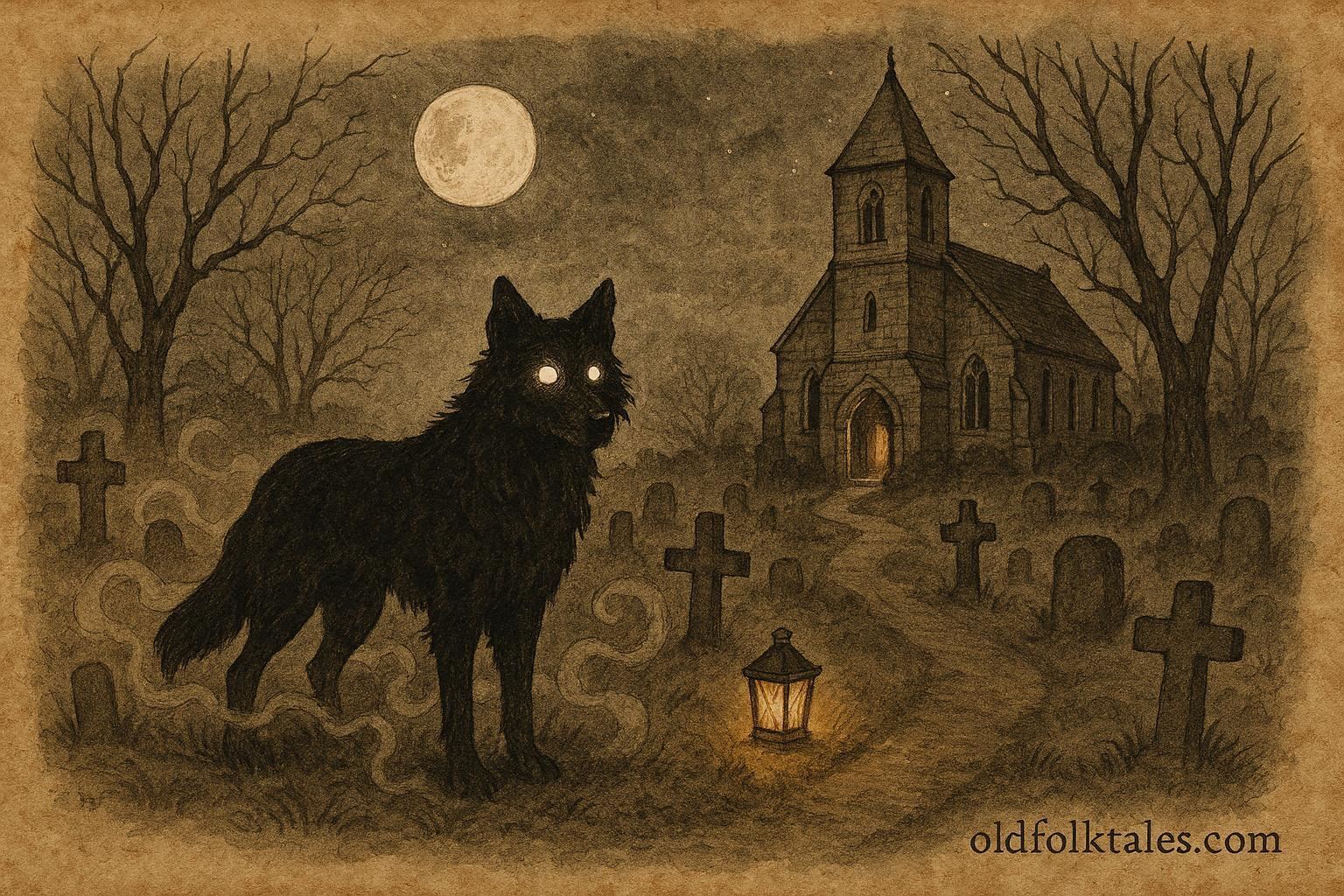
In the quiet villages of Denmark and southern Sweden, where stone churches stood at the heart of the community, people believed that death did not end responsibility. The dead were not abandoned to the soil, nor left unguarded beneath the cold stars. Sacred ground required protection, and the boundary between the living and the departed demanded vigilance. From this belief arose the legend of the Church Grim.
It was said that when a church was first built, the ground was restless. Spirits wandered, uncertain of their place, and death itself lingered close. To ensure peace, a guardian was needed, one that did not belong fully to either world.
And so the Church Grim came to be.
The First Burial
In the old days, when churches were newly raised from timber and stone, villagers whispered of a ritual never spoken aloud. The first burial in the churchyard was not always human. Sometimes, it was a black dog, strong, loyal, and watchful, buried beneath the church floor or at the edge of consecrated ground.
The sacrifice was not cruelty in the villagers’ eyes, but duty. The dog’s spirit would remain bound to the churchyard, transformed into something more than flesh, a guardian of the dead, a watcher of graves, and a herald of fate.
From that night onward, the Church Grim would walk.
The Black Dog at the Gate
Those who claimed to have seen the Grim described it the same way:
a great black dog with glowing eyes, fur darker than moonless night, silent as shadow.
It appeared only after dusk. It paced the churchyard walls, sat at the gate, or lay among the gravestones as though listening to voices no living ear could hear.
The Grim never barked.
If a traveler passed the church late at night and glimpsed the dog watching from the corner of their eye, they were advised not to run. To flee was to invite misfortune. Instead, one must bow their head and pass quietly, acknowledging the guardian’s duty.
Those who showed respect were unharmed.
Those who mocked the Grim, or dared to trespass among the graves after dark, were not always so fortunate.
The Watchman’s Encounter
In a village near the southern coast of Sweden, there lived a church watchman whose task was to keep the grounds secure at night. He had heard the stories, but like many men, believed himself wiser than superstition.
One winter evening, as snow softened the world into silence, he noticed footprints circling the graves, large, canine prints that appeared and vanished without leading anywhere.
Then he saw it.
The black dog stood beside a newly turned grave, eyes glowing faintly like embers beneath ash. The watchman’s breath froze in his chest. His lantern flickered, though there was no wind.
The Grim did not move.
At dawn, the watchman was found alive but shaken, unable to speak. Before the week ended, the family whose grave the Grim had guarded buried another of their own.
From then on, no one doubted the warning.
Protector of the Dead
Despite its fearful reputation, the Church Grim was not a creature of malice. Its purpose was protection.
It guarded the churchyard from grave robbers, witches, and restless spirits. In some villages, it was said the Grim chased away the undead, ensuring that the dead stayed where they belonged.
Children were told that if they wandered too close to graves at night, the Grim would frighten them back home, not to harm them, but to teach respect.
Farmers swore their cattle refused to graze near churchyards after sunset, sensing something unseen moving through the mist.
The Grim existed not to punish the living, but to maintain balance.
A Warning, Not a Curse
To see the Church Grim was often believed to foretell death, but not always the death of the one who saw it. Sometimes, it was a warning that death walked nearby, that illness or accident approached the community.
In Denmark, it was said that if the Grim stood directly before the church door, someone would soon be carried through it feet-first. In southern Sweden, seeing the Grim washing its paws in a stream meant a funeral would follow before the next moon.
Yet the Grim did not cause death.
It merely witnessed it.
The Farmer Who Laughed
Once, a farmer returning late from market passed the churchyard road. Seeing the black dog standing by the gate, he laughed and threw a stone.
The dog did not chase him.
The next morning, the farmer’s best horse lay dead in the stable. By week’s end, the farmer himself fell ill. The villagers whispered that the Grim had not punished him but had withdrawn its protection.
Sacred spaces, they believed, demanded humility.
Between Fear and Reverence
As years passed and churches grew older, belief in the Church Grim softened but never vanished. Even when people spoke less openly of spirits, they still avoided churchyards at night.
Some claimed that when churches were rebuilt or abandoned, the Grim moved on, fading back into the soil. Others believed it remained forever, pacing its invisible path beneath the earth.
The Church Grim was not evil, nor kind, it was necessary.
Moral Lesson
Not all guardians bring comfort. Some protect through silence and fear. To respect the dead is to respect the unseen order of the world.
Knowledge Check
1. What is the Church Grim in Scandinavian folklore?
A spectral black dog that guards churchyards and protects the dead.
2. Why was a dog buried beneath some churches?
To bind its spirit as a guardian of sacred ground.
3. What does seeing the Church Grim often signify?
An approaching death or significant change within the community.
4. Is the Church Grim considered evil?
No, it is a protective spirit maintaining balance and respect.
5. How should one behave if encountering the Grim?
With silence, humility, and respect.
6. Which regions feature Church Grim legends?
Denmark and southern Sweden.
Source: Scandinavian folk belief documented by folklorists such as Evald Tang Kristensen, Late 19th century (c. 1870–1890)
Cultural Origin: Denmark and southern Sweden