Along the Atlantic coast of Portugal, where villages cling to rocky shores and the sea speaks in tides and storms, fishermen have long believed that the ocean listens. It remembers every net cast, every oath sworn, and every act of respect, or arrogance, shown upon its waters. In such places, the boundary between the human world and the realm of spirits has never been firm. It was in one such village, facing a wide stretch of restless sea, that there lived a fisherman named Mateus.
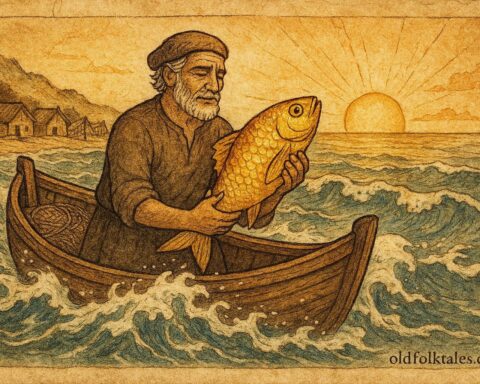
Mateus was neither wealthy nor destitute. His small boat bore the marks of long use, its wood weathered by salt and wind. Each morning before dawn, he pushed it into the surf, whispering the customary words taught by his father and grandfather before him, words of greeting to the sea, asking safe passage and a fair return. Like most fishermen, he knew that survival depended not only on skill, but on humility before the vastness that fed and threatened them all.
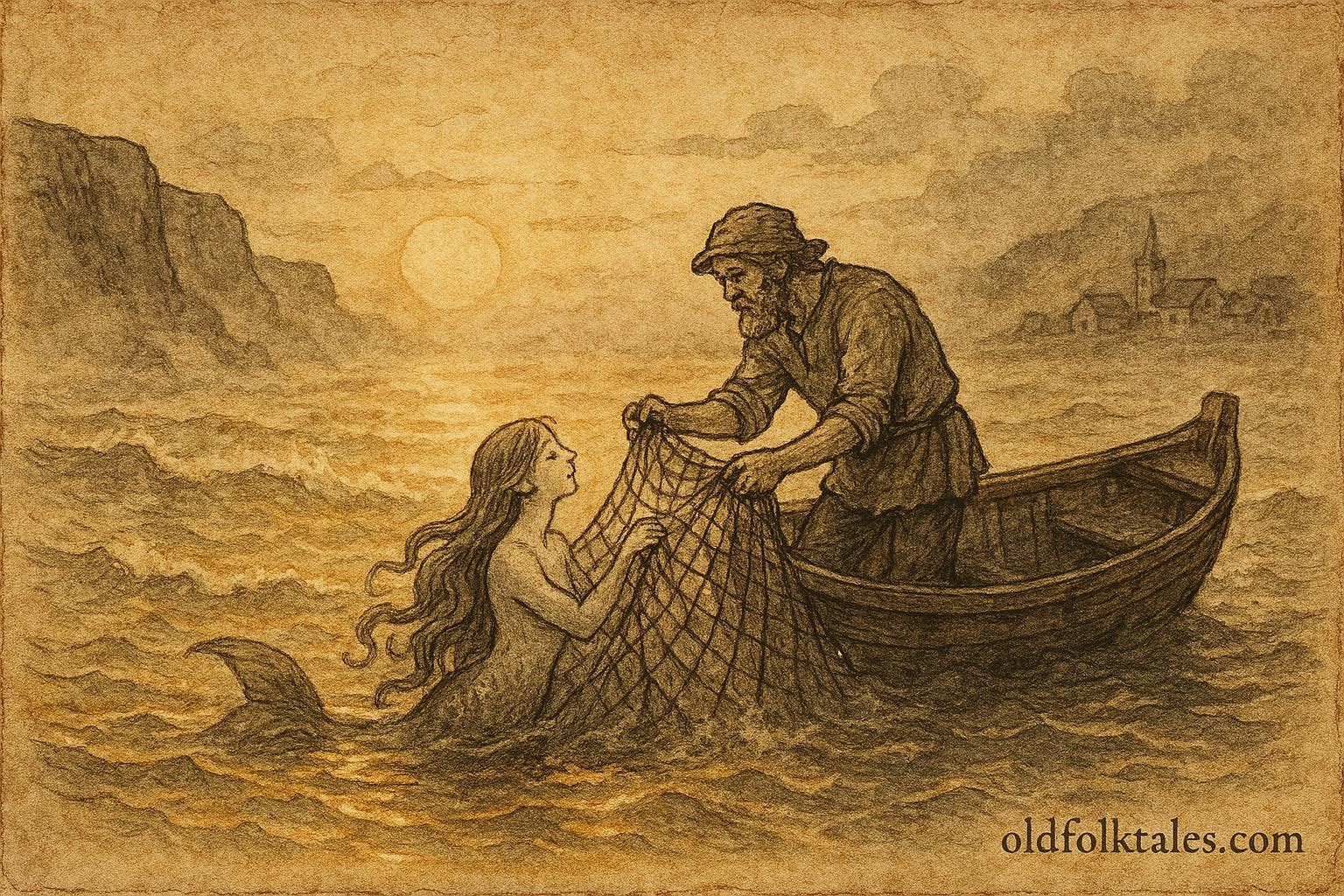
One evening, after a long day of poor catch, Mateus cast his net farther from shore than usual. The sun sank low, staining the waves copper and gold. As he hauled the net back, it snagged on something heavy that resisted his pull. Straining, he drew it closer until he saw a figure tangled within the mesh.
It was not a fish.
A young woman lay caught among the cords, her hair dark and flowing like seaweed, her skin pale as moonlit foam. Where her legs should have been, there shimmered the tail of a fish, scaled and luminous. Her eyes opened slowly, filled not with fear, but exhaustion.
Mateus froze. Every tale he had heard since childhood rose in his mind, stories of sea maidens, spirits of the deep who could bless or ruin a man’s life depending on how he treated them.
With careful hands, he cut the net free, releasing her from its hold. She did not cry out or struggle. Instead, she watched him closely, as though weighing his heart.
“You have saved me,” she said at last, her voice soft as the tide against sand. “Few would have done so.”
“I could not leave you bound,” Mateus replied. “The sea gives enough without taking more than it must.”
The sea maiden studied him, then nodded. “For your kindness, I will grant you prosperity. Your nets will be full, your home secure. But there is one condition.”
Mateus listened, his breath caught in his chest.
“Never boast of my gift,” she said. “Speak of your labor, your patience, and your respect—but never claim the sea’s favor as your own.”
He agreed without hesitation.
With a final glance, she slipped beneath the waves, vanishing into the deep as though she had never been there.
From that day forward, Mateus’s fortunes changed. His nets came up heavy with fish. Storms passed him by. His family never went hungry, and his boat remained sound when others faltered. When neighbors asked the secret of his success, he spoke only of early mornings, careful work, and gratitude to the sea.
For many years, he kept his promise.
But pride is a quiet thing. It grows slowly, unnoticed, fed by praise and comfort.
As Mateus’s prosperity became known beyond the village, visitors came to see the fisherman favored by fortune. At gatherings, men pressed him for answers. His words, once simple, began to carry a different tone. He spoke more of his luck than his labor, more of destiny than humility.
One night, after too much wine and too many admiring voices, Mateus laughed and declared that even the sea itself had chosen him above others.
The moment the words left his mouth, a hush fell over the room.
The following morning, his nets returned nearly empty. The sea grew unpredictable. A sudden squall cracked his mast. Repairs cost what savings he had set aside.
Still, Mateus told himself it was chance.
Days later, as he stood alone on the shore at dusk, the sea maiden rose once more from the waves. Her expression was no longer gentle.
“You broke your promise,” she said.
Mateus fell to his knees, shame flooding him. “Forgive me,” he pleaded. “I forgot myself.”
“The sea forgets nothing,” she replied. “What was given in trust must now be reclaimed.”
The tide surged forward, washing away his boat, his nets, and the last signs of the fortune he had boasted of. When the waters retreated, Mateus stood alone on the sand, returned to what he had been before, no richer, no poorer, but wiser.
From that day on, the village spoke of the fisherman not as a man of luck, but as a warning. And when the sea is calm at sunset, some still say a pale figure watches from beneath the waves, guarding the balance between gift and gratitude.
Moral Lesson
Gifts granted through humility endure only while respect is maintained; pride invites the sea to reclaim what it once gave.
Knowledge Check
1. Why does the sea maiden reward the fisherman?
Because he frees her without greed or expectation.
2. What condition does she place on her gift?
That he must never boast of her favor or claim it as his own.
3. How does the fisherman break his promise?
By speaking proudly and claiming the sea’s favor before others.
4. What happens when the promise is broken?
The sea withdraws its gifts, returning him to his former state.
5. What does the sea maiden symbolize in Portuguese folklore?
The sea’s spirit, generous but unforgiving of arrogance.
6. What lesson does the story teach coastal communities?
Prosperity depends on humility, restraint, and respect for nature.
Source: Portuguese maritime folklore, recorded in coastal collections, c. 1860–1880
Cultural Origin: Atlantic coastal Portugal