In the green hills of Navarre, near the borderlands of the Basque Country, lies the small village of Zugarramurdi. It is a place shaped by rain and stone, where caves open like mouths in the earth and streams disappear beneath the soil only to rise again elsewhere. Long before courts and inquisitors ever spoke its name, the land itself seemed alive, breathing mist in the mornings, echoing strangely at night, holding secrets older than written memory.
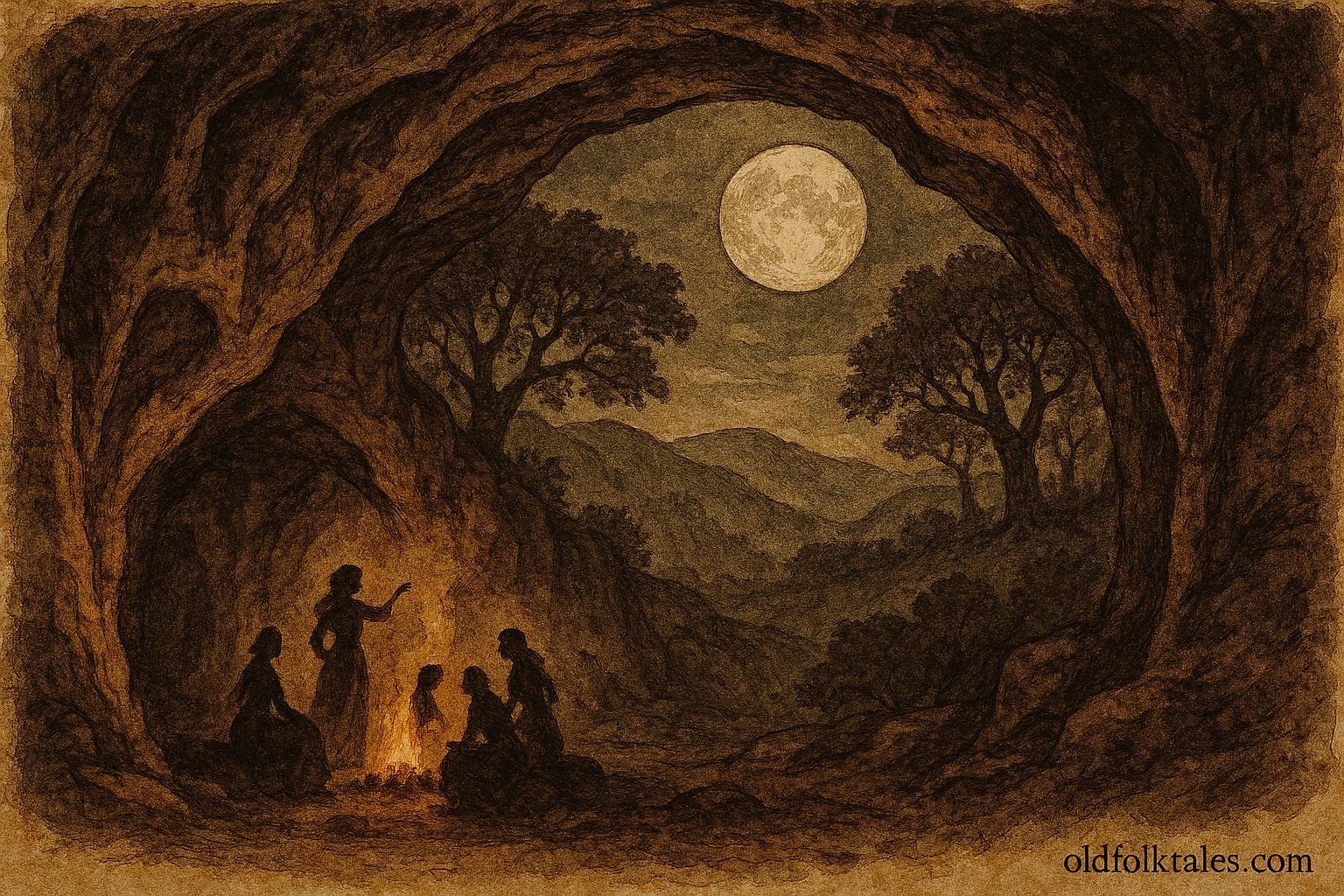
At the edge of the village, beyond pasture and field, stood the caves. They were known to the people as places of gathering, shelter, and ritual. For generations, villagers, especially women, had come there under the moon, not in secrecy born of malice, but in continuation of customs rooted deep in the land. These gatherings were shaped by folk belief, seasonal rhythms, and communal knowledge passed quietly from one generation to the next.
Discover the spiritual depth and wisdom hidden in the ancient folklore of Eastern and Balkan Europe
But what was familiar to those who lived within the village became terrifying to those who looked upon it from outside.
The Moonlit Gatherings
On certain nights, when the moon hung full above the hills, women would leave their homes and walk toward the caves. They carried no banners, no weapons. Their steps were careful, their movements practiced. Some came to sing, others to prepare herbal remedies, others simply to take part in rituals that marked the turning of the seasons.
Inside the caves, firelight flickered against damp stone walls. Shadows moved and stretched, transforming ordinary gestures into shapes that could easily be misunderstood by an untrained eye. Words spoken in Basque, old and rich with metaphor, echoed strangely in the enclosed space. Songs rose and fell, mingling with the sound of dripping water and wind passing through the caverns.
To the women of Zugarramurdi, these gatherings were acts of continuity, ways of honoring the land, the body, and the cycles of life and death. They were not spectacles meant to be witnessed, nor secrets meant to provoke fear.
But fear does not require understanding to grow.
Outsiders and Suspicion
Beyond Zugarramurdi, the world was changing. Authority tightened its grip on belief, demanding uniformity in thought and practice. Anything that did not fit neatly within sanctioned doctrine became suspect. Folk customs, especially those led by women, were increasingly viewed not as tradition, but as threat.
Whispers began to spread.
Travelers spoke of strange lights in the hills. Sermons warned of hidden evil. Stories were exaggerated, reshaped, and repeated until ritual became rebellion and gathering became conspiracy. The caves, once neutral places of shelter and ceremony, were reimagined as dens of corruption.
What villagers understood as ancestral practice, outsiders named witchcraft.
The Weight of Accusation
Fear has a way of narrowing vision. Once suspicion took hold, every gesture was reinterpreted. Knowledge of herbs became poison. Songs became spells. Silence became guilt.
Accusations followed no clear logic. They fed on rumor and reinforced themselves through repetition. Women were named, questioned, and watched. The caves of Zugarramurdi, unchanged in stone and shadow, became symbols of imagined danger.
Eventually, authority arrived.
The year was 1610, and the weight of the Inquisition pressed down upon the village. Records were taken, testimonies collected. What had once existed in the realm of folklore now collided with the machinery of judgment.
Belief was no longer enough. Confession was demanded.
Folklore Meets Tragedy
Under interrogation, stories were extracted, some shaped by fear, others by exhaustion, others by the simple desire for suffering to end. Folkloric elements were stripped of context and reassembled into narratives of diabolism. The line between myth and reality dissolved under pressure.
The caves were no longer just caves. They became evidence.
What had been communal memory turned into recorded accusation. And what had once been living tradition became frozen in legal text.
Yet even as the trials unfolded, the land itself remained unchanged. The hills did not move. The caves did not close. The moon continued its cycle, indifferent to human judgment.
Survival Beyond Silence
Not all stories end with flames or finality. Though the trials marked a deep wound, belief did not vanish entirely. Some customs retreated into silence. Others survived in altered forms, songs softened, rituals renamed, gatherings reduced to whispers within families.
Zugarramurdi endured.
Over time, the fear that once fueled persecution gave way to reflection. The tale of the witches became not only a story of superstition, but a warning, a reminder of how easily difference becomes danger when power fears what it cannot control.
Today, the caves still stand. Visitors walk their paths, hearing echoes that carry no accusation, only memory. The story remains, not as a celebration of fear, but as testimony to the resilience of belief and the cost of repression.
Moral Lesson
The story of the Witches of Zugarramurdi teaches that fear, when paired with power, can turn tradition into crime and belief into punishment. It reminds us that misunderstanding and repression often reveal more about the accusers than the accused, and that cultural survival depends on remembering, not erasing, the past.
Knowledge Check
1. Where does the story of the Witches of Zugarramurdi originate?
It originates in Zugarramurdi, Navarre, in the Basque region of northern Spain.
2. What were the moonlit gatherings in the caves?
They were traditional folk rituals rooted in seasonal and communal belief.
3. Why were these gatherings misunderstood?
Outsiders viewed unfamiliar practices through fear and religious suspicion.
4. What historical event shaped this folktale?
The Zugarramurdi witch trials of 1610 conducted by the Inquisition.
5. What themes does the story explore?
Fear of difference, repression, persecution, and survival of belief.
6. Why is this tale considered both folklore and tragedy?
Because it blends oral tradition with real historical persecution.
Source: Inquisition records and Basque oral folklore documented by Julio Caro Baroja, 1610 (Zugarramurdi witch trials)
Cultural Origin: Navarre / Basque region, Spain