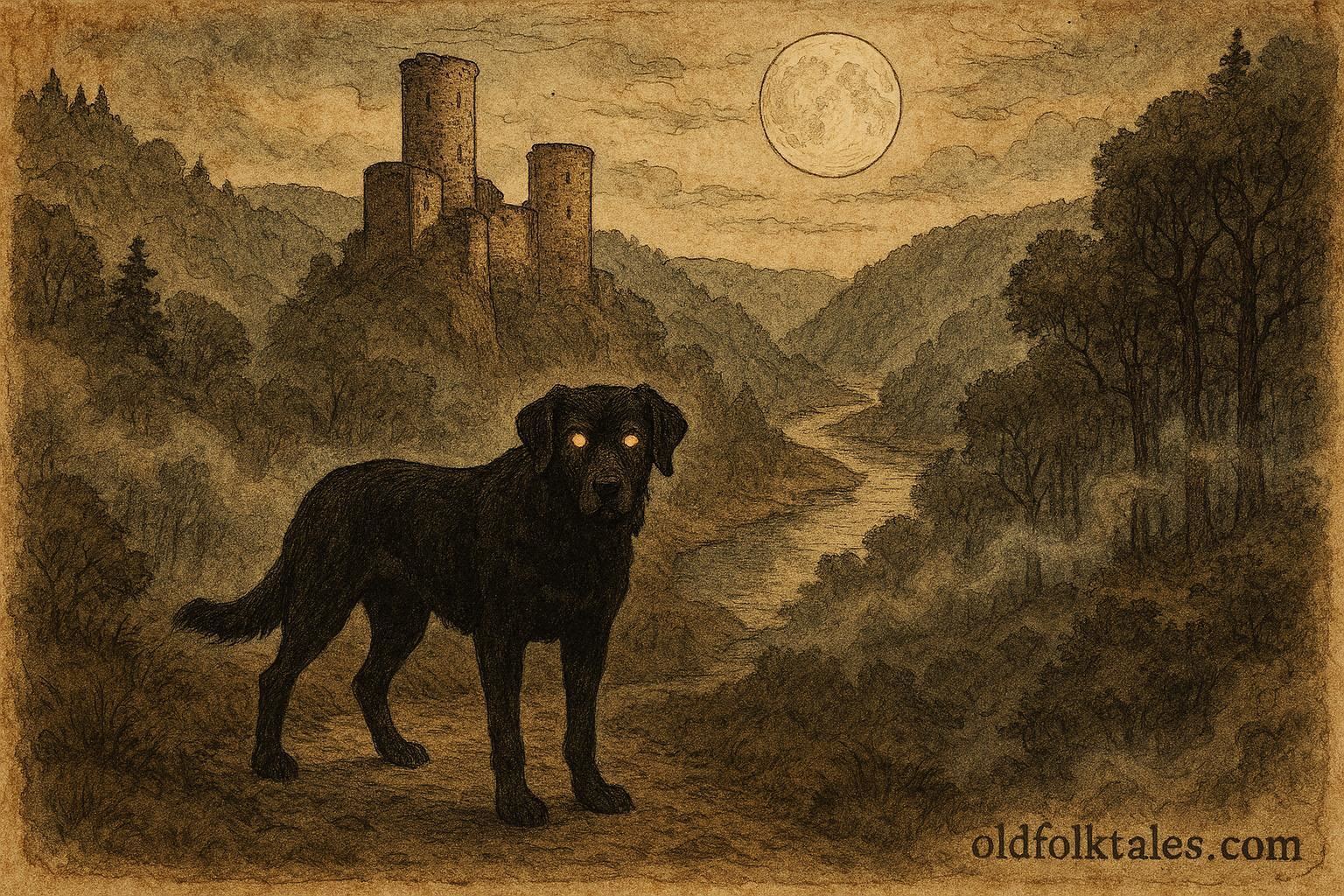
In the northern reaches of Luxembourg, where thick forests press close against winding roads and the River Sûre coils patiently through steep valleys, the ruins of Esch-sur-Sûre Castle rise above the village like a memory that refuses to fade. Its broken towers and jagged walls cling to a rocky spur, overlooking both river and settlement below. Even in daylight, the ruins seem watchful. By night, they are said to belong to something older than stone.
The villagers of Esch-sur-Sûre have long spoken of a presence that guards the castle ruins once darkness falls. It is not human, nor does it resemble any living beast known to the forest. Travelers describe it as a great black hound larger than any dog, its body solid yet unnaturally still, its eyes glowing faintly like embers caught beneath ash.
Journey into the charm of British wit and Irish wonder through centuries of folk tradition
This hound does not roam the village itself. It keeps to the paths leading toward the castle, appearing where the road narrows, where trees lean inward, and where footsteps echo too loudly against stone. It is there, at the threshold between settlement and ruin, that the Black Hound waits.
Esch-sur-Sûre Castle has stood for centuries. Once a stronghold of power, it guarded territory, trade routes, and noble ambition. Wars passed over it. Time broke its walls. What remained became sacred by endurance alone, a place marked by memory, blood, and silence. Locals learned early that the ruins were not merely abandoned stone, but ground deserving respect.
At dusk, elders warned children away from the paths leading upward. Hunters returned before nightfall. Shepherds counted their flocks carefully before the light faded. Not because the ruins were dangerous in themselves, but because night belonged to the guardian.
Those who encountered the Black Hound told remarkably similar accounts, though many insisted they had not believed the stories beforehand.
A traveler walking late would sense first a change in the air. Sounds softened. Wind fell quiet. Even insects stilled. Then, from the edge of the path or between the trunks of old trees, the hound would emerge.
Its fur appeared darker than shadow, absorbing moonlight rather than reflecting it. Its form was unmistakably canine, yet wrong in scale and stillness. It did not pant. It did not pace. It stood as though carved from darkness itself. And its eyes, those were what most remembered. Not blazing, not wild, but steady, glowing faintly like coals buried deep.
The hound never barked.
Instead, it watched.
Those who froze in terror often felt the ground grow colder beneath their feet. Some claimed their legs refused to move. Others felt a sudden, overwhelming sense of being weighed, not by fear alone, but by judgment. The hound did not attack. It did not chase. It waited, allowing the traveler to reveal themselves through action.
The villagers believed this was no accident.
The Black Hound, they said, was a tester.
Those who approached the ruins with ill intent, thieves seeking stone or relics, vandals, or those who mocked the castle’s history, felt the hound advance. Slowly. Silently. Each step heavy enough to seem final. The closer it came, the stronger the fear became, until panic took hold and the intruder fled blindly into the forest, sometimes injured, sometimes lost until dawn.
Others were not so fortunate. A few travelers were said to have collapsed on the path, overwhelmed by terror or struck ill by the encounter. Whether from fright or something more, no one could say. But all survived understood the same truth: the ruins had rejected them.
Yet not everyone who met the Black Hound was turned away.
Those who approached the castle respectfully, travelers seeking shelter, villagers passing quietly, pilgrims who paused and spoke a blessing, experienced something different. The hound still appeared. The test was never skipped. But it did not advance. It did not threaten.
Instead, it stood watch.
Some said the hound lowered its head slightly, as though acknowledging restraint. Others claimed it simply stepped aside, allowing the traveler to pass unharmed along the path. In such cases, fear gave way to an eerie calm. The forest sounds returned. The night breathed again.
By dawn, the hound was always gone.
No one claimed to have followed it. No one claimed to have seen it leave. It vanished as silently as it arrived, leaving behind only memory and the certainty that the ruins remained protected.
Many theories arose regarding the hound’s origin. Some believed it was the spirit of a knight who once defended the castle unto death, bound by oath to guard it even beyond the grave. Others said it was older still, a manifestation of the land itself, given form to enforce boundaries humans had forgotten to respect.
Nikolaus Gredt, who recorded the legend in the nineteenth century, noted how consistently the hound was described not as evil, but as moral. It punished greed, arrogance, and disrespect, while sparing humility and caution. It did not seek victims. It sought balance.
Over generations, the people of Esch-sur-Sûre adjusted their lives accordingly. Festivals ended before nightfall near the castle. Stone was never taken from the ruins. Children learned early that courage was not shown by defiance, but by knowing when to turn back.
Even outsiders, skeptical at first, often left the village with a quiet respect for the legend. Too many accounts matched too closely. Too many travelers returned pale and shaken, unwilling to dismiss what they had seen.
The castle remains in ruins today, restored only enough to stand safely against time. The paths remain open. The forest still breathes. And on certain nights, when clouds thin and the moon rides high, some swear they glimpse two faint lights at the edge of the old road.
Watching. Waiting.
Guarding what should not be crossed without care.
Discover the timeless charm of French, Dutch, and Belgian stories filled with cleverness and heart
Moral Lesson
The Black Hound of Esch-sur-Sûre teaches that fear can serve as wisdom, and boundaries exist for a reason. Sacred places, whether built by hands or shaped by memory, demand respect, and those who approach them without humility will be turned away.
Knowledge Check
1. What form does the guardian of Esch-sur-Sûre Castle take?
A large black hound with glowing eyes.
2. Where does the Black Hound appear?
On paths leading to the ruins of Esch-sur-Sûre Castle at night.
3. Does the hound attack travelers?
No. It tests their intentions and reacts based on their behavior.
4. Who is driven away by the Black Hound?
Those who approach the ruins with greed, arrogance, or disrespect.
5. What happens to respectful travelers?
They are allowed to pass unharmed.
6. What does the Black Hound symbolize in Luxembourg folklore?
Moral judgment, sacred boundaries, and protective guardianship.
Source: Nikolaus Gredt, Sagenschatz des Luxemburger Landes, 1883
Cultural Origin: Esch-sur-Sûre, northern Luxembourg