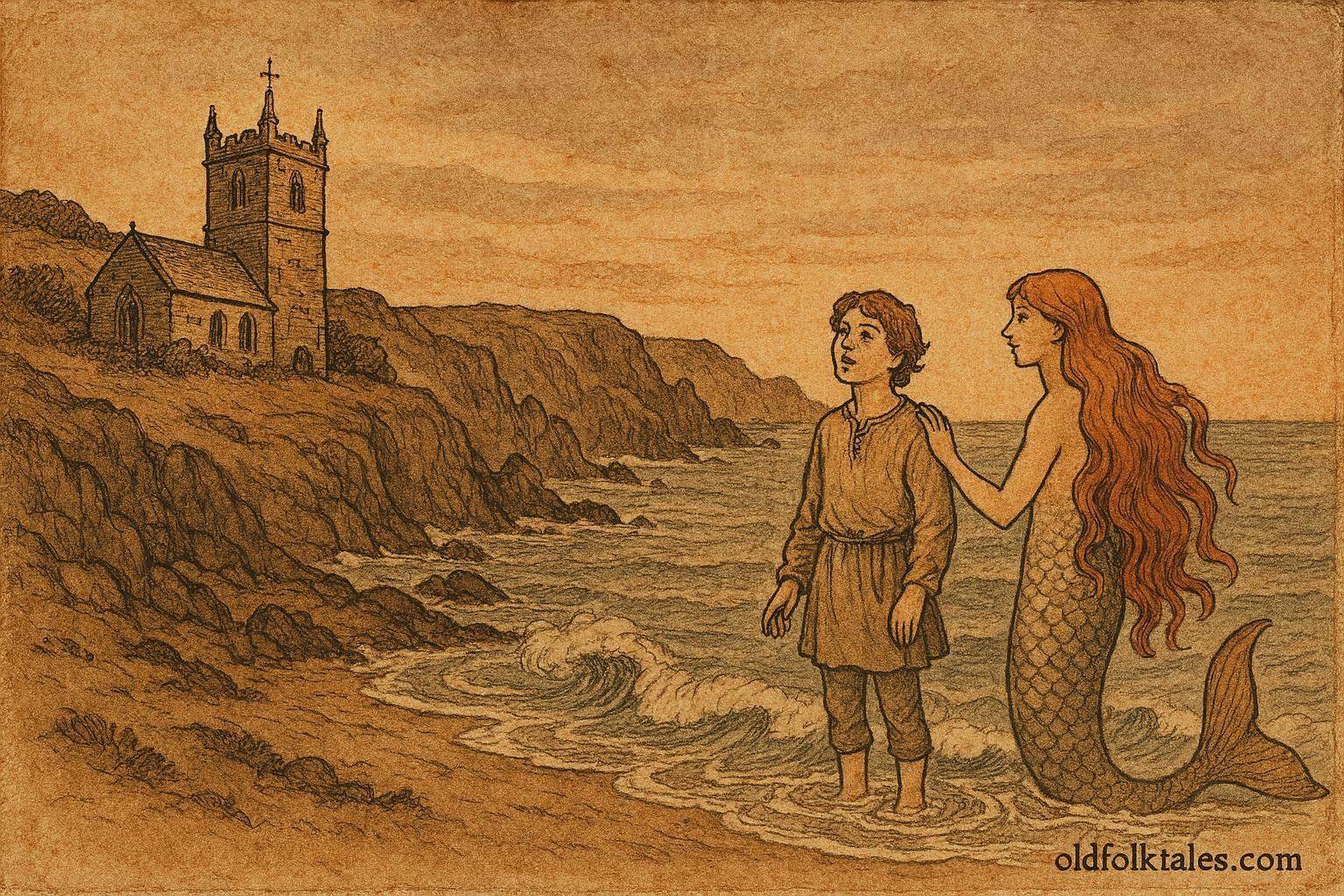
Along the rugged northern coast of Cornwall, where the Atlantic wind combs the grass into silver waves and granite cliffs rise like ancient guardians, lies the small village of Zennor. Stone cottages cluster against the weather, and at the heart of the village stands a modest church built of grey granite, its tower facing the restless sea. It is here that one of Cornwall’s most enduring legends took root, a tale of music, mystery, and the sea’s unyielding call.
Long ago, when fishing boats were carved by hand and lantern light flickered through salt-streaked windows, the people of Zennor gathered faithfully each Sunday inside their church. The interior was cool and dim, lit by narrow windows and softened by the scent of aged wood and beeswax. The sea could sometimes be heard even during prayer, its distant rumble a constant reminder of the world beyond stone walls.
Discover the timeless charm of French, Dutch, and Belgian stories filled with cleverness and heart
Among the parishioners was a young man known for his singing. His voice was clear and bright, carrying through the nave with a sweetness that seemed to still even the creaking timbers. When he sang the psalms, heads lifted. When he sang the hymns, the congregation felt something stir within them, something both solemn and joyful. It was said that his music reached beyond the rafters and out across the cliffs, drifting over the sea itself.
One autumn morning, as the wind rattled the church door, a stranger appeared.
She entered quietly, her cloak dark and damp as though she had walked far along the shore. Her hair was long and gleaming, the color of burnished copper in candlelight. She chose a seat near the young singer and listened with unwavering attention. Her eyes did not wander. They rested only on him.
Whispers passed between the villagers. No one recognized her. Zennor was small; strangers were rare. Yet she spoke to no one, and after the service she slipped away before questions could be asked.
The following Sunday she returned.
Again she sat near the singer. Again she listened with rapt attention, her gaze intent and unreadable. The singer, who had first noticed her as one notices a curious shadow, now felt her presence as something more. When he sang, he felt as though he sang to her alone.
Week after week she came.
Some said she must be from a neighboring parish. Others wondered whether she had kin among the fishermen. But none could say where she lodged, nor did anyone see her walk the village roads except on Sundays. She appeared at church, and when the service ended, she vanished like mist at midday.
The young singer, drawn by curiosity and perhaps by something deeper, at last spoke to her. Their conversation was quiet and brief. She asked him about the hymns. She asked about the sea. Her voice, those who overheard later said, was low and melodic, like water flowing over stones.
Soon, their exchanges grew longer.
They walked together along the cliff paths after service, where thrift flowers clung to the edge and the ocean stretched vast and unknowable below. She listened as he sang fragments of melody, and sometimes she would smile in a way that made him forget the wind’s chill.
Villagers began to murmur.
There was something strange about her. She never removed her long cloak completely. Even in milder weather, she kept it wrapped about her as though guarding a secret. Some claimed her footsteps left no clear mark in the sand. Others said they glimpsed her standing alone by the rocks at dusk, gazing out to sea as if waiting.
Yet the singer did not heed the whispers.
One evening, when the sky burned with the last gold of sunset, she spoke to him of the ocean, not as fishermen spoke of tides and shoals, but as one who knew its hidden chambers and secret corridors. She described halls beneath the waves where light shimmered green and silver. She spoke of currents that carried music farther than any wind.
“There is more to the sea,” she told him softly, “than men have ever known.”
Her words stirred him deeply. The singer had always felt something in his music that seemed too large for stone walls, too wide for the fields. Now, listening to her, he wondered if his voice belonged not to the land at all, but to the sea.
The day came when she did not attend church.
The singer’s voice faltered that morning. He scanned the pews, expecting her copper hair to catch the light, but her seat remained empty. A strange unease took root within him.
After the service, he walked the cliff path alone.
He found her near the shore, standing upon a flat rock as the tide crept inward. The wind tangled her hair, and the sea surged restlessly behind her.
“You did not come,” he said.
“I have always been here,” she replied.
There was something in her expression that held both tenderness and inevitability. She told him that the time had come for him to see what lay beyond the horizon of his knowing.
He hesitated only briefly.
The villagers would later say that love clouded his judgment. Others would say it was enchantment. But those who understood the power of longing might say it was neither, only the answering of a call he had heard all his life.
They walked together toward the water.
As the tide reached their feet, she removed her cloak.
Some accounts say that beneath it shimmered scales that caught the fading light. Others say her lower form was that of a fish, glistening and powerful. Whatever the truth, there was no mistaking her nature then. She was not merely a stranger. She was a being of the sea.
The singer stood transfixed, not with horror, but with awe.
She extended her hand.
And he took it.
The waves closed around them.
From the cliffs above, fishermen later claimed to have seen two figures moving beyond the breakers, then only one shape gliding beneath the surface. By nightfall, the sea lay calm once more.
The singer did not return.
Search parties combed the shoreline. Boats ventured farther than was safe. But there was no sign of him, not a scrap of cloth, not a trace.
In time, grief settled into legend.
Some said he had drowned. Others insisted he had chosen a different life beneath the waves. A few swore that on quiet evenings, when the tide was low and the air still, they could hear singing rising faintly from the sea, clear and bright as ever.
Inside Zennor Church, a carving appeared upon one of the old wooden benches, a mermaid holding a mirror and comb. Whether it was carved in memory or warning, none could say for certain. Yet the image remained: a sea maiden forever seated among the faithful, her gaze turned slightly toward the aisle.
Years passed. Generations changed.
Still, the story endured.
The Mermaid of Zennor became part of Cornwall’s living memory, a tale told to children at hearthside and to travelers who paused beneath the church tower. Some told it as a warning against enchantment. Others as a celebration of love that transcends boundaries. But all agreed on one thing: the sea keeps what it claims.
And if you stand upon the cliffs at dusk, when the Atlantic hushes into a low murmur, you may hear something carried upon the wind, a thread of melody rising from beneath the waves, neither wholly sorrowful nor wholly joyful, but eternal.
Moral Lesson
The legend of the Mermaid of Zennor reminds us that longing and enchantment can lead beyond familiar shores. It teaches respect for the mysterious forces of nature and warns that some calls, however beautiful, may demand everything in return.
Knowledge Check
1. Who was the Mermaid of Zennor in Cornish folklore?
The Mermaid of Zennor was a mysterious sea spirit who attended church in Cornwall and later lured a young singer beneath the waves.
2. What role does music play in the Zennor mermaid legend?
Music serves as the bridge between land and sea, symbolizing emotional connection and the power of song to transcend boundaries.
3. What is the significance of the mermaid chair in Zennor Church?
The carved mermaid chair represents the enduring memory of the legend and links folklore to a physical historical site.
4. Where does the Mermaid of Zennor folktale originate?
The story originates from Cornwall, England, particularly the village of Zennor.
5. What themes are central to the Mermaid of Zennor legend?
Themes include seduction and mystery, the power of music, and the irresistible pull of the unknown sea.
6. What warning does the Cornish mermaid story convey?
It warns of the dangers of enchantment and the unpredictable nature of the sea.
Source: Robert Hunt, Popular Romances of the West of England (1865).
Cultural Origin: Cornwall, England.