In the rugged lands of old Austria, where alpine winds swept through narrow valleys and small villages clung to the edges of forests and mountains, there once lived a poor soldier who had returned from long years of service. He had fought bravely and faithfully, yet when peace came, he found himself with little more than worn boots, a patched coat, and a heart still strong with courage.
No king had rewarded him richly. No noble had honored his loyalty. He walked the dusty roads alone, carrying only his small bundle and his quiet determination not to let bitterness harden his spirit.
One evening, as the sun sank behind the mountains and the sky glowed amber, he came upon a humble cottage at the edge of the forest. An old man with sharp but knowing eyes sat outside, warming his hands beside a small fire.
“You look weary,” said the old man.
“I have served my country,” replied the soldier simply, “but now I must serve myself.”
The old man studied him for a long moment. “Many who leave war carry anger. You carry hunger, but not resentment.”
The soldier nodded. “I ask only enough to live honestly.”
The old man smiled faintly and beckoned him inside.
Within the cottage stood a plain wooden table. It seemed ordinary, scratched and worn by time. The old man placed his hand upon it and said clearly:
“Table, set yourself.”
At once, the surface filled with roasted meats, warm bread, fresh fruits, cheese, wine, and delicacies fit for a royal banquet. The aroma filled the room.
The soldier stared in disbelief.
“This is the Wishing Table,” said the old man. “It obeys only honest command. Speak the words, and it will provide.”
The soldier hesitated. “Why give such a gift to me?”
“Because hunger without bitterness is rare,” replied the old man. “Take it. But remember, greed always reveals itself.”
The next morning, the soldier thanked him deeply and continued his journey, carrying the magical table.
Before long, he reached an inn in a prosperous town. The innkeeper, a plump man with restless eyes, welcomed him warmly, too warmly.
“You look tired, my good man! Rest here tonight.”
The soldier, unaware of deceit, agreed. When supper time came, he placed the table in a private room and said:
“Table, set yourself.”
The feast appeared again, rich and abundant. The innkeeper, spying through the keyhole, gasped in envy.
That night, while the soldier slept, the innkeeper switched the magical table with an ordinary one.
The next day, the soldier journeyed onward, confident in his blessing. But when he stopped again and commanded, “Table, set yourself,” nothing happened.
He stared at the empty wood in confusion. Shame burned in his chest. Had the magic faded? Had he imagined it?
Determined to understand, he returned to the forest cottage and told the old man what had happened.
The old man nodded knowingly. “Greed has tested you. Very well.”
From the stable behind the cottage, he brought forth a small gray donkey.
“This is the Gold-Ass. Speak the word ‘Bricklebrit,’ and gold coins will fall from him.”
The soldier blinked. “You trust me again?”
The old man looked into his eyes. “You returned. That is enough.”
The soldier accepted the donkey gratefully and set out once more. And once more, he stopped at the same inn.
The innkeeper recognized him and smirked inwardly.
That evening, the soldier led the donkey into his chamber and said softly:
“Bricklebrit.”
Gold coins spilled onto the floor in shining cascades.
The innkeeper nearly choked with greed.
That night, he replaced the donkey with another identical gray beast.
When the soldier attempted the magic again the following day, nothing.
Now anger stirred within him, but not blind fury. Instead, clear understanding.
He returned once more to the old man.
“Twice I have been robbed,” he said.
The old man’s eyes grew sharper.
“This time,” he said, reaching into a corner, “you shall take something different.”
He handed the soldier a simple sack.
“Inside is a cudgel. Say ‘Cudgel, out of the sack!’ and it will leap forth and beat any wrongdoer until you command it to return.”
The soldier held the sack carefully. “I understand.”
He returned again to the inn.
The innkeeper, greedy beyond wisdom now, greeted him with false smiles.
That evening, the soldier placed the sack upon the floor.
The innkeeper waited until night fell and crept into the chamber.
The moment his hand touched the sack, the soldier spoke clearly:
“Cudgel, out of the sack!”
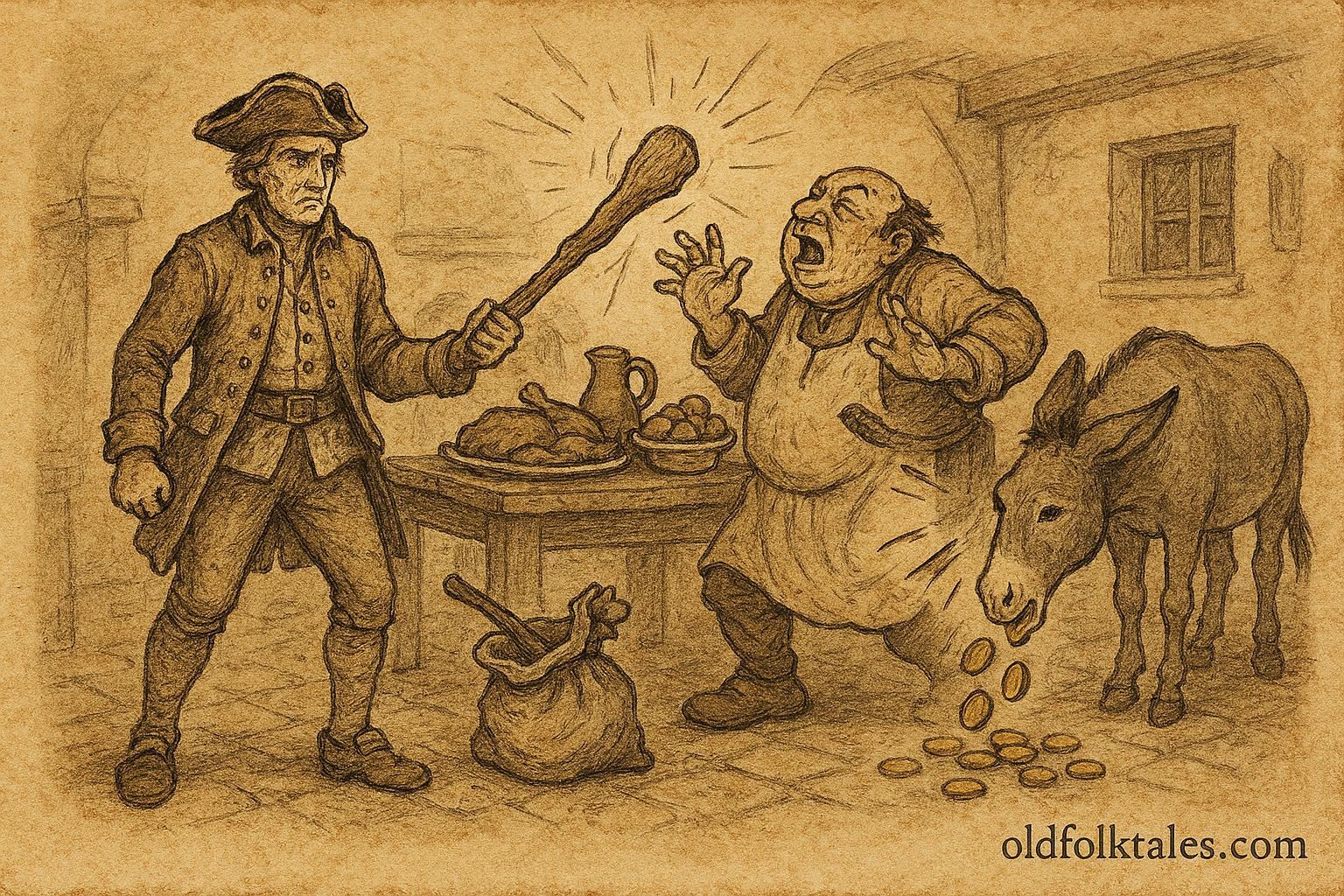
Out sprang a stout wooden club, alive with righteous fury. It beat the innkeeper soundly, thumping and striking until he cried out in terror.
“Mercy! Mercy!”
“Return my table and my donkey,” commanded the soldier calmly.
“Yes! Yes!” cried the innkeeper, scrambling to retrieve the stolen goods.
Only when the Wishing Table and the Gold-Ass stood restored before him did the soldier say:
“Cudgel, back into the sack.”
At once, it obeyed.
The innkeeper lay trembling, wiser now through pain.
With his magical items secure, the soldier continued onward. News of his wealth soon spread, reaching even the ears of a greedy king who ruled nearby lands.
The king summoned him.
“I hear you possess remarkable objects,” said the king coldly. “Such things belong in royal hands.”
“They were given to me,” replied the soldier respectfully.
The king ordered his guards to seize the items.
But the soldier stood firm.
“Cudgel, out of the sack!”
The cudgel leapt forth again, this time striking corrupt courtiers and dishonest guards, scattering them across the hall.
The king himself cried for peace.
“Enough! Enough! Keep your treasures!”
The soldier commanded the cudgel back.
From that day forward, no noble dared rob him. Instead, he used the Wishing Table to feed the hungry. He used the Gold-Ass to build a modest home and help the poor of the villages who had long suffered under unjust taxes.
He did not hoard his blessings.
In time, he became known not for his riches, but for his fairness. The magical items had not changed his heart; they had only revealed it.
And thus, through wit and virtue, a poor soldier overcame greed, restored justice, and proved that moral strength outweighs royal power.
Moral Lesson
True prosperity belongs to those who remain honest in hardship. Greed leads to humiliation, while virtue, when paired with courage, restores balance and justice.
Knowledge Check
1. What magical objects did the soldier receive?
A Wishing Table, a Gold-Ass that produced coins, and a Cudgel in a Sack that punished evildoers.
2. Who first stole the magical items?
A greedy innkeeper who envied the soldier’s gifts.
3. What command activated the Gold-Ass?
The word “Bricklebrit.”
4. How did the soldier defeat greedy nobles and the king?
By using the enchanted cudgel to enforce justice.
5. What is the central theme of this Austrian fairy tale?
Virtue and ingenuity triumph over greed and unjust authority.
6. Where does this story originate?
From Austrian-rooted oral folklore collected by the Brothers Grimm in Kinder- und Hausmärchen (1819).
Source: Brothers Grimm, Kinder- und Hausmärchen, 2nd edition, 1819 (Austrian-rooted oral variant)
Cultural Origin: Austrian peasant and soldier folklore