In a quiet corner of the German countryside, where forests leaned low over winding streams and reeds whispered secrets to the wind, there once lived a brother and sister whose lives were changed forever by the dark waters of a river. Their mother, a poor washerwoman, labored day after day beside the current. She beat linen against smooth stones, rinsed it in the cold stream, and laid it out beneath the sun. The river was her livelihood, and her danger. For beneath its shining surface dwelled a water spirit known in those lands as the Nixie.
The Water Nixie was no simple creature. She was ancient as the riverbed, cunning as shifting currents, and capable of taking many forms. Some said she appeared as a beautiful woman with streaming green hair; others whispered that her true body was half-shadow, half-mist. What all agreed upon was this: she lured the unwary, and once she claimed someone, they did not easily return.
One day, while their mother worked, the children played along the bank. They chased dragonflies, plucked wildflowers, and dared one another to step closer to the rippling edge. The sister laughed as she skipped across damp stones; the brother stretched his arms like a fearless captain surveying the sea.
The river glittered invitingly.
Then the current stirred, not with wind, not with rain, but with will.
From the depths rose a pale hand.
Before the children could cry out, the Water Nixie seized them and drew them beneath the surface. The water swallowed their screams. The washerwoman, intent upon her work, heard only the steady slap of linen against stone.
Beneath the river lay a hidden dwelling, neither wholly solid nor wholly fluid. It shimmered like light through green glass. There, in a chamber of wavering walls and luminous reeds, the Nixie set the children before her.
“You are mine now,” she said, her voice like bubbles rising through deep water. “You will serve me in my house beneath the stream.”
The children trembled. Yet though fear tightened their throats, despair did not conquer them. They clung to one another’s hands, and in that small gesture lay their first strength.
The Nixie gave them tasks, simple ones at first. They were to gather pearls from muddy beds, polish stones until they gleamed, and braid river-grass into coils. She watched them always, her pale eyes following their every movement.
But though she possessed magic, she did not understand the quiet resilience of human hearts.
Days passed, or what felt like days beneath that wavering sky. The children spoke in whispers when the Nixie drifted away to inspect her watery realm.
“We must escape,” said the sister. “She thinks us helpless, but we are not.”
The brother nodded. “We must wait until she sleeps.”
The Nixie did not sleep as mortals do, yet there were moments when her power waned. In those hours, the current slowed and the chamber dimmed.
One such moment came.
The children felt the river’s pulse soften. The Nixie drifted into stillness, her form dissolving like mist into deeper waters.
“Now,” whispered the sister.
They fled.
With swift strokes, they swam upward, breaking through the surface into sunlight. Air filled their lungs; the world above seemed vast and bright beyond imagining. Without pausing, they ran toward the forest.
Behind them, the river churned.
The Nixie had awakened.
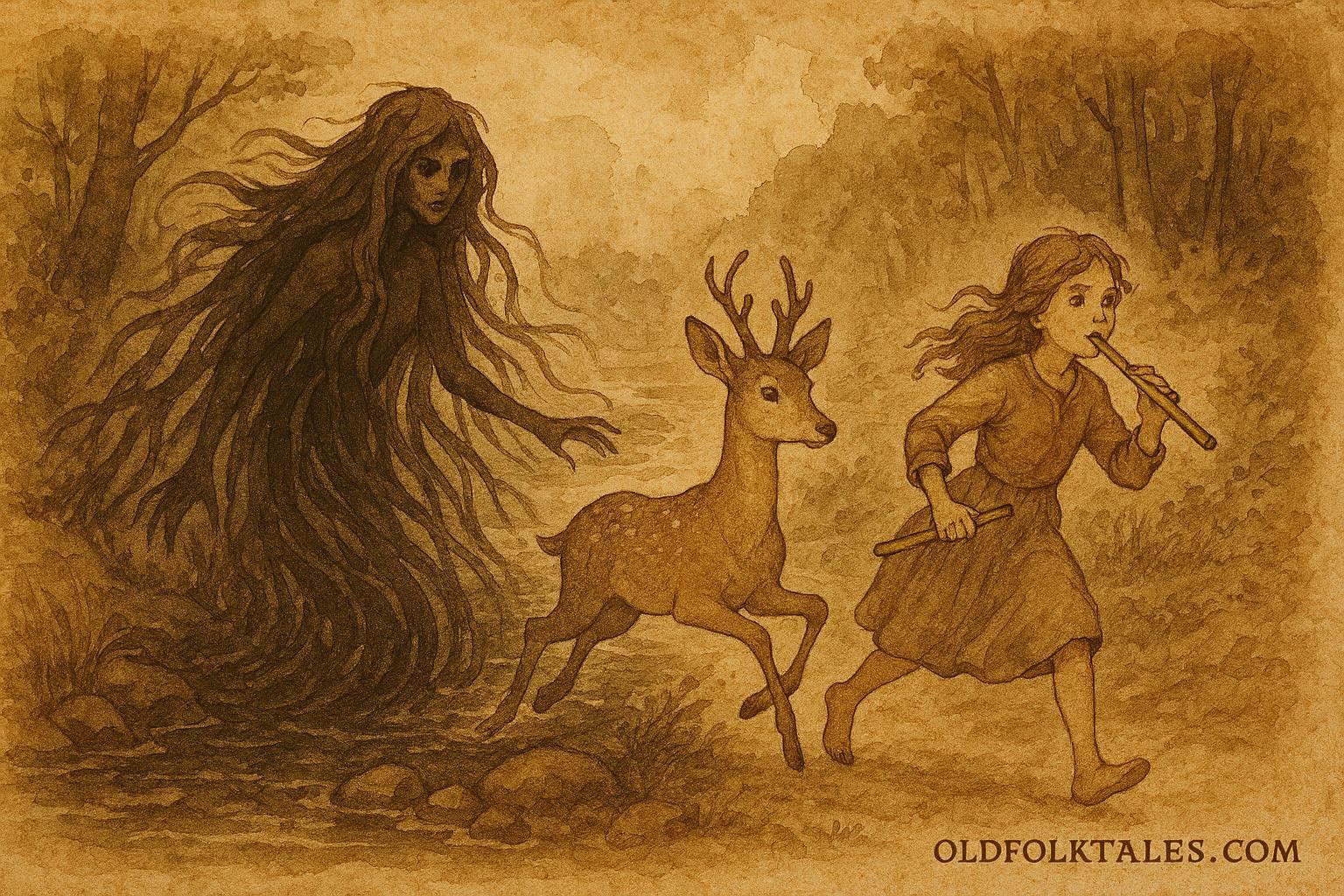
Her cry split the air like thunder over water. She rose from the stream in furious pursuit, gliding across wet grass as though it were liquid. Her hair streamed behind her like dark weeds.
The children ran until their breath burned. Yet they knew the Nixie could overtake them unless they used wit rather than speed.
“Transform!” cried the brother, recalling tales whispered by village elders.
The sister nodded. In that instant, through courage and quick thinking, they changed their forms.
The brother became a fish, darting into a nearby pond. The sister became a duck, skimming the water’s surface.
The Nixie arrived moments later.
She saw only a pond disturbed by ripples and a duck floating serenely. Suspicion narrowed her eyes. With a hiss, she transformed herself into a fisherman and cast a net.
The fish wriggled; the duck paddled. The net fell, but the siblings were clever. As the mesh touched water, they shifted again.
The fish became a swift deer bounding into the forest. The duck transformed into a vine winding around a tree trunk.
The Nixie snarled and altered her shape once more, now a huntsman with bow drawn.
The deer leapt; the vine clung tighter.
An arrow flew, slicing leaves. Yet before it struck, the deer became a hare darting through undergrowth, and the vine became a thorn bush bristling with sharp points.
The chase intensified. Each time the Nixie changed form, hunter, falcon, wolf, the siblings matched her with greater ingenuity.
At last, exhausted but determined, they enacted their boldest transformation yet.
The brother became a flute carved from elder wood. The sister became a musician who lifted the flute to her lips.
When the Nixie, now in human guise, approached, she heard music unlike any she had known. It was light and free, rising above the memory of water’s pull. It was laughter returned to breath.
Drawn by curiosity, and by the faint longing she could not name, the Nixie stepped closer.
The sister played.
The melody twined around the Nixie, soft at first, then bright as sunlight dancing upon waves. The music held within it every leap of the deer, every flutter of the duck, every swift dart of the fish. It was freedom given sound.
The Nixie’s power faltered.
Water spirits thrive upon fear, upon the heavy silence of captivity. But music born of courage weakened her hold. As the final note rang clear, the Nixie dissolved into mist and retreated toward the river from which she came.
She did not pursue them again.
The siblings stood in human form once more, trembling yet victorious. They embraced, astonished by their own survival.
Hand in hand, they returned to their mother, who wept with relief at their reappearance. They told her what had happened, and though she feared the river ever after, she marveled at her children’s cleverness.
From that day forward, the children carried within them the memory of water, not as terror alone, but as a lesson. Nature could nurture and destroy; it demanded respect and awareness. They had learned that strength lay not merely in force but in imagination and unity.
And so the tale of the Water Nixie passed from hearth to hearth across German lands: a story of danger, yes, but more so of transformation, resilience, and the enduring power of human wit.
Moral Lesson
When confronted by overwhelming forces, cleverness and unity can achieve what strength alone cannot. Courage under pressure and the willingness to adapt are the truest paths to freedom.
Knowledge Check
1. Who is the Water Nixie in German folklore?
The Water Nixie is a river spirit from German folklore who lures and captures humans, symbolizing nature’s hidden dangers.
2. How do the brother and sister escape the Nixie?
They escape through clever magical transformations, constantly changing forms to outwit the pursuing water spirit.
3. What does shape-shifting symbolize in this Grimm fairy tale?
Shape-shifting represents adaptability, resilience, and the power of intelligence under pressure.
4. What themes are central to “The Water Nixie”?
Key themes include freedom from captivity, ingenuity over brute force, and nature as both threat and refuge.
5. What is the cultural origin of The Water Nixie?
The story originates from German folklore and was collected by the Brothers Grimm.
6. When was The Water Nixie first published?
It appeared in 1812 in Kinder- und Hausmärchen by Jacob and Wilhelm Grimm.
Source: Kinder- und Hausmärchen by Jacob and Wilhelm Grimm (1812).
Cultural Origin: German folklore.