High in the mist-veiled slopes of the Rhodope Mountains, where pine forests breathe resin into the wind and shepherd songs drift across valleys at dusk, there once lived a bride whose name is no longer spoken, only sung. In the villages scattered along those ridges, weddings were not quiet affairs. They echoed with gaida music, with ululations from the women, with the stamping of boots on packed earth. Marriage was not only a union of two hearts but of families, of fields, of future harvests.
On one such evening, beneath a sky brushed pink by sunset, a young bride stood at the threshold of her new life. Her veil shimmered in the fading light, and silver coins sewn into her garments chimed softly when she moved. Her groom, earnest, proud, and trembling with happiness, could not take his eyes from her.
The celebration lasted long into the night.
Yet before dawn, joy turned to dread.
When the bride’s mother entered the bridal chamber, she found the room undisturbed. The window was closed. The door latched from within. The groom lay asleep as though wrapped in enchanted rest.
And the bride was gone.
No footprints marked the ground outside. No sound had been heard. The veil lay folded upon the chest at the foot of the bed, as if placed deliberately.
Whispers began immediately.
In the Rhodope Mountains, where nature looms close and ancient, people speak carefully of spirits. The forests are older than memory. The cliffs hold echoes older than language. Some believe the mountains themselves choose what they keep.
“She has been taken,” an elder woman murmured.
“By whom?” asked the groom, his voice hollow.
By what, some thought.
In Rhodope shepherd lore, mountain spirits are not always cruel, but they are possessive. They favor beauty. They favor song. They dwell in caves, in mist, in the shadowed folds of valleys where sunlight lingers only briefly.
Search parties combed the slopes. They called her name until their throats grew raw. They checked ravines and forest paths. They questioned travelers.
Nothing.
The groom aged quickly in grief. His fields went untilled. His laughter vanished. Some urged him to remarry. He refused. “She is not dead,” he said. “The mountains do not swallow without voice.”
Years passed.
And then the shepherds began to hear it.
At twilight, when sheep gathered close and shadows lengthened across pastureland, a voice would rise from the high ridges, clear, mournful, woven with longing. It carried across valleys in a melody unlike any known song.
It was not wind.
It was not echo.
It was a woman’s voice.
Some shepherds crossed themselves. Others wept without knowing why.
The song told no clear words, yet its sorrow was unmistakable.
The villagers listened. The groom listened most of all. He would climb hillsides at dusk, straining for the sound. He would call her name into the gathering dark.
But the voice never answered directly.
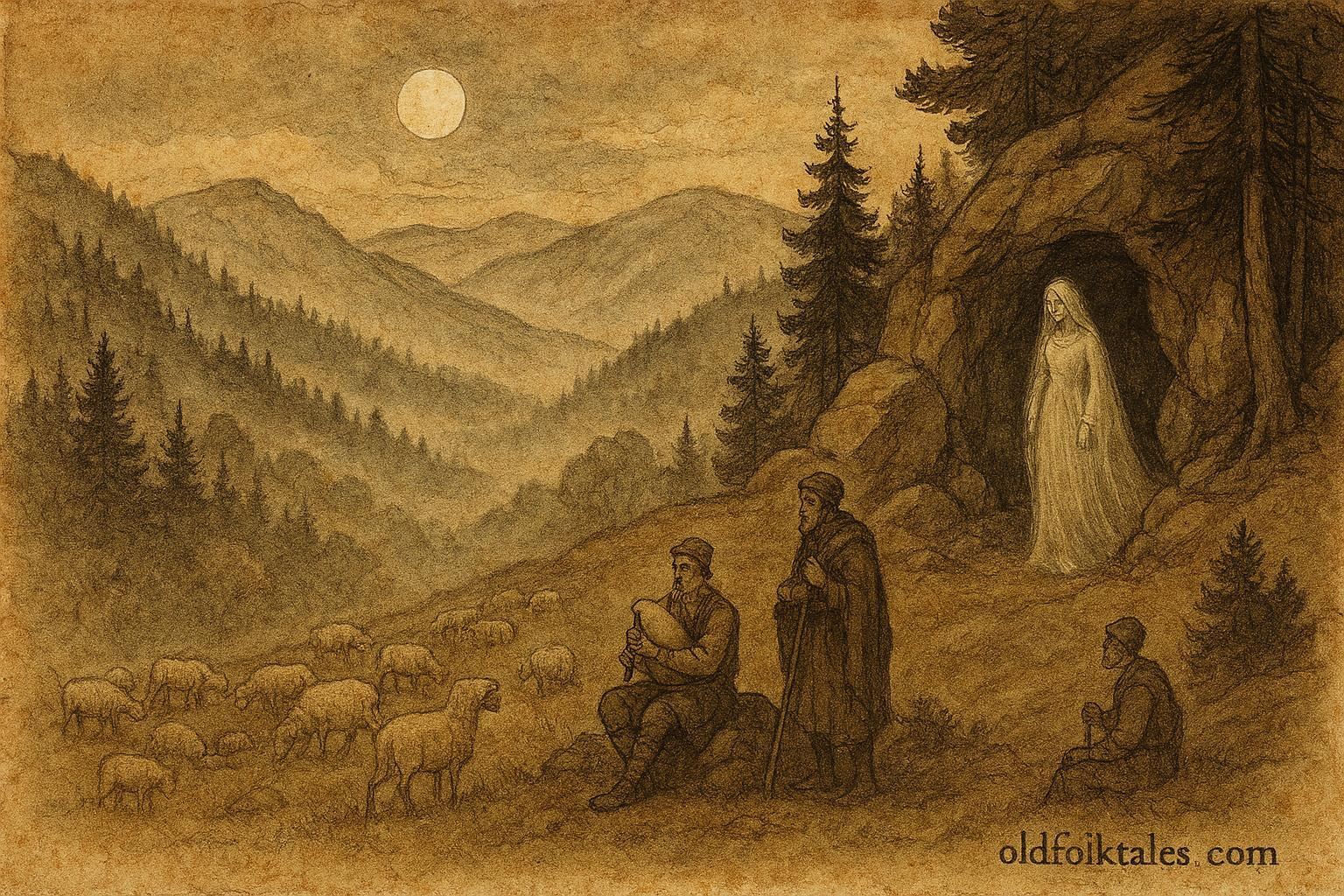
One autumn, when leaves burned gold against gray rock, a wandering gaidar entered the region. He was a solitary man, traveling with little but his wooden bagpipe carved from mountain maple. His craft was not mere music, it was conversation with wind and stone.
He heard the tale upon his arrival.
“A bride stolen,” the innkeeper told him. “A voice in the hills.”
The gaidar did not laugh.
He had traveled enough to know that mountain songs are rarely born from imagination alone.
That evening, instead of playing in the square, he climbed toward the highest pasture. He waited until dusk bled into night.
Then he lifted the gaida to his lips.
The melody he played was old, older than wedding songs, older than grief. It was a shepherd’s call of invitation, a tune meant not to command but to invite.
The first notes drifted upward, weaving through pine and stone.
Silence answered.
He played again, softer.
The wind shifted.
Then, faint but unmistakable, the woman’s voice joined him.
Not from behind.
Not from below.
From above.
The gaidar did not stop. He altered his melody gently, offering phrases like questions.
The voice responded.
Their duet continued until the moon rose high. The shepherds below listened in awe as the music braided itself between earth and sky.
At last, when the final note faded, the gaidar spoke aloud, not in command, but in respect.
“If you are bound, tell me.”
The mountains answered with quiet.
But in that quiet, something changed.
The next evening, he climbed higher still, toward a cavern known in village lore as a dwelling of spirits. No villager dared approach it after nightfall.
He entered at twilight.
The air within was cool and scented faintly of damp stone. Deep inside, where shadows thickened, he heard it again, the bride’s voice, no longer distant, but near.
She stood there, unchanged by time. Her garments shimmered faintly as though woven from mist. Her eyes held both joy and sorrow.
“You are neither alive nor dead,” the gaidar said carefully.
“I am between,” she answered. Her voice echoed gently against stone. “The mountains heard my heart the night I was wed. They claimed what was pure.”
“Do you wish to return?” he asked.
She lowered her gaze.
“I remember love,” she said. “But the mountains have wrapped me in their breath. I belong to both worlds, and to neither.”
In Rhodope belief, the boundary between human and enchanted wild is fragile. Crossing it cannot always be undone.
The gaidar understood something vital: this was not abduction by cruelty. It was claiming by enchantment.
Her voice carried longing, not rebellion.
He raised his gaida once more.
This time he played a farewell song, a melody of acceptance, not rescue. A song that acknowledged love without possession. A song that releases what cannot be reclaimed.
As the final notes echoed, the bride’s form shimmered like morning fog dissolving.
“You have given me voice,” she whispered. “Tell them I am not forgotten.”
Then she faded, not into nothingness, but into song.
The gaidar descended at dawn.
The villagers gathered.
He did not speak of caves or spirits. He spoke only this: “She sings because she remembers. And because she must remain.”
The groom wept, not with despair, but with understanding. He climbed once more to the high pasture at dusk and listened.
The voice came again.
But now it was gentler.
It did not ache.
It lingered like a blessing carried by wind.
In time, the groom planted trees along the slope where her voice was strongest. Shepherds sang in harmony when they heard her. Children grew up knowing the melody as part of the mountains themselves.
Thus, the Shadow Bride became not a tale of terror, but of longing balanced between worlds.
Even today, in the Rhodope Mountains, shepherd songs carry echoes of that ancient harmony, human breath answering mountain spirit.
For love, in these highlands, is not always possession.
Sometimes it is memory.
Sometimes it is song.
Moral Lesson
Love cannot always conquer the pull of the supernatural or the call of nature. Some bonds endure not through possession, but through remembrance and respect.
Knowledge Check
1. Why did the bride disappear on her wedding night?
She was believed taken by a mountain spirit drawn to her purity and song.
2. What role do shepherd songs play in the legend?
They carry her lingering voice across the mountains, symbolizing connection between worlds.
3. Who helps uncover the truth?
A wandering gaidar (Bulgarian bagpiper) communicates with her through music.
4. What does the story suggest about mountain spirits in Rhodope folklore?
They are powerful and possessive but not always malicious.
5. What is the central theme of the tale?
The tension between human love and the enchanting pull of the natural world.
6. How does the story end?
The bride remains bound to the mountains, her presence preserved through song.
Source: Collected in Bulgarian Folk Songs by Dimitar Miladinov and Konstantin Miladinov, 1861.
Cultural Origin: Rhodope Mountain folklore, Bulgaria.