Long ago, on the island of Crete, the labyrinthine palace of King Minos loomed like a fortress of stone and cunning. Within its walls resided a brilliant craftsman named Daedalus, famed for his cleverness, skill, and artistry. His hands shaped wood and stone as if they obeyed a mind more than mere touch, and his mind, unmatched in ingenuity, had crafted wonders that left kings and commoners alike in awe. Yet, for all his talents, Daedalus carried a weight heavier than stone: his son Icarus, bright-eyed and eager, shared his father’s restless spirit, though not always his patience.
The kingdom of Minos was not always a haven of peace. After Daedalus had built the great labyrinth to contain the monstrous Minotaur, a creature half-man, half-bull, he and his son became prisoners themselves. King Minos, fearing that the secrets of the labyrinth might escape the world, kept them confined within the island. Though the palace’s stone walls were high, they could not contain the ingenuity of Daedalus, nor the yearning of a young boy for the sky.
Days stretched into nights, and nights into weeks. Daedalus measured time not by the sun, which climbed the sky freely beyond their reach, but by the restlessness in his son’s eyes. Icarus would gaze longingly at the gulls, skimming the waves, and whisper, “Father, why are we trapped while the world flies free?”
Daedalus’ mind turned, weaving plans like threads in a tapestry. At last, the solution came to him in secret, like a spark of lightning over the Mediterranean: wings. If feathers could be gathered, and wax could hold them in place, perhaps he and his son could soar above the prison of stone and earth.
Collecting bird feathers in secrecy, he sorted them by size, aligning each with meticulous care. Then he melted wax, warm and malleable, binding feathers into a structure both strong and light. Each wing became a mirror of the bird’s flight, crafted for a human form. He fastened them to their shoulders with leather thongs, bending his body to the shape that promised liberation.
Before the attempt, Daedalus embraced his son and spoke with the solemnity of the sea before a storm. “Icarus, listen well,” he warned. “These wings are our salvation, but they are fragile. Do not fly too low, or the sea’s mist will wet the feathers and weigh you down. Do not fly too high, or the sun will melt the wax. Moderation will carry you safely. Remember, my son, the path of balance is the path of life.”
Icarus nodded, his heart pounding with excitement and fear alike. The allure of flight, of the sun itself seeming within reach, stirred in him an exhilaration he had never known. Together, father and son climbed the cliffs overlooking the sparkling Aegean, each step a drumbeat toward freedom. Daedalus’ hands, steady and sure, adjusted the wings one last time.
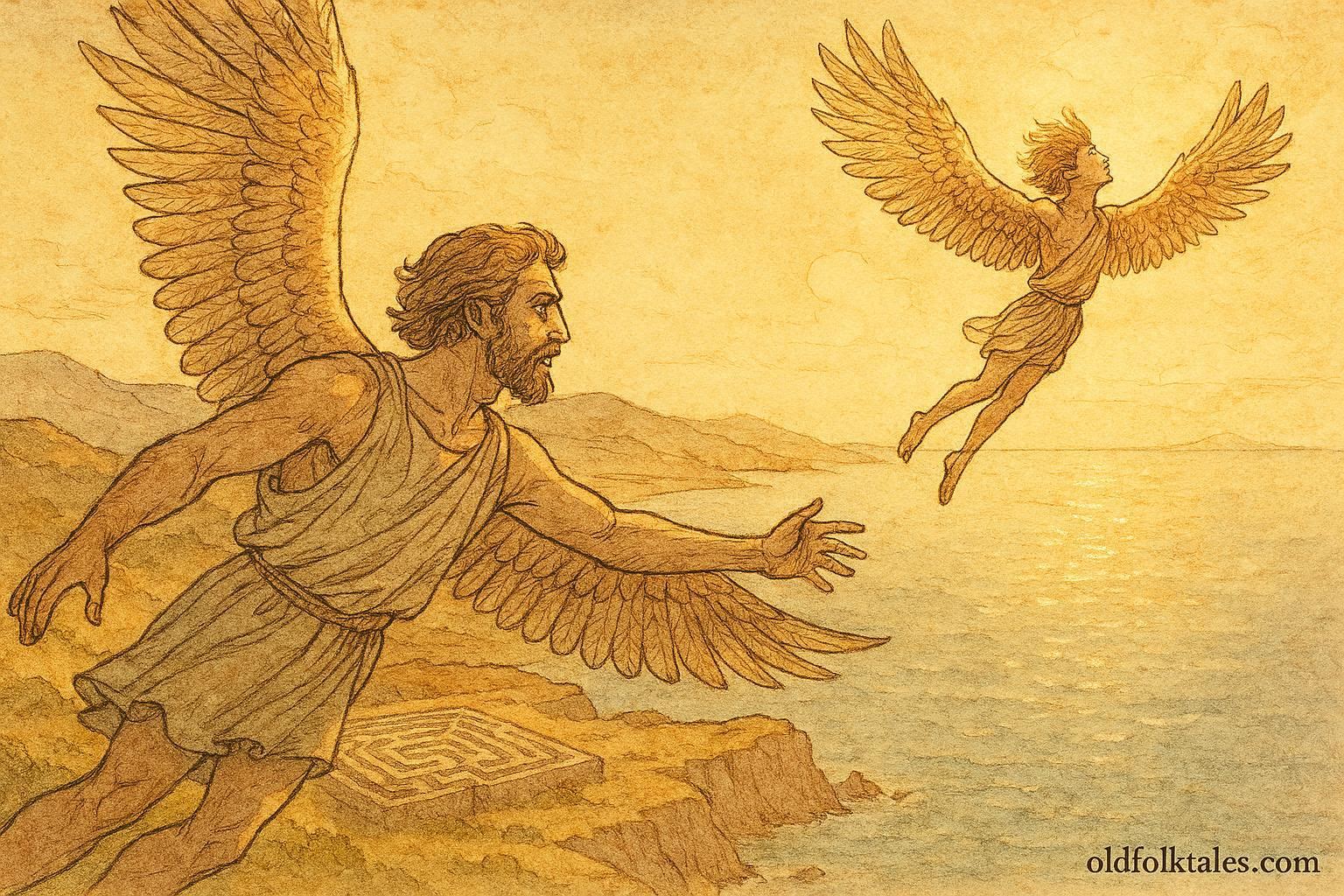
With a leap of faith, they launched into the wind. The boy and the father rose above the jagged cliffs, the salt air whipping their hair, the sun glinting off feathers stitched by ingenuity and love. Below, the labyrinth receded into the distance, walls of stone unable to contain dreams.
At first, Icarus followed Daedalus obediently, feeling the rhythm of the air, the lift of the wings, the gentle currents guiding them forward. But as they soared, something within the boy awakened, a hunger not just for flight, but for grandeur. The sky, the sun, the very horizon seemed to promise immortality. He glanced down at the glittering waves far below and then upward toward the blazing orb above.
“I can reach the sun!” he cried, eyes alight with the fire of youth.
Daedalus called back, his voice firm with fear, “Icarus! Do not fly so high! Remember the wax!”
But the thrill of ascent drowned caution. Icarus’s wings stretched toward the sun, and for a fleeting, brilliant moment, he felt as though he were a god, soaring beyond the bounds of men. Then came the inevitable. The sun’s heat softened the wax, the glue of his liberation melting in the glow of ambition. Feathers loosened. Wings disintegrated. The boy plummeted.
Daedalus watched, horror-stricken, as his son fell through the golden sky. The wind screamed past his ears, carrying a cry no parent could ever forget. The blue of the Aegean swallowed Icarus, and the wings that had promised freedom became nothing but scattered feathers on the waves.
The grief that followed was as vast as the sea. Daedalus mourned, holding his wings close, their fragile perfection now a reminder of human limits. He gathered the feathers that drifted to the water’s edge and carved a grave in his heart for the boy who had flown too high. From that day forth, the story of Icarus became legend, carried in songs of sailors and whispers among craftsmen: a tale of invention, exhilaration, and the cost of ignoring wisdom.
Yet the wings themselves remained a testament to human ingenuity. Daedalus, tempered by loss, continued his journey, teaching those who would listen that creativity is a gift, but that every gift must be guided by prudence.
Thus, the tale of Daedalus and Icarus endures: a lesson stitched into the very sky, where ambition brushes against the sun, and caution whispers in the wind.
Discover the spiritual depth and wisdom hidden in the ancient folklore of Eastern and Balkan Europe
Moral Lesson
Excessive pride and recklessness, even in moments of triumph, can lead to ruin. True mastery lies not only in skill and ingenuity but in understanding limits and exercising moderation.
Knowledge Check
1. Who created the wings for the escape from Crete?
Daedalus, the master craftsman, built the wings of feathers and wax.
2. What was Icarus warned against?
He was warned not to fly too high toward the sun or too low toward the sea.
3. What happens when Icarus ignores his father’s warning?
The sun melts the wax on his wings, and he falls into the sea.
4. What themes are central to the story?
Moderation, consequences of recklessness, human ingenuity, and the wisdom of experience.
5. What role does Crete play in the narrative?
Crete is both the prison of Daedalus and Icarus and the origin of the labyrinth they seek to escape.
6. How does the story reflect Ancient Greek values?
It emphasizes human skill, the tension between ambition and limitation, and the consequences of hubris.
Source: Metamorphoses by Ovid, c. 8 CE.
Cultural Origin: Ancient Greece (Cretan–Attic tradition).