In a time when gods and mortals walked the earth in intertwined destinies, there was a hero whose name echoed across the hills and valleys of Greece: Heracles. Son of Zeus and the mortal Alcmene, he was blessed with extraordinary strength but cursed by fate and divine jealousy. Hera, queen of the gods and resentful of Zeus’s infidelity, held a bitter grudge against Heracles from the moment of his birth. Her wrath would shape his life and ultimately demand a path of suffering, endurance, and redemption.
Heracles’ story begins with tragedy. In a fit of madness induced by Hera, he committed an unthinkable act: he took the lives of his own children. Overcome by grief and guilt, he sought purification for his sins. The oracle of Delphi instructed him to serve King Eurystheus of Tiryns and Mycenae and to perform twelve labors, each seemingly impossible. These labors would not only atone for his guilt but would also test the limits of human and divine strength, cunning, and perseverance.
The First Labor: The Nemean Lion
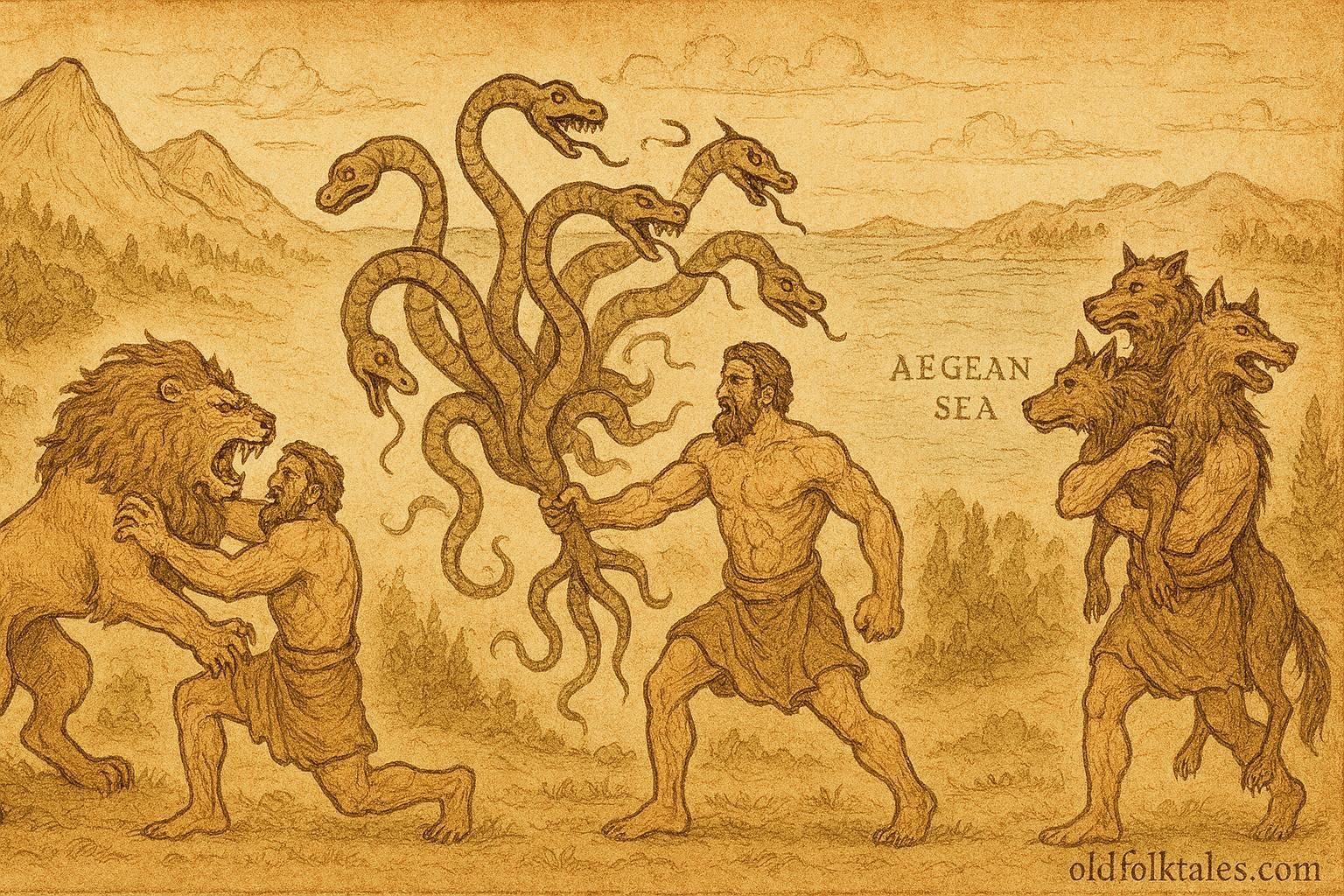
Heracles’ first task was to slay the Nemean Lion, a beast with fur impervious to weapons and claws sharp as blades. The creature roamed the hills of Nemea, terrorizing villages and evading capture. Heracles tracked it to its lair, a shadowed cave hidden beneath gnarled rock. Arrows and spears failed to pierce the lion’s hide, forcing him to grapple it with his bare hands. Straining against the monster’s power, Heracles finally strangled it, victorious yet mindful of the lesson that strength alone is not enough; strategy and courage must guide it. Using the lion’s own claws, he skinned the hide, a trophy that would later shield him from harm.
The Second Labor: The Lernaean Hydra
Next, Heracles faced the Lernaean Hydra, a serpent with many heads, one of which was immortal. Each time a head was severed, two more would grow in its place. Heracles, realizing brute force alone would fail, enlisted the help of his nephew, Iolaus. As Heracles cut the heads, Iolaus cauterized the stumps with fire, preventing regeneration. The final immortal head was buried under a heavy rock. This labor taught Heracles that even the strongest must rely on wisdom, cooperation, and ingenuity.
The Third Labor: The Ceryneian Hind
Heracles’ pursuit of the Ceryneian Hind required patience rather than force. This sacred deer, with golden antlers and bronze hooves, belonged to Artemis, goddess of the hunt. Heracles chased the hind across forests and hills for an entire year without harming it, respecting its sacred nature. Finally, he captured it with gentle restraint, earning the favor of the goddess and demonstrating that strength tempered by respect and patience achieves what force alone cannot.
The Fourth Labor: The Erymanthian Boar
The Erymanthian Boar, a monstrous creature of immense size and strength, terrorized the countryside. Heracles cornered the beast in deep snow, immobilizing it with sheer will, and brought it alive to Eurystheus. This labor highlighted the importance of clever use of environment, observation, and strategic action in overcoming formidable challenges.
The Fifth Labor: The Augean Stables
Heracles’ fifth task tested endurance, cleverness, and ingenuity. King Augeas’ stables had not been cleaned for decades, filled with filth and the stench of thousands of cattle. The labor seemed impossible. Instead of attempting to clean them by hand, Heracles rerouted the course of nearby rivers, washing the stables clean in a single, powerful flood. This act showcased that intelligence, along with strength, is essential for overcoming monumental challenges.
The Sixth Labor: The Stymphalian Birds
Heracles next confronted the Stymphalian Birds, man-eating creatures with metallic feathers capable of shooting like arrows. Using a rattle given by Athena to frighten the birds into flight, he shot many with his bow, driving the rest away. This labor combined cunning, divine assistance, and precision, reminding mortals and heroes alike that skill and strategy can triumph over brute force.
The Seventh Labor: The Cretan Bull
Heracles sailed to Crete to capture the bull that had fathered the Minotaur. The bull rampaged across the island with destructive power. Heracles seized it with relentless effort, bringing it to Eurystheus. This labor emphasized the hero’s balance of courage, physical power, and respect for the untamed forces of nature.
The Eighth Labor: The Mares of Diomedes
The man-eating horses of King Diomedes presented another trial. Heracles overcame the savage beasts, feeding Diomedes to them as the story recounts, subduing the wild through clever use of circumstance. By understanding the nature of his adversaries, he transformed danger into control, ensuring the completion of his task.
The Ninth Labor: The Girdle of Hippolyta
Heracles journeyed to the distant lands of the Amazons to obtain the girdle of their queen, Hippolyta. Initially welcomed, the situation became complicated by Hera’s interference, provoking conflict. Through negotiation and, when necessary, force, Heracles obtained the girdle, demonstrating that diplomacy and tact are as important as physical prowess.
The Tenth Labor: The Cattle of Geryon
Crossing deserts and oceans, Heracles traveled to the far western lands to capture the red cattle of Geryon, a giant with three bodies. He overcame monstrous guardians and navigated unknown lands to achieve his goal. This labor symbolized endurance, resilience, and the hero’s willingness to confront the unknown.
The Eleventh Labor: The Apples of the Hesperides
Heracles sought the golden apples of the Hesperides, guarded by nymphs and a hundred-headed dragon. Through cunning, he convinced the titan Atlas to retrieve the apples while he temporarily bore the sky. This labor demonstrated negotiation, patience, and the ability to shoulder burdens greater than one’s own.
The Twelfth Labor: Capturing Cerberus
Heracles’ final labor brought him to the underworld, where he was tasked with bringing Cerberus, the three-headed guardian of Hades, to the mortal realm without harming the creature. With courage and compassion, he calmed the fearsome guardian and led it to Eurystheus before returning it to Hades. This labor symbolized mastery over fear, death, and the acceptance of life’s ultimate boundaries.
Each labor was a crucible of mind, body, and spirit. Heracles endured divine punishment, mortal peril, and moral challenges, emerging not only as a figure of immense physical strength but also as a model of perseverance, ingenuity, and the journey toward redemption. Though his story is marked by suffering and trials, it also illuminates the virtues of courage, wisdom, and the relentless pursuit of honor and justice.
Moral Lesson
True strength is measured not only by physical power but by moral courage, intelligence, and endurance. Redemption often requires facing overwhelming challenges, embracing perseverance, and learning from one’s mistakes.
Knowledge Check
1. Who assigned the twelve labors to Heracles?
King Eurystheus of Tiryns commanded Heracles to perform the twelve tasks as atonement.
2. Why did Heracles have to complete these labors?
He sought to atone for the murder of his children, a tragedy caused by Hera’s induced madness.
3. Name two of the twelve labors.
Examples: Slaying the Nemean Lion, capturing the Ceryneian Hind, obtaining the Apples of the Hesperides, or bringing Cerberus from the underworld.
4. How do the labors reflect Ancient Greek values?
They emphasize strength, perseverance, cunning, morality, and the pursuit of honor.
5. What role does Hera play in the story?
Hera’s jealousy causes much of Heracles’ suffering, motivating the divine challenges he must overcome.
6. What lessons do the labors teach about human limitation and effort?
They illustrate that even heroes must combine intelligence, moral judgment, endurance, and courage to succeed against overwhelming challenges.
Source: Bibliotheca by Apollodorus, c. 1st–2nd century CE.
Cultural Origin: Ancient Greece (Panhellenic tradition).