In a fertile kingdom nestled among rolling hills and shimmering rivers, there grew a magnificent orchard unlike any other in the land. Its trees bore apples of pure gold, each gleaming with a light that seemed to capture the morning sun. The people of the kingdom whispered that these apples were no ordinary fruit. Those who ate them gained wisdom, vitality, and blessings beyond measure. But such treasures, naturally, attracted envy and danger.
A wealthy merchant, seeking protection for his precious orchard, entrusted the guardianship of the apples to his three sons. The two elder brothers, strong and self-assured, believed the task beneath them, preferring to hunt and revel in their strength. The youngest son, Prâslea, was slight in build and quiet of demeanor, yet his heart was brave and his mind keen. Though underestimated, he carried within him a spark of courage that would soon illuminate his destiny.
The Mysterious Theft
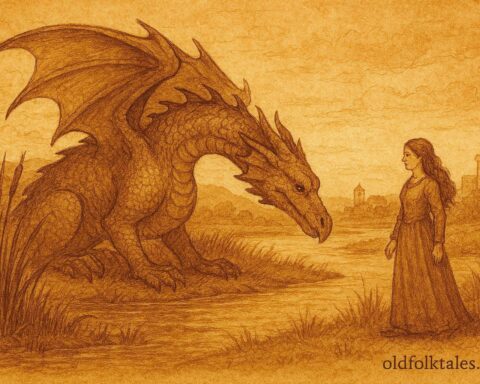
For nights uncounted, the golden apples disappeared. No ordinary thief dared steal them; the orchard was watched by the elder brothers, and the fences were fortified with iron gates. Yet time and again, under the cover of darkness, the fruit vanished. Rumors spread that a zmeu, a dragon-like creature of tremendous power and cunning, had claimed the apples for himself. Its eyes glowed like molten amber, and its scales shimmered in colors that seemed almost alive.
When the orchard fell to Prâslea’s watch, he resolved not to rely solely on strength, as his brothers had done. Instead, he stationed himself beneath the apple trees, listening intently for the slightest rustle of wings or scuff of claws. Night after night, he observed silently, learning the patterns of the zmeu, the subtle glimmer of its scales in moonlight, and the way it moved with an almost regal patience.
One night, as the wind whispered through the orchard and the stars hung like silver lanterns overhead, Prâslea caught sight of a shadow. The zmeu approached, each step sending ripples through the dewy grass. With a deep breath to steady his racing heart, Prâslea leapt from the shadows, tripping the creature with a carefully laid snare. The zmeu stumbled, snarling in fury, but escaped before he could be fully caught. Though he fled, the young boy had gained something far more important than victory: knowledge.
He realized that cleverness, observation, and strategy could triumph over brute force. Fear had no dominion over him; he had learned to trust his wits, and this understanding would carry him far.
The Abduction of the Princess
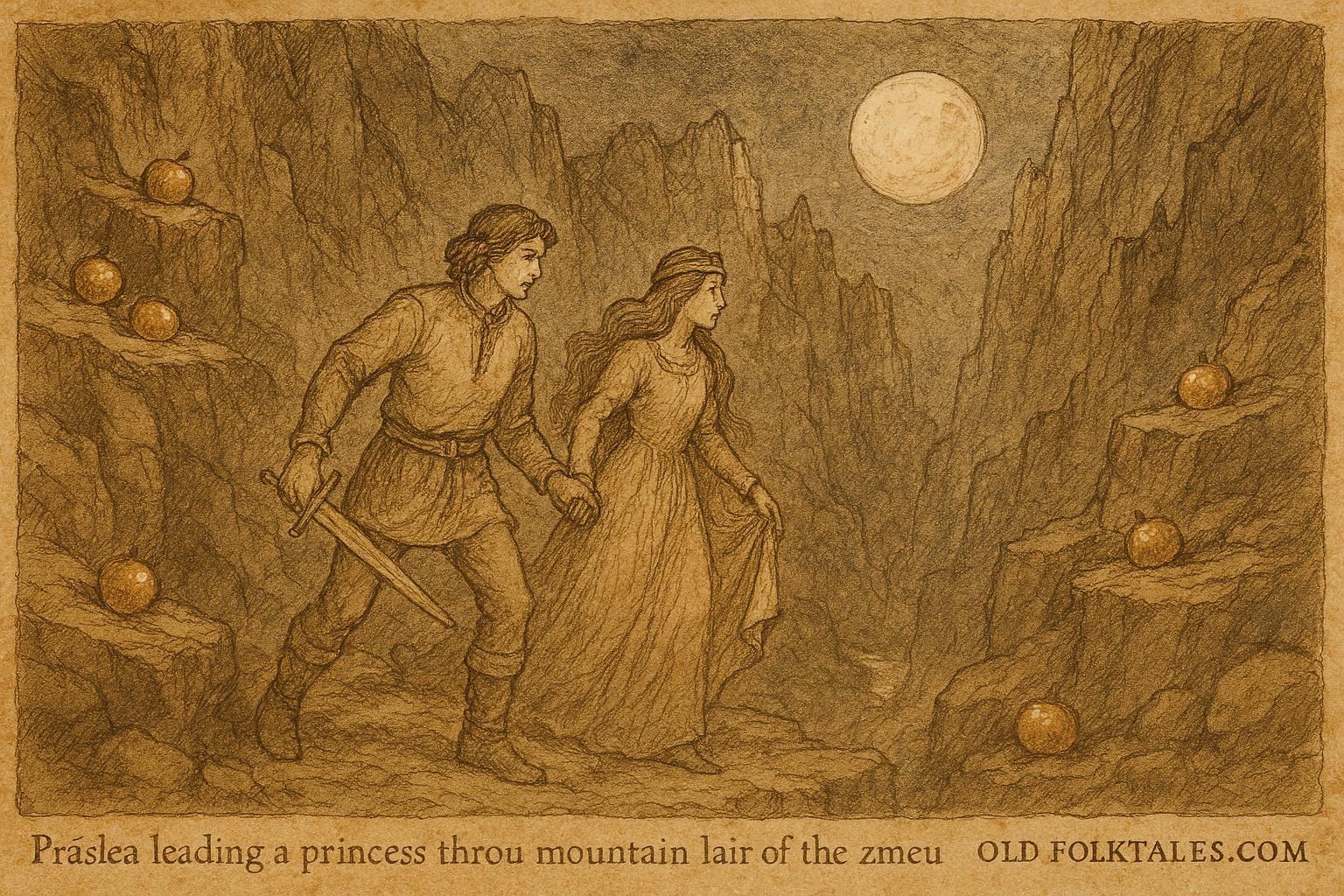
Not long after, troubling news arrived: a zmeu had kidnapped a princess from a neighboring kingdom. Known throughout the lands for her beauty, wisdom, and grace, the princess had been taken to a high, craggy mountain where the zmeu kept his lair. Fires blazed around the cavern entrances, and treacherous paths twisted across sheer cliffs, making the journey nearly impossible for mortals.
Prâslea, young yet unshakable, resolved to rescue her. He gathered supplies, and with a determined heart, began the ascent through forests thick with ancient trees, where the wind carried the cries of night birds and the howls of wolves. The rivers he crossed roared over jagged rocks, their waters ice-cold and swift. Each challenge tested his courage, yet he met them with ingenuity, fallen logs became bridges, reflective pools allowed him to spy on the zmeu without detection, and clever disguises kept him hidden from wandering eyes.
He slept under starlit skies, the cool mountain air brushing his cheeks. He kept his mind sharp, thinking through every possible scenario. The zmeu’s lair, perched high above the clouds, seemed nearly unreachable. Yet Prâslea pressed onward, motivated not by glory but by duty and compassion.
The Confrontation
Finally, he arrived at the mouth of the zmeu’s cavern. Smoke and embers curled into the night, and the stench of sulfur filled the air. The beast slept atop a hoard of treasure, golden apples gleaming nearby. The princess was trapped within the lair, her eyes wide with fear yet alight with hope as she saw the young hero.
Prâslea approached carefully, noting every detail: the creature’s heavy breathing, the rhythm of its claws upon stone, and the slack in its scales where he might exploit weakness. Then, in a display of bravery and ingenuity, he freed the princess, guiding her through secret tunnels he had discovered at the cliff’s base.
When the zmeu awoke, it roared, shaking the very rocks beneath them. Fire blazed from its nostrils, yet Prâslea was prepared. He used clever traps: pits concealed by brush, rocks that tumbled from cliffs to startle the creature, and narrow passages that allowed him to evade its grasp. Each move was deliberate, a dance of wit against brute strength. Finally, with a final snare and clever misdirection, the zmeu fell into a deep chasm, vanishing from the world and leaving the princess safe.
The Return Home
Prâslea and the princess descended the mountain together, weary but triumphant. Word of his bravery spread quickly; even his elder brothers, who had long dismissed him, acknowledged his wisdom and courage. The king, grateful for his daughter’s safe return, praised the young hero, offering riches and honor, yet Prâslea valued something greater: the knowledge that courage and cleverness, combined with steadfast determination, could overcome even the most formidable of foes.
In time, the orchard flourished as never before. The golden apples glimmered in the sunlight, no longer threatened by thieves or dragons. Prâslea’s reputation grew, not merely for his victory but for the heart he carried, the quiet diligence, and the bravery that outshone even the greatest warriors.
Discover the spiritual depth and wisdom hidden in the ancient folklore of Eastern and Balkan Europe
Moral Lesson
Bravery is not measured by size or strength but by courage, intelligence, and persistence in the face of danger. True heroism combines cleverness with heart, showing that even the youngest or seemingly weakest can accomplish extraordinary feats. Loyalty, compassion, and perseverance bring rewards beyond measure.
Knowledge Check
1. Who is Prâslea and what makes him heroic?
Prâslea is the youngest son tasked with guarding magical golden apples. His courage, cleverness, and determination make him a true hero.
2. What is a zmeu in Romanian folklore?
A zmeu is a dragon-like creature that hoards treasures and abducts maidens, often representing greed or danger.
3. Why are the golden apples significant?
They symbolize magical power, virtue, and the responsibility to protect valuable treasures against envy and evil.
4. How does Prâslea defeat the zmeu?
Through strategy, observation, clever traps, and ingenuity rather than relying on physical strength alone.
5. What are the central themes of the story?
Bravery, cleverness, perseverance, loyalty, the reward for virtuous action, and intelligence overcoming brute force.
6. What is the cultural origin of the tale?
Romanian folklore, Wallachia region, 19th century; collected by Petre Ispirescu.
Source: Petre Ispirescu, Legende sau basmele românilor, 1882.
Cultural Origin: Romanian folklore, Wallachia, 19th century.