Long ago, in a Serbian village where red-tiled roofs clustered beneath rolling hills and church bells marked the rhythm of life, there lived a respected peasant and his wife. Though blessed with modest land and steady harvests, they carried one sorrow: they had no child.
For years they prayed before icons, lit candles in the village church, and whispered petitions beneath the vast Balkan sky. At last, their wish was granted. A daughter was born, bright-eyed, gentle, and beloved from the moment she first cried.
The child grew into a young woman of quiet grace. Her voice was soft, her hands diligent, and her heart obedient. Suitors began to notice her beauty. Yet fate had prepared a path none could foresee.
The Unusual Proposal
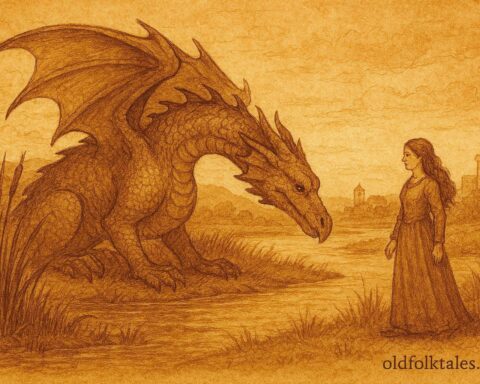
One afternoon, as her father worked in the field beyond the village, a great snake appeared near the boundary stones. It did not hiss or strike. Instead, it lifted its head and spoke in a clear human voice:
“Give me your daughter as my bride.”
The father staggered back in terror. He crossed himself, thinking it a demon’s trick. But the snake did not threaten him. It repeated its request calmly, as if it were the most natural proposal in the world.
The man fled home in distress and told his wife what he had heard. Fear filled their house. Yet the snake returned the next day, and the next, always repeating the same demand.
In Serbian folk belief, oaths and spoken promises carry sacred weight. Words once uttered bind both heaven and earth. Worn down by dread and uncertain whether defiance might bring harm upon the household, the father reluctantly gave his word.
When he told his daughter, she did not scream nor curse her fate. She listened in silence. Then she said only, “If it is given, I will obey.”
Her calm acceptance was not foolishness but trust, trust in divine order, trust in patience.
The Wedding of Mystery
The wedding took place quietly. No grand feast, no village music filled the air. Instead, the strange bridegroom appeared as a serpent, coiled and watchful.
After the ceremony, he led his bride away from her parents’ home, beyond the village fields, toward a distant dwelling prepared for them.
The house stood alone among orchards and gentle hills. It was not dark or cursed as one might imagine, but peaceful and well kept. Still, the bride’s heart trembled.
That night, when darkness covered the land and candles flickered low, the impossible happened.
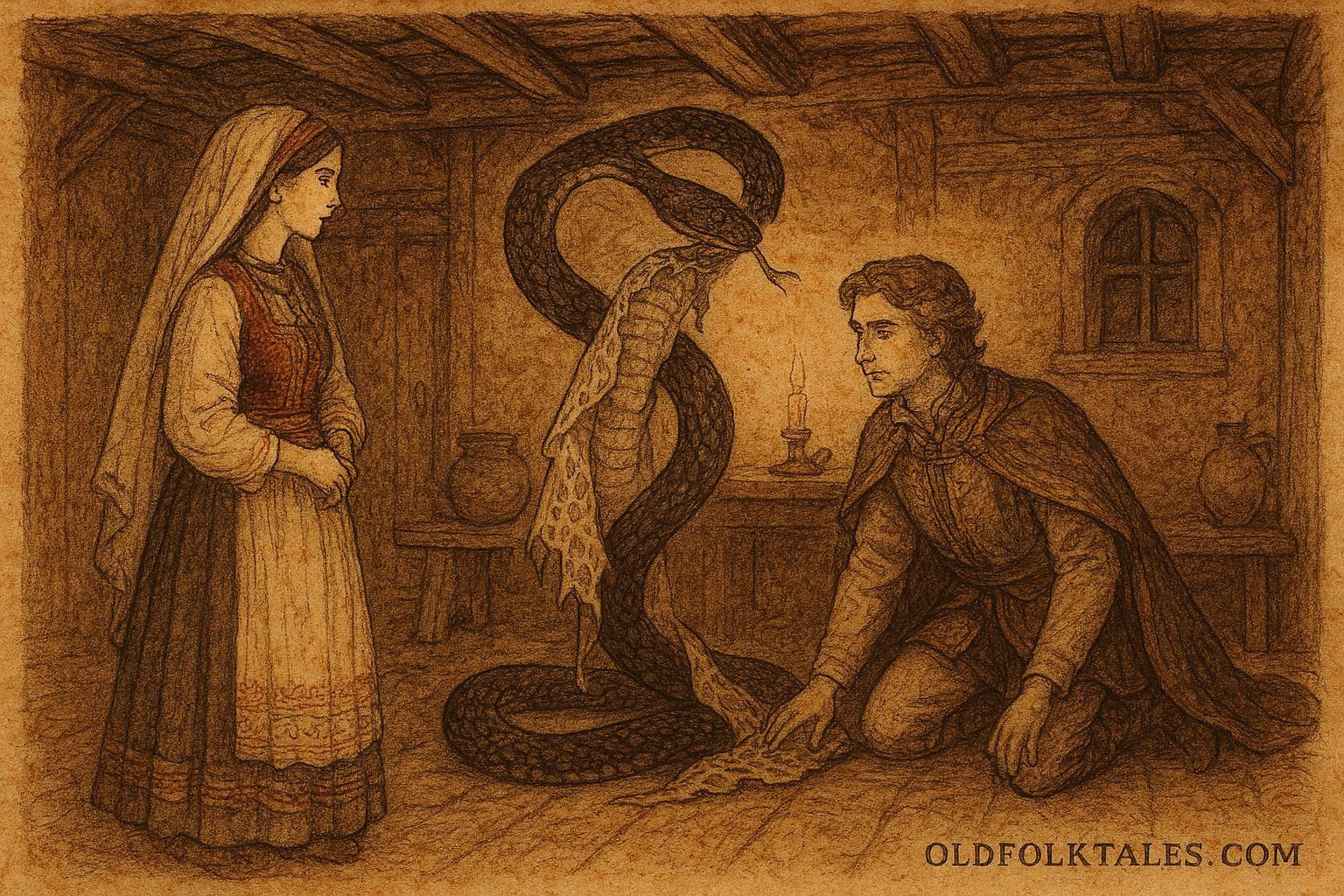
The snake shed its skin.
Before her stood a young man of striking appearance, tall, noble, with eyes reflecting both sorrow and hope.
“Do not be afraid,” he said gently. “By day I must wear the serpent’s form. By night I am as you see me now. This is the burden of a curse laid upon me long ago.”
The bride listened, her breath shallow but steady.
“You must tell no one,” he continued. “And you must never disturb the order of this transformation. If the secret is betrayed, suffering will follow.”
She nodded. In that moment, obedience was not submission, it was sacred guardianship.
Life Between Two Worlds
Days passed. By daylight, her husband moved as a snake within their household. She tended to him without complaint. She carried water, baked bread, and spoke kindly, never allowing revulsion to cloud her duty.
By night, he became her husband in human form. They spoke of faith, of longing, of the mystery of fate. Love grew slowly, not from passion alone but from shared endurance.
Though alone, they were not unhappy.
Yet isolation invites curiosity.
When the young bride visited her parents, they noticed her health and quiet contentment. Her mother pressed her with questions.
“Is he cruel? Is he monstrous?”
The daughter hesitated but kept her promise. She revealed nothing.
Still, doubt crept like wind beneath a door. Neighbors whispered. What kind of life was she living? Was she deceived? Enchanted? Endangered?
The mother’s worry turned to suspicion.
The Breaking of Trust
One evening, unable to bear uncertainty, the bride’s mother followed her secretly. Hiding outside the house, she waited.
At nightfall, she saw the serpent’s skin fall away and a man emerge.
A gasp escaped her lips.
She rushed home and confronted her daughter the next day.
“You live with a curse!” the mother cried. “Burn the snakeskin. Free him forever!”
The daughter trembled. Her husband had warned her. The transformation followed sacred order. Interference could unravel everything.
But pressure from family can be heavier than iron chains.
That night, while her husband slept in human form, the bride’s mother entered the house and seized the discarded snakeskin. Without hesitation, she cast it into the fire.
The flames consumed it.
When dawn approached, the husband awoke in terror.
“What have you done?”
The bride wept. “I did not wish it.”
The curse had not been broken, it had been disrupted. Sacred timing violated. The path incomplete.
Because the transformation was forced before its destined release, he could not remain.
“You have broken trust,” he said, not with anger, but sorrow. “Now I must go far away. Only great hardship can restore what was lost.”
And before her eyes, he vanished.
The Journey of Endurance
Left alone, the bride did not collapse into despair. Instead, she prepared herself.
If her mistake, through weakness, through yielding to others, had driven him away, then perseverance must bring him back.
She put on traveling clothes and set out across mountains and forests.
Her path was not easy. In many South Slavic tales, journeys symbolize purification. She endured hunger, storms, and solitude.
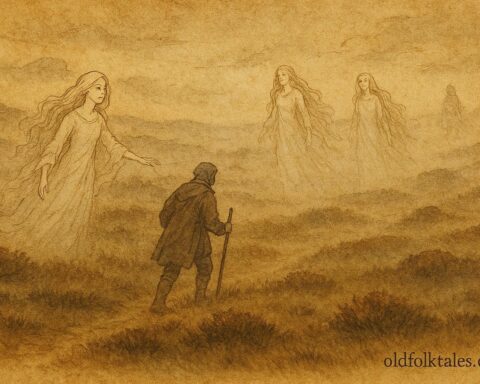
Along the way, she met old women, figures common in Balkan folklore as guardians of hidden knowledge. Each offered advice in exchange for humility.
“You must not complain,” one warned.
“You must not turn back,” said another.
“You must remain patient even when hope thins.”
Armed with small tokens and sacred instructions, she pressed onward.
The Final Trial
At last, she reached a distant land where her husband now lived under another enchantment. He was promised to another bride, bound again by forces beyond his control.
But the young woman did not shout nor accuse. She remembered the lessons learned.
On the wedding night, she was allowed to sit near the chamber. She used the tokens given by the wise women, objects symbolizing endurance, memory, and truth.
She sang softly.
Her song spoke of promise broken not by malice but by fear. It spoke of patience tried and lessons learned.
Within the chamber, her husband stirred.
Memory returned, not of anger, but of love tested by adversity.
Before the marriage could be sealed, he rose and came to her.
The curse, having run its full measure through suffering and faithfulness, dissolved at last, not by force, not by impatience, but by perseverance.
Restoration
They returned home together, no longer bound to shifting forms. The serpent’s burden was gone, its purpose fulfilled.
The village that once whispered now witnessed the truth: what appears monstrous may conceal nobility. What seems broken may require only time and faith.
The bride had learned that obedience must be balanced with discernment. The husband had endured the weight of mistrust. Together, they rebuilt their life, stronger for the trial.
And in Serbian hearthside tradition, their story remains a reminder that sacred promises must not be handled carelessly.
Moral Lesson
Patience and trust are sacred foundations of love. When promises are broken through fear or interference, hardship follows, but perseverance and faith can restore what was lost.
Knowledge Check
1. Who is the Snake Bridegroom?
An enchanted Serbian man cursed to live as a serpent by day and human by night.
2. Why must the bride keep his secret?
Because the transformation follows sacred conditions that cannot be disrupted without consequence.
3. What causes the husband’s disappearance?
The burning of his snakeskin before the curse has naturally ended.
4. What role do the old women play?
They guide the heroine through trials, symbolizing ancestral wisdom in South Slavic folklore.
5. What is the central theme of the tale?
Patience, trust, and perseverance restore love after broken promises.
6. What is the cultural origin of the story?
Serbian oral tradition recorded in 1849 by Vuk Stefanović Karadžić.
Source: Vuk Stefanović Karadžić, Srpske narodne pripovijetke, 1849.
Cultural Origin: Serbian (South Slavic oral tradition).