High above the forests of southern Poland rises the stony summit of Łysa Góra, known in English as Bald Mountain. The wind moves differently there. It does not merely pass, it circles. It waits. The bare crown of rock, stripped of tall trees, has long stirred unease in those who dwell below in the valleys of the Świętokrzyskie Mountains.
To the villagers, the mountain was more than stone and soil. It was layered with memory. Long before church bells echoed through the valleys, people said ancient rites had been performed upon that height. Fires once burned there for forgotten gods. Even after crosses were raised and monasteries built in the region, whispers remained: on storm-filled nights, the old powers stirred.
It was said that when thunder rolled across the ridges and lightning cracked the sky open, figures gathered upon the summit, witches and sorcerers in secret assembly, their sabbath hidden within wind and darkness.
Most villagers spoke of it quietly. A few scoffed. Among the scoffers was a young man from a nearby settlement, known more for his bold tongue than for wisdom. He had grown tired of hearing old tales repeated by trembling elders. “If witches danced on Bald Mountain,” he would say, “surely someone would have seen them plainly.”
The elders would answer only with silence.
One autumn evening, a storm gathered with unnatural force. Clouds folded over the mountains like black wool. The wind pressed low against the fields, bending grain and snapping loose shutters. Thunder boomed so close that it shook the wooden beams of cottages.
The young villager felt the storm not as warning but as invitation.
“This is the night,” he said to himself. “If ever such gatherings exist, they will meet now.”
Against every sensible instinct, he wrapped his cloak tightly and began the climb toward Łysa Góra.
The forest path was slick with rain. Branches whipped against his shoulders. The air smelled of wet earth and pine resin torn fresh from bark. As he ascended, the world below grew distant, the warm lamplight of homes swallowed by mist. Only the storm remained.
The mountain grew barer near its crown. Trees thinned into twisted silhouettes. Stones protruded like the ribs of some ancient beast. The wind howled without obstruction.
Then he saw it.
Far ahead, just beyond a ring of jagged rocks, a glow pulsed against the darkness. Not lightning. Not moonlight. Firelight.
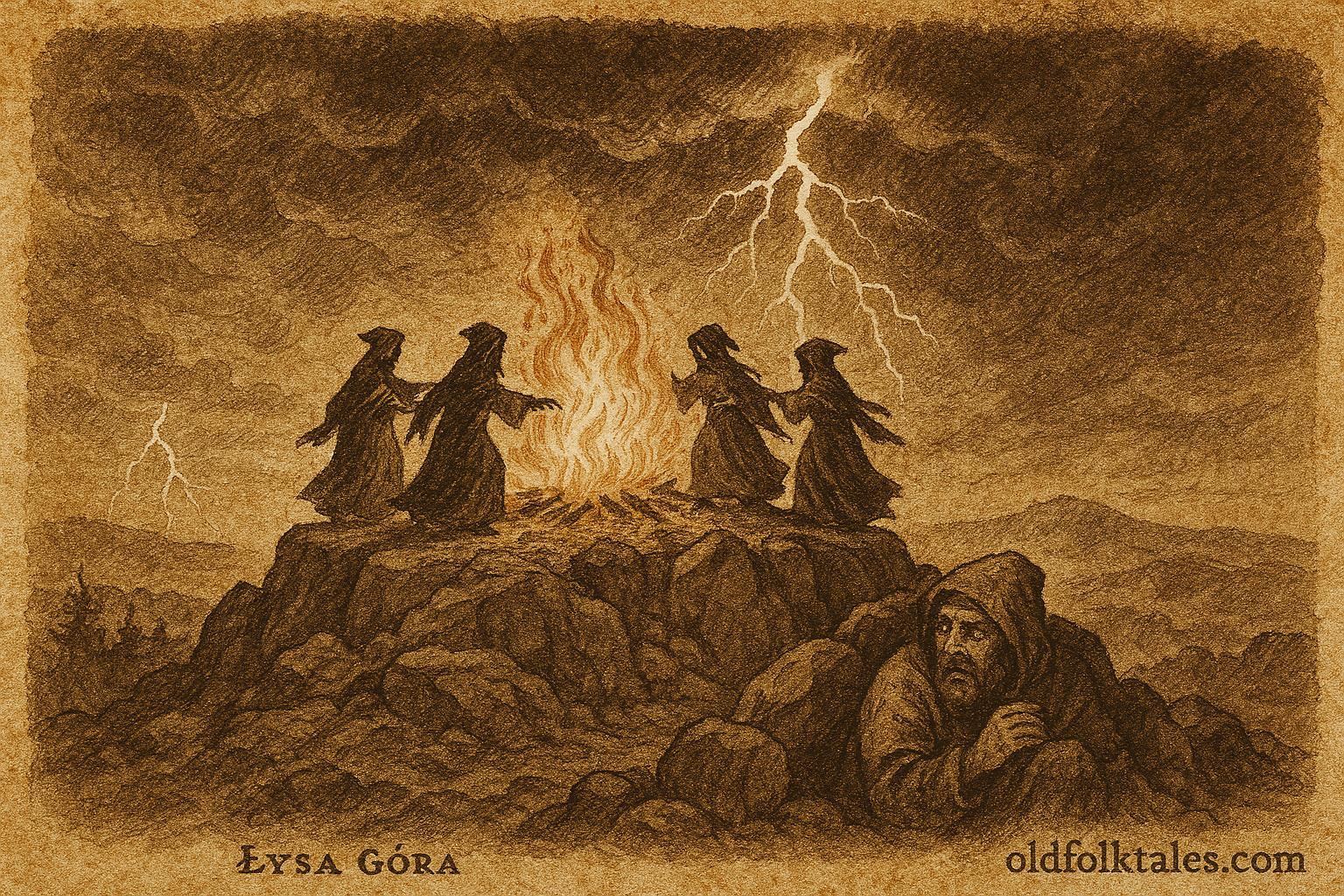
He dropped to the ground, heart pounding. Crawling closer, he pressed himself behind a low stone ridge and peered over its edge.
There, in the open clearing at the summit, figures moved.
They were cloaked in dark garments that whipped around them like torn banners. Their faces were shadowed beneath hoods. Around a central fire they gathered, circling slowly. Their movements were not wild but deliberate, measured steps, as if following a pattern known only to them.
The flames rose high, bending strangely against the wind, yet never extinguished. Sparks lifted upward but did not scatter. Instead, they seemed to hover, suspended in unnatural stillness before fading.
The young man strained to hear. Beneath the thunder, beneath the wind, he caught fragments of sound, low murmuring, rhythmic chanting that rose and fell like a tide. The words were indistinct, yet heavy with age.
Lightning tore the sky open.
In that white flash, he glimpsed faces, pale, stern, intent. Not grotesque, not monstrous. Human. But their eyes reflected the fire in a way that unsettled him. Not with warmth, but with intensity.
He felt then, not curiosity, but intrusion.
This was no performance for villagers’ daring. This was not meant to be seen.
The circle of figures shifted. One among them lifted her head slowly, as though sensing something beyond the firelight. The young man froze. The wind seemed to stop breathing.
Her gaze turned, not to the sky, but toward the stones where he hid.
Another lightning strike illuminated the summit.
For a heartbeat, her eyes met his.
Whether she truly saw him or merely sensed movement, he never knew. But fear struck him harder than thunder. The old warnings he had mocked rose within him like cold water.
He scrambled backward, stones clattering beneath his boots. A gust of wind nearly toppled him. He did not dare look again.
Behind him, the chanting grew louder, or perhaps the storm magnified it. The fire flared unnaturally bright, casting tall, distorted shadows against the rocks.
He ran.
Down the slope he fled, slipping in mud, grasping at branches. The forest that had seemed familiar hours earlier now felt endless. Every crack of thunder sounded like pursuit. Every flash of lightning cast shapes that might have been cloaked figures descending behind him.
His breath tore at his chest. His cloak snagged on thorns. Still, he ran.
Only when he reached the lower fields, where cottages stood dark but solid against the storm, did he dare stop. He turned, trembling.
The summit of Łysa Góra lay hidden in cloud. No fire was visible. No figures. Only lightning breaking the sky.
He staggered home before dawn.
In the days that followed, the young man spoke little. When neighbors asked why his boots were torn and his face pale, he offered no bold explanations. He no longer mocked tales of the mountain. When elders mentioned sabbaths or old rites lingering in stone and soil, he did not argue.
He had seen enough to understand this: not all knowledge belongs to the curious. Some places carry memory deeper than words. And some boundaries exist not to be challenged, but respected.
From then on, whenever storms gathered over Bald Mountain, he closed his shutters and remained indoors, listening, not with disbelief, but with humility.
The people of the region continued to speak of witches and sorcerers assembling upon Łysa Góra. Chroniclers such as Jan Długosz recorded accounts of strange gatherings in the Holy Cross region, blending medieval Christian warnings with echoes of older rites. Centuries later, ethnographers like Oskar Kolberg collected stories passed through generations, tales of storm-lit sabbaths, forbidden observation, and narrow escape.
The mountain remained what it had always been: a place where belief systems met and sometimes clashed. Pagan memory beneath Christian sky. Fear intertwined with reverence. A summit both sacred and unsettling.
And always, when lightning strikes over the Świętokrzyskie peaks, some still say that figures gather in the wind.
Moral Lesson
The legend of Łysa Góra reminds us that curiosity without humility can lead to peril. Not every boundary exists to be broken. Respect for sacred spaces, inherited traditions, and unseen forces preserves both wisdom and safety.
Knowledge Check
1. Where is Łysa Góra located in Polish folklore?
Łysa Góra (Bald Mountain) is in the Świętokrzyskie or Holy Cross Mountains of southern Poland and is linked to legends of witch gatherings.
2. What happens during stormy nights on Bald Mountain?
According to folklore, witches and sorcerers assemble in secret sabbaths during violent storms.
3. Who documented the legends of Łysa Góra?
Medieval references appear in chronicles by Jan Długosz, and later folklore accounts were recorded by Oskar Kolberg.
4. What central theme does this Polish legend emphasize?
The danger of reckless curiosity and the importance of respecting sacred or forbidden places.
5. How does the story reflect pagan and Christian belief systems?
It blends ancient pre-Christian ritual imagery with later Christian interpretations of witchcraft and moral warning.
6. What lesson does the villager learn after witnessing the sabbath?
He learns that some knowledge carries danger and that humility is wiser than arrogance.
Source: Medieval references in chronicles by Jan Długosz; later ethnographic documentation by Oskar Kolberg. 15th-century references; 19th-century folklore collections
Cultural Origin: Świętokrzyskie Mountains (Holy Cross region), Poland