In the quiet villages of central Ukraine, where the wind whispered through tall rye fields and the lowing of cattle echoed in the valleys, there lived a young seminarian named Khoma Brut. He was diligent in his studies, devout in prayer, and curious about the mysterious forces that lay beyond the visible world. Though he devoted himself to the Church, he could not suppress the fascination he felt for the strange stories whispered by the peasants, tales of spirits, witches, and demons who walked unseen among the living.
One evening, as the sun dipped behind the horizon and shadows stretched long over the Poltava plains, Khoma was sent on a peculiar errand. A wealthy landowner had requested his presence at the manor of a recently deceased old woman, whose funeral rites were to be conducted at midnight. The villagers had murmured warnings: this was no ordinary death. The woman had lived a life of secrecy, rumored to practice dark arts, and whispers claimed she had made pacts with forces that mortals should fear.
Khoma, both apprehensive and compelled, accepted the charge. He arrived at the isolated manor just as the moon rose high, its silver light illuminating the frost-covered fields. The air was heavy with the scent of damp earth, and a distant owl hooted a mournful warning. Inside the modest chapel attached to the manor, the coffin of the dead woman had been placed upon a raised platform, candles flickering around it, casting dancing shadows upon the walls.
As Khoma approached, he was struck by the eerie stillness. The villagers had left him alone with the body, and all at once he sensed that the very room seemed alive with hidden eyes. He began the prayers of blessing, his voice steady but tinged with unease. Then, as the hour grew later, a tremor of fear ran through him. The corpse’s eyelids fluttered, barely perceptible at first, and Khoma’s heart pounded. He recoiled, yet the instinct to confront the supernatural drew him forward.
The old woman’s body began to move with uncanny vitality. Her fingers twitched, her lips murmured incomprehensible words, and a strange, unearthly light glimmered around her form. Khoma realized that this was no ordinary specter; the stories of witches who commanded dark powers were true. And in that dreadful moment, the true horror began to manifest.
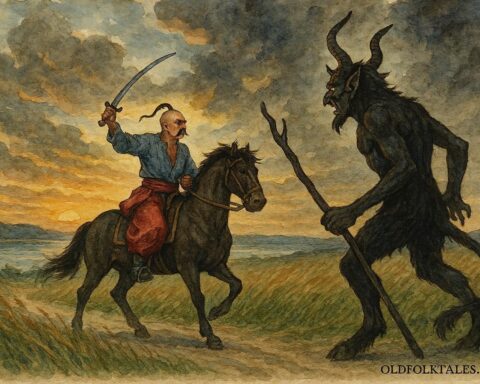
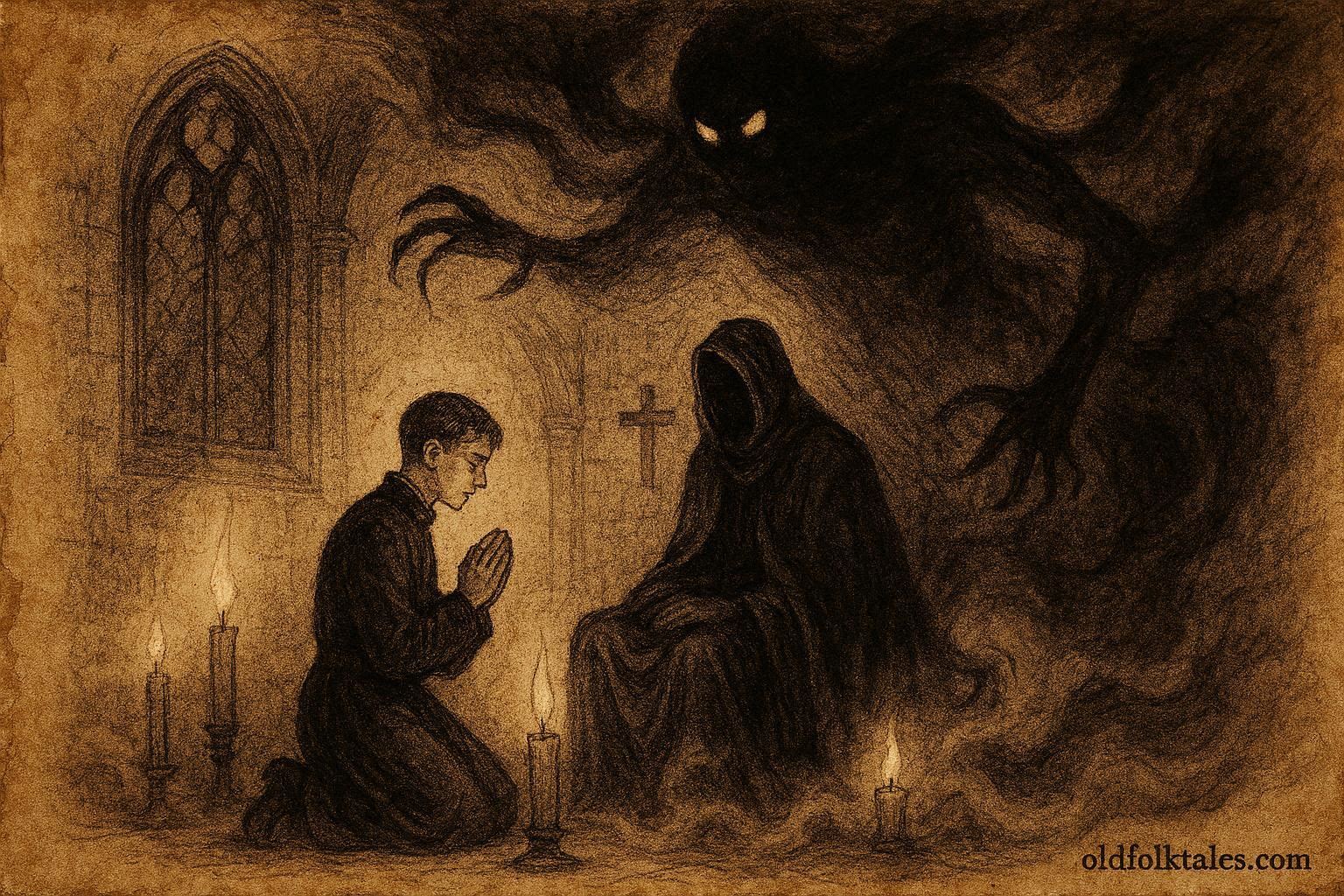
From the corner of the room, shadows coalesced into a figure unlike any mortal being. Viy, the dreaded night demon, rose slowly from the darkness. He was immense, hunched, and grotesque, with eyes so large that even a single glance could paralyze a man with death. His eyelids were heavy, yet beneath them burned a fiery, merciless gaze. The very air grew thick, and the candles’ flames flickered violently, as though the presence of evil resisted the natural world itself.
Khoma understood immediately the peril of what lay before him. Legend held that anyone who met Viy’s gaze would be struck dead, yet here he was, standing within reach of the most terrifying of all demonic forces. He remembered the villagers’ warnings, the whispered lore of the Slavic world, and the teachings of the Church: courage and prayer could shield a mortal against forces unseen, but only if one remained steadfast.
The night stretched on in tense silence. The demon’s body did not advance, but its gaze swept over the room in waves of terror. Khoma knelt before the coffin, clutching his cross and murmuring the sacred prayers, beads cold in his trembling hand. He recited Psalm after Psalm, his voice quivering yet determined, invoking the protection of heaven against the monstrous power of the netherworld.
Hours passed, or perhaps minutes, for time seemed to warp in the presence of such malignancy. The corpse of the old woman writhed upon the platform, rising and falling as if pushed by invisible forces. Khoma’s eyes strained, refusing to meet the deadly stare of Viy directly, yet he could sense the gaze drawing nearer, testing his courage, probing for fear. Every muscle in his body tensed, and he realized that even the act of survival required cleverness as well as faith.
Viy’s power was unlike any simple ghost or spirit. He commanded the forces of death itself, capable of bending the natural world to his will. The wind outside the chapel howled as if the very trees and fields sensed the presence of evil. The young seminarian, though terrified, clung to the thought that the demon’s strength, immense though it was, could be contained by persistence, prayer, and cunning.
With steady breathing, Khoma began to move his lips silently in incantation, focusing his mind entirely on the protection of sacred rituals. Slowly, the demon’s approach became more deliberate. The coffin shuddered violently, the candles’ light danced with a fiery intensity, and Khoma’s heart raced like the wings of a trapped bird. He dared not glance directly at Viy, but he imagined the enormous eyes hidden beneath the heavy lids, eyes that could see all weakness, all doubt.
Throughout the night, Khoma endured the terrifying trials set before him. He sensed the boundaries between life and death blur, the invisible forces pressing against him from every side. The old woman’s corpse writhed and summoned all the darkness of the world, yet he remained steadfast. His courage was not born of ignorance; it was forged through knowledge of sacred rites, a deep understanding of the world of spirits, and a pure heart committed to righteousness.
At the first light of dawn, when the moon had given way to pale morning beams, Viy finally released his hold. The night demon, unable to pierce the shield of unwavering faith and intellect, retreated into the shadows, leaving behind only a faint echo of his terrible presence. The old woman’s body lay still once more, lifeless and powerless. Khoma, exhausted but triumphant, emerged from the chapel, carrying the knowledge that mortal courage, guided by prayer and understanding, could indeed resist even the most formidable supernatural forces.
News of Khoma’s ordeal spread throughout the villages. The tale of his night with Viy became legend, a story repeated around hearths and in the hushed tones of night travelers. People marveled at the combination of fear and faith, the mortal resolve that had stood against the darkness. The villagers understood, as the young seminarian had learned, that curiosity could lead one into peril, but courage, wisdom, and the guidance of sacred tradition could restore balance and protect life.
And so, Khoma Brut became a figure of reverence, a symbol of human perseverance in the face of evil. The tale of Viy endured for generations, not only as a story of terror but as a reminder of the power of faith, courage, and cleverness when confronting forces beyond the ordinary world.
Moral Lesson
The story of Viy teaches that courage, faith, and wisdom are essential when facing overwhelming evil. Curiosity may lead to danger, but steadfast devotion, knowledge, and perseverance can protect the mortal soul and restore balance between the natural and supernatural worlds.
Knowledge Check
-
Who is the protagonist of the tale?
Khoma Brut, a young seminary student who confronts the night demon. -
What is Viy’s defining characteristic?
His deadly gaze, which can kill anyone who looks directly at him. -
How does Khoma survive Viy’s attacks?
Through courage, prayer, and careful adherence to sacred rites. -
What role does the old woman’s corpse play?
She is a conduit for dark powers, whose necromantic movements summon the demon. -
What themes are emphasized in the story?
Courage in adversity, the consequences of curiosity, and the clash between mortal and supernatural forces. -
What cultural origin does this tale represent?
Central and Poltava Ukrainian folklore, blending Slavic paganism and Christian traditions.
Source: Adapted from Nikolai Gogol, Viy, published 1835 in Evenings on a Farm Near Dikanka.
Cultural Origin: Central and Poltava Ukrainian folklore blending Slavic pagan and Christian traditions