In the parish of Myrka stood a small wooden church, weathered by wind and snow. Its graveyard sloped gently behind it, where crooked stones marked the resting places of generations past. Among the living of that parish was a young woman, fair and hopeful, who had pledged herself to a deacon, a learned and respected church servant. He was thoughtful, steady in his duties, and beloved for his devotion.
They were to be married.
But fate, as it often does in northern ballads, did not bend to human plans.
Before their wedding day arrived, the deacon fell ill and died.
The bells tolled mournfully. The earth received him. The young woman wept beside his grave, her future turned suddenly to shadow.
Time passed, though grief did not soften easily.
The Sunday Meeting
One Sunday evening, after attending church, the young woman lingered among the departing parishioners. Twilight stretched long across the churchyard. The air held that chill which comes between autumn and winter.
As she stepped toward the gate, a rider approached.
The horse moved quietly. The rider’s cloak hung dark and still.
It was the deacon.
At least, so it seemed.
He greeted her gently, as he had in life. His voice was calm. His face pale in the fading light.
“I have come to escort you home,” he said.
Her heart leapt with confusion and longing. Had she imagined his burial? Could death have released him? The dusk blurred certainty.
Without fully understanding, she accepted his offer.
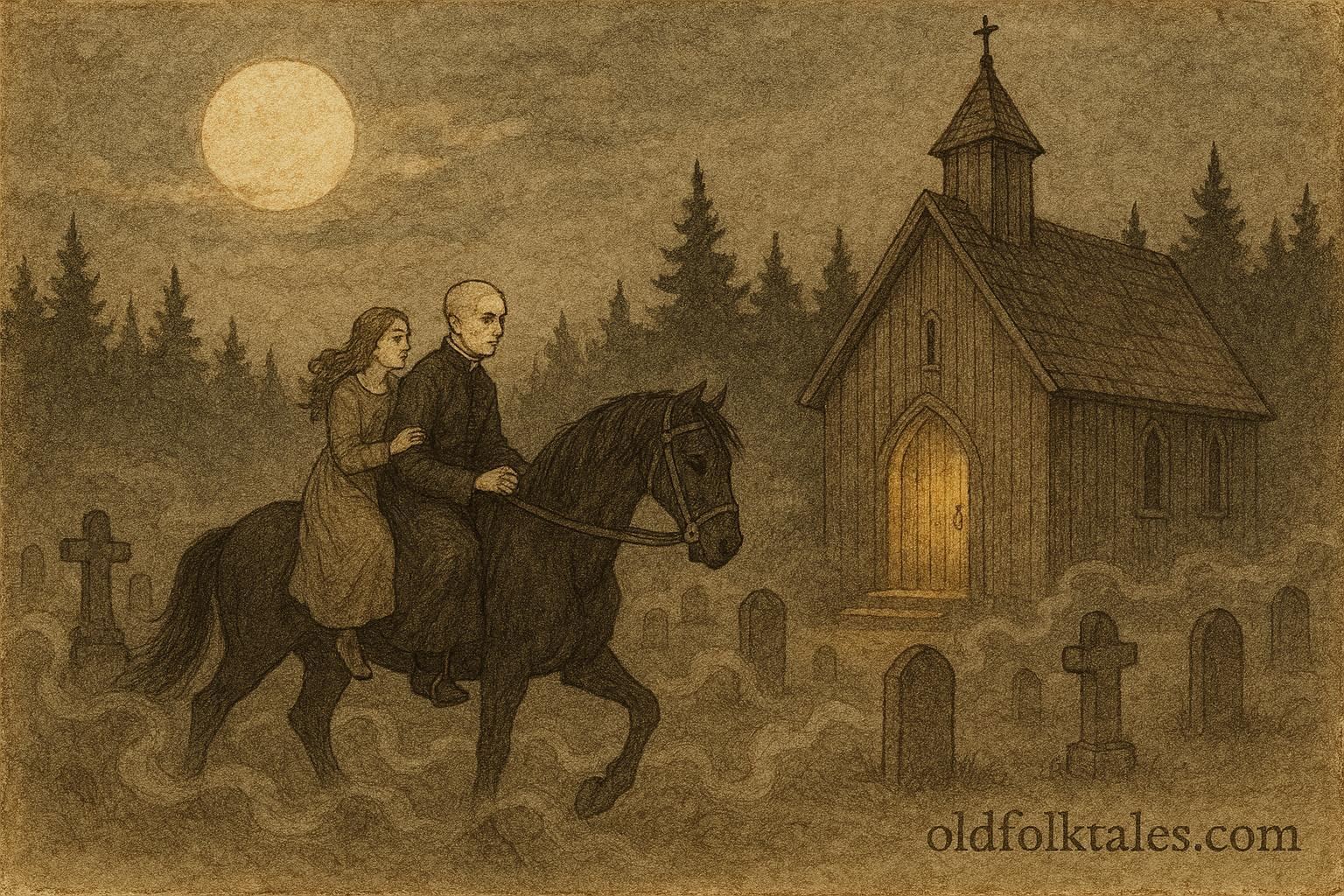
He lifted her onto the horse behind him, and together they rode into the deepening night.
The Ride
At first, the journey felt ordinary. The hooves struck the earth in steady rhythm. The trees passed in dark silence.
But soon, unease stirred.
The deacon did not speak.
His body was rigid before her.
She noticed how cold the air felt around him, colder than the wind itself.
Then she saw it.
Beneath his cloak, earth clung to his garments. Damp soil marked his sleeves. A scent of grave mold lingered faintly.
The horse’s pace quickened.
The young woman’s breath grew shallow.
She dared not look directly at his face again, but she felt something unnatural in the stillness of his form.
In some versions of the ballad, she sees his burial shroud beneath his cloak. In others, she glimpses the grave earth falling from his boots as they ride. What remains constant is this:
She understands.
The man before her is no living fiancé.
He is the Deacon of Myrka, risen from his grave.
The Realization
Fear surged through her, but she did not scream.
Instead, she watched the road carefully.
The horse no longer followed the familiar path toward her home. It veered instead toward the churchyard.
Toward the grave.
The deacon’s grip tightened, not violently, but with a cold inevitability.
In the old ballad tradition, the boundary between life and death is thin, especially for those bound by strong earthly ties. The dead may rise not from malice, but from longing.
Yet longing does not restore life.
The young woman’s mind raced.
Ahead, through the trees, she saw the faint outline of the church.
Its door stood closed.
Its threshold, sacred.
Sanctuary
With sudden resolve, she slipped from the horse.
She ran.
The ground seemed to pull at her skirts. The night pressed close. Behind her, she heard the horse halt sharply.
She reached the church door and grasped the iron handle.
“Sanctuary!” she cried.
The old wood trembled beneath her hands.
In that instant, the power of sacred ground asserted itself.
The deacon could not cross.
Bound by the laws that separate the living from the dead, he remained beyond the threshold.
In some tellings, he calls to her softly, asking her to return. In others, he vanishes in silence as the cock crows and dawn breaks.
What is certain is this:
She survives.
When morning light touches the churchyard, the grave of the deacon is found disturbed, earth scattered, as though something had risen and returned.
The young woman tells her story.
And from that day forward, no one in Myrka doubts the strength of holy ground.
The Ballad’s Meaning
The tale of the Deacon of Myrka belongs to Sweden’s ghost ballad tradition, a genre where love, death, and the sacred meet in haunting harmony.
It is not merely a story of terror.
It is a warning.
Love cannot bridge the final boundary without consequence. The dead must remain among the dead. The living must guard themselves with faith and wisdom.
And above all, sacred places hold protective power.
Discover the moral heart and wild spirit of the north through timeless Nordic storytelling
Moral Lesson
The story teaches that the boundary between life and death must be respected. Longing cannot overturn natural law, and sacred spaces offer protection against forces that disturb the balance between worlds.
Knowledge Check
1. Who recorded the Deacon of Myrka ballad?
Arvid August Afzelius in Svenska Folk-Visor från Forntiden (1814–1816).
2. What happens to the deacon before the story begins?
He dies before he can marry his fiancée.
3. Why does the young woman accept the ride?
She believes, or hopes, that her fiancé has returned.
4. How does she realize he is dead?
She notices signs of the grave—coldness, earth, unnatural silence.
5. What saves her from harm?
She reaches sanctuary at the church door, protected by sacred ground.
6. What theme defines this Swedish ghost legend?
The boundary between life and death and the protective power of faith.
Source: Arvid August Afzelius, Svenska Folk-Visor från Forntiden, 1814–1816.
Cultural Origin: Sweden.