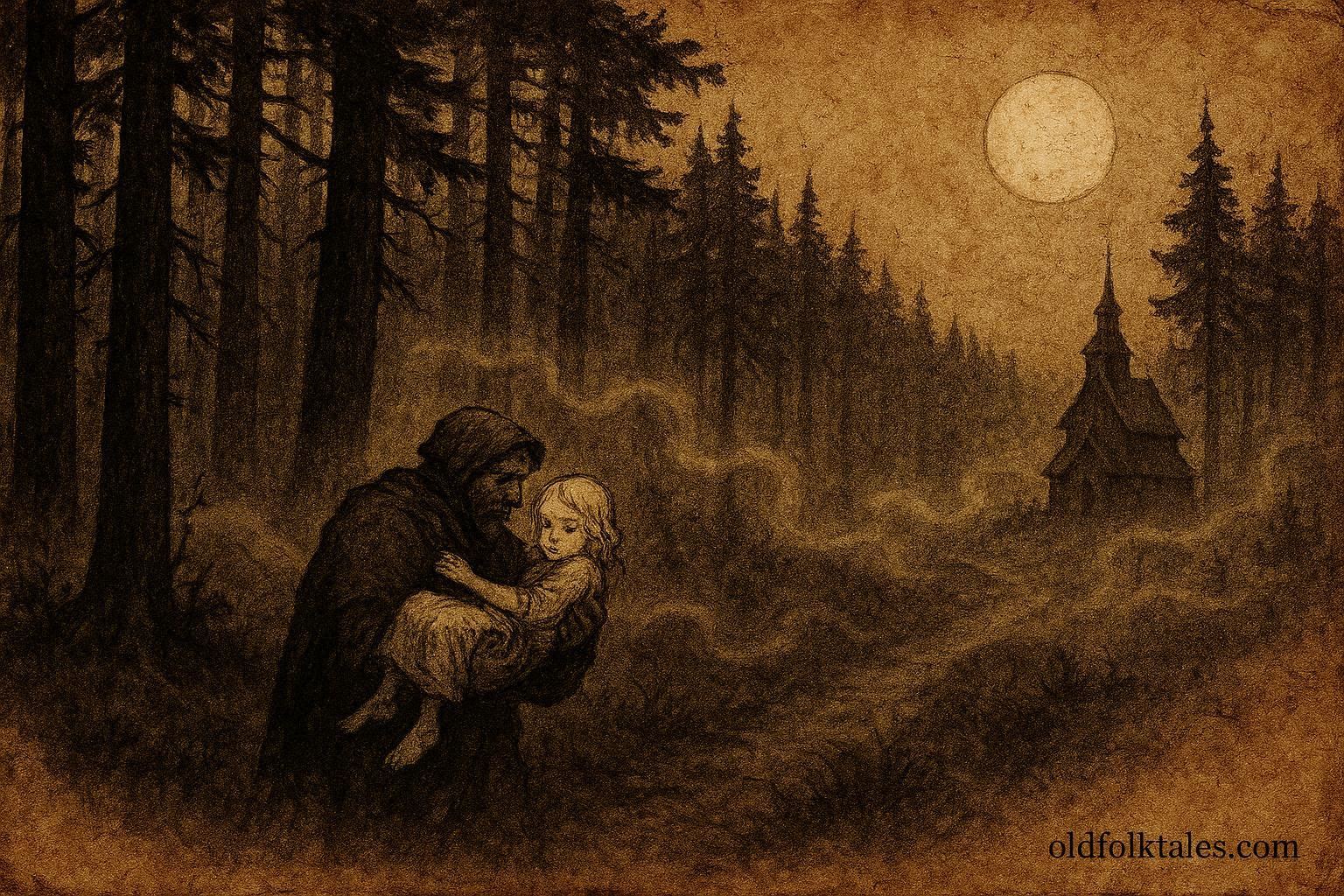
In the deep forests of rural Sweden, where pine and spruce crowd close together and the earth is soft with moss, there are paths few dare to walk after nightfall. The wind moves quietly there, and even the boldest traveler may feel that he is not alone. Among the old forest communities, one legend was whispered more than most, the tale of the myling.
A myling, people said, was the restless spirit of an unbaptized child, left without proper burial or consecration. Bound between earth and heaven, it wandered lonely woods and forgotten paths, seeking what it had been denied in life: rest in holy ground.
This is one such tale.
The Lonely Road
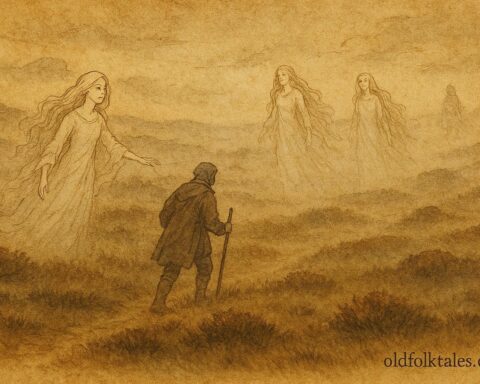
One autumn evening, when twilight sank quickly beneath the trees, a traveler made his way along a narrow forest road. He had spent the day visiting a neighboring farm and was eager to reach his own hearth before full darkness fell.
The sky dimmed faster than he expected.
Shadows thickened. The forest swallowed sound. Only the crunch of his boots on gravel broke the silence.
Then he heard it.
A cry.
Soft at first, so faint he thought it might be wind threading through branches.
But it came again.
A child’s cry.
Thin. Desperate. Alone.
The traveler stopped.
He listened.
The cry drifted from somewhere deeper in the woods, not from the road. It trembled with need.
No child should be alone in such a place.
Though unease stirred within him, compassion outweighed fear. He stepped from the path and pushed through undergrowth toward the sound.
The Child in the Moss
In a clearing dimly lit by fading light, he saw it.
A small shape, no larger than an infant, lying upon the moss.
It did not move as living children do. Its skin was pale, almost gray. Its eyes reflected no warmth of breath.
Yet it cried.
The traveler felt cold settle into his bones.
“Who has left you here?” he whispered.
The crying stopped abruptly.
Then, in a voice not like that of a living child, but thin and echoing as though carried through hollow wood, it spoke:
“Carry me.”
The traveler’s heart pounded.
“To where?” he asked.
“To the churchyard. To consecrated ground.”
He understood then.
The stories of the myling were not merely stories.
Still, he could not leave it there.
He bent and lifted the small body.
It felt light at first, no heavier than any infant.
He turned toward the road and began to walk.
The Growing Weight
With each step, the forest darkened.
With each step, the burden grew heavier.
At first, the traveler thought it was only his imagination, fear lending weight to his arms.
But soon the child pressed against him like stone.
His shoulders strained.
His breathing grew labored.
The myling’s voice whispered near his ear.
“Are we near?”
“Not yet,” he gasped.
The church lay miles away, beyond hills and fields.
The child’s weight increased again.
Sweat formed on his brow though the air was cold.
He stumbled but did not fall.
“Are we near?” came the voice once more, sharper now.
“Soon,” he answered, though he was unsure.
The burden pressed harder. His knees trembled. His back ached as though bearing a sack of grain soaked through with rain.
The traveler realized this was no ordinary weight.
It was a burden of guilt.
A burden of forgotten responsibility.
In Swedish lore, the myling did not haunt out of cruelty. It sought justice. It sought acknowledgment. It sought the rites denied to it.
The traveler was being tested.
The Edge of Despair
The forest thinned at last, and the road reappeared before him.
But the church tower was still distant against the darkening sky.
The myling grew unbearably heavy.
His arms burned. His legs faltered. He feared he would collapse before reaching sacred ground.
“Are we near?” the spirit asked again.
The voice now carried urgency, and something else. Hope.
“Yes,” the traveler forced himself to say. “We are near.”
The weight increased one final time.
He cried out as his knees buckled.
Yet he staggered forward.
The church gate came into view.
The ground within its boundary was consecrated. Hallowed. Protected.
With the last of his strength, he crossed the threshold.
Release
In that instant, the weight vanished.
The traveler nearly fell forward from the sudden absence of pressure.
The child was no longer in his arms.
The forest wind moved softly through the churchyard grass.
Where he had stood, there remained only silence.
Some say the earth stirred gently, as if something had finally been received.
Others say a faint cry of relief drifted upward and faded.
What is certain is this:
The myling was gone.
The traveler knelt, exhausted but alive.
He had faced fear and chosen compassion. He had carried what others had abandoned. And in doing so, he had restored balance between the living and the dead.
The Lesson of the Forest
In rural Sweden, such tales served as warnings.
They spoke of responsibility, particularly toward the vulnerable.
They reminded listeners that actions cannot be buried without consequence.
The myling is not merely a ghost.
It is memory.
It is guilt.
It is the weight of neglect demanding recognition.
And the only path to peace is acknowledgment and proper care.
Moral Lesson
The Myling’s Cry teaches that compassion must overcome fear, and that neglected responsibilities grow heavier over time. Justice, even spiritual justice, requires courage and moral strength.
Knowledge Check
1. What is a myling in Swedish folklore?
A restless spirit of an unbaptized infant seeking burial in consecrated ground.
2. Why does the myling demand to be carried?
It seeks spiritual rest and proper burial rites.
3. Why does the burden grow heavier?
The increasing weight symbolizes guilt, responsibility, and moral testing.
4. What saves the traveler from harm?
Reaching consecrated churchyard ground releases the spirit.
5. What themes define this folktale?
Compassion versus fear, moral burden, and spiritual justice.
6. Where does this legend originate?
Rural Swedish forest communities, documented in 19th-century folklore collections.
Source: Documented in 19th-century Swedish folklore collections.
Cultural Origin: Rural Sweden, especially forest communities.