Along the jagged western coastline of Sweden, where granite cliffs plunge into restless gray water, lies the province of Bohuslän. Here the sea is not gentle. It is vast, iron-colored, and unpredictable. Fishing villages cling to the rocks as if held there by stubborn will alone.
For generations, fishermen of Bohuslän have told of something that lives beneath those cold waves.
Not a creature of simple flesh.
But a sea troll.
The legend appears in early Scandinavian maritime traditions and was later popularized in the illustrated folklore collections known as Bland tomtar och troll, first published in 1907. Yet long before it was written down, it lived in whispered warnings passed from father to son beside creaking docks and tar-darkened boats.
This is the tale of the Sea Troll of Bohuslän.
The Coast That Demands Respect
In a small fishing village tucked between steep cliffs and a narrow harbor, the sea governed every life. The men rose before dawn to cast their nets. The women salted fish and mended sails. Children learned early that the tide could give, and just as swiftly take.
The elders taught one rule above all:
“Never mock the sea. And never forget to give thanks.”
For beneath the waves, they said, dwelled a troll older than the village itself.
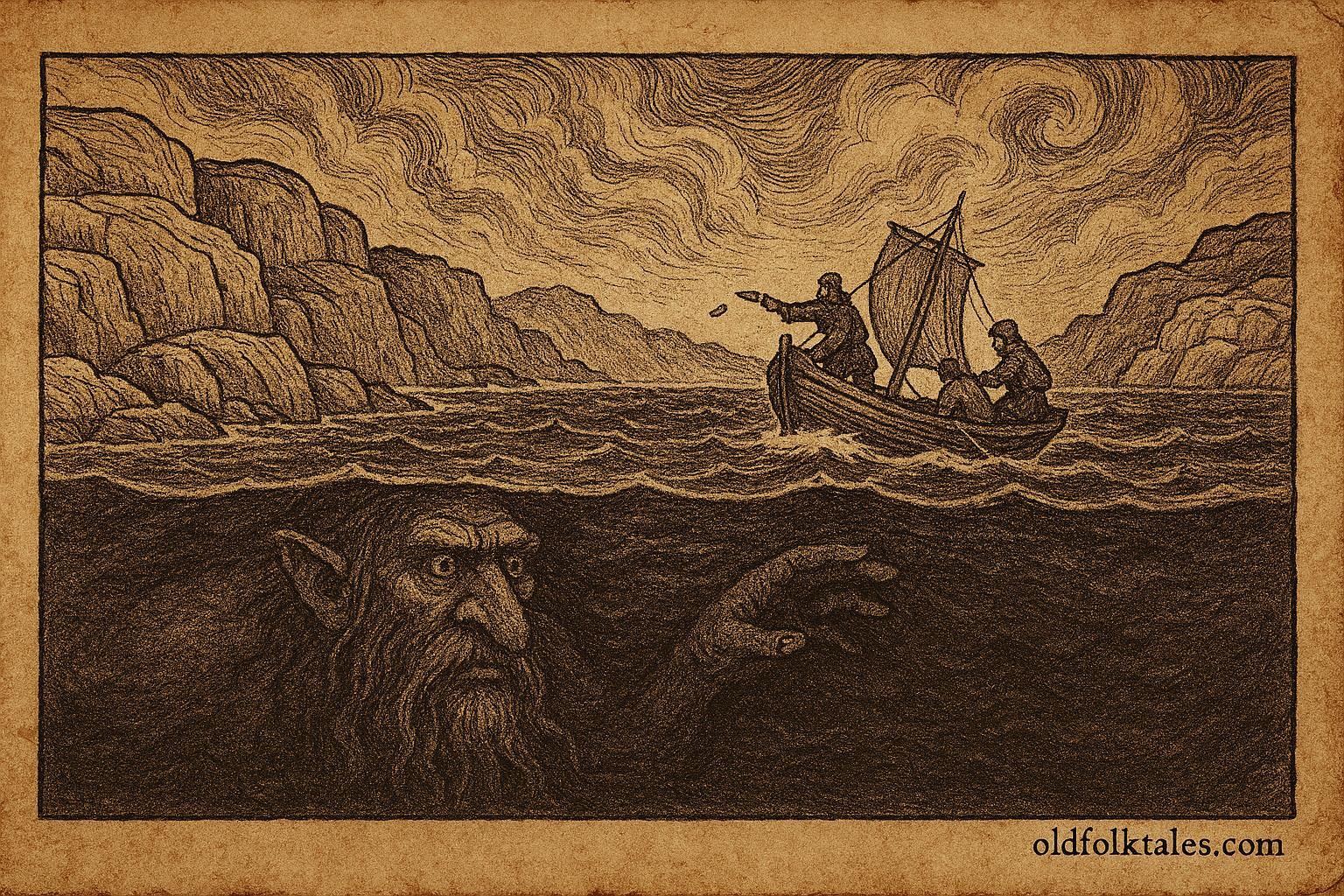
Some described him as vast and barnacle-covered, his beard tangled with seaweed, eyes glowing green like deep-water light. Others claimed he appeared only as a shadow beneath the hull, a sudden swell where no wind blew.
Whatever form he took, his temper was tied to the conduct of those who sailed above him.
If respected, the waters remained calm.
If insulted, storms followed.
The Custom of Offering
Before each season’s first voyage, the fishermen gathered at the edge of the harbor. One by one, they cast small offerings into the waves, bread, a splash of ale, sometimes a coin.
It was not worship.
It was acknowledgment.
A reminder that no man commands the sea.
The offerings sank quietly.
And more often than not, the boats returned safely with nets heavy and hulls intact.
But as years passed, prosperity grew.
New boats were built, larger and stronger. Nets improved. Catches increased.
With success came confidence.
And with confidence, carelessness.
The Mockery
One summer, a young fisherman named Anders began to boast openly.
“There is no troll beneath these waters,” he laughed one morning as the older men prepared their offerings. “Only wind and tide.”
He refused to cast bread into the sea.
Instead, he flicked a pebble carelessly overboard.
“Let the troll eat stone,” he joked.
Some of the older fishermen frowned.
The sea lay still that morning, too still.
They sailed regardless.
At first, the day was fair. The sun glinted off calm waters. Nets filled quickly.
Anders smirked at the superstition of his elders.
But as afternoon waned, the horizon darkened.
Clouds rolled in without warning. The air thickened. The sea shifted from glass to iron in moments.
A swell rose beneath Anders’ boat, not from wind, but from below.
His hull shuddered violently.
From the depths came a sound like grinding rock.
Then the storm struck.
The Storm Stirred from Below
The wind howled across Bohuslän’s cliffs. Waves rose like moving walls. Boats pitched and groaned.
But the strangest thing was this: the storm circled primarily around Anders’ vessel.
Other boats battled fierce waves, yet his seemed hunted.
A shadow moved beneath him, vast and deliberate.
The water swelled upward, lifting the boat at an unnatural angle before dropping it hard against the sea’s surface.
His mast cracked.
His nets were torn away.
Panic replaced pride.
“Please!” he shouted into the wind. “Spare us!”
But the sea answered only with thunder.
The other fishermen, though battered, managed to steer toward harbor.
Anders’ boat struggled alone against something unseen.
The Plea
In desperation, Anders remembered the old words.
He reached into his satchel and pulled out the bread he had brought for his own meal.
With trembling hands, he cast it into the waves.
“I meant no disrespect!” he cried. “I give thanks!”
The bread vanished instantly.
For a moment, nothing changed.
Then the swell beneath his boat eased.
The shadow drifted deeper.
The storm did not cease at once, but it no longer seemed aimed at him.
With broken mast and damaged hull, Anders barely reached harbor before darkness fell.
He staggered ashore humbled, soaked, and shaken.
The Lesson of the Cliffs
The next morning, wreckage from his boat washed against the rocks. The damage was undeniable.
No one laughed.
The elders said little. They did not scold.
They simply returned to their custom.
Bread into the sea.
Ale poured quietly over the bow.
From that day forward, Anders never failed to give offering.
Nor did he mock what he could not see.
For along the rocky coast of Bohuslän, survival depends not only on skill, but on humility.
The sea is older than men.
And what lives within it demands respect.
The Meaning of the Sea Troll
The Sea Troll of Bohuslän is not merely a monster of waves.
He represents the unpredictable force of nature.
He is the embodiment of the sea’s power, its capacity to provide and destroy.
The offerings symbolize gratitude. The ritual enforces humility. The storm reminds fishermen that arrogance courts disaster.
In maritime folklore across Scandinavia, spirits of water reflect human conduct. Disrespect invites peril. Balance preserves life.
And so the tale endures, not as superstition, but as warning.
Moral Lesson
The Sea Troll of Bohuslän teaches that nature must be approached with humility and gratitude. Greed and mockery invite ruin, while respect ensures survival. The sea gives—but only to those who honor its power.
Knowledge Check
1. Where does this folktale originate?
The western coastal province of Bohuslän in Sweden.
2. What does the sea troll symbolize?
The unpredictable and powerful forces of nature.
3. Why do fishermen cast offerings into the sea?
To show respect and acknowledge the sea’s authority.
4. What happens when Anders mocks the tradition?
A violent storm targets his boat, nearly destroying it.
5. What theme is central to this maritime legend?
Humility before nature and respect for tradition.
6. In which collection was the legend later popularized?
Bland tomtar och troll, first published in 1907.
Source: Early Scandinavian maritime folklore traditions; later popularized in Bland tomtar och troll (1907).
Cultural Origin: Western coastal Sweden (Bohuslän).