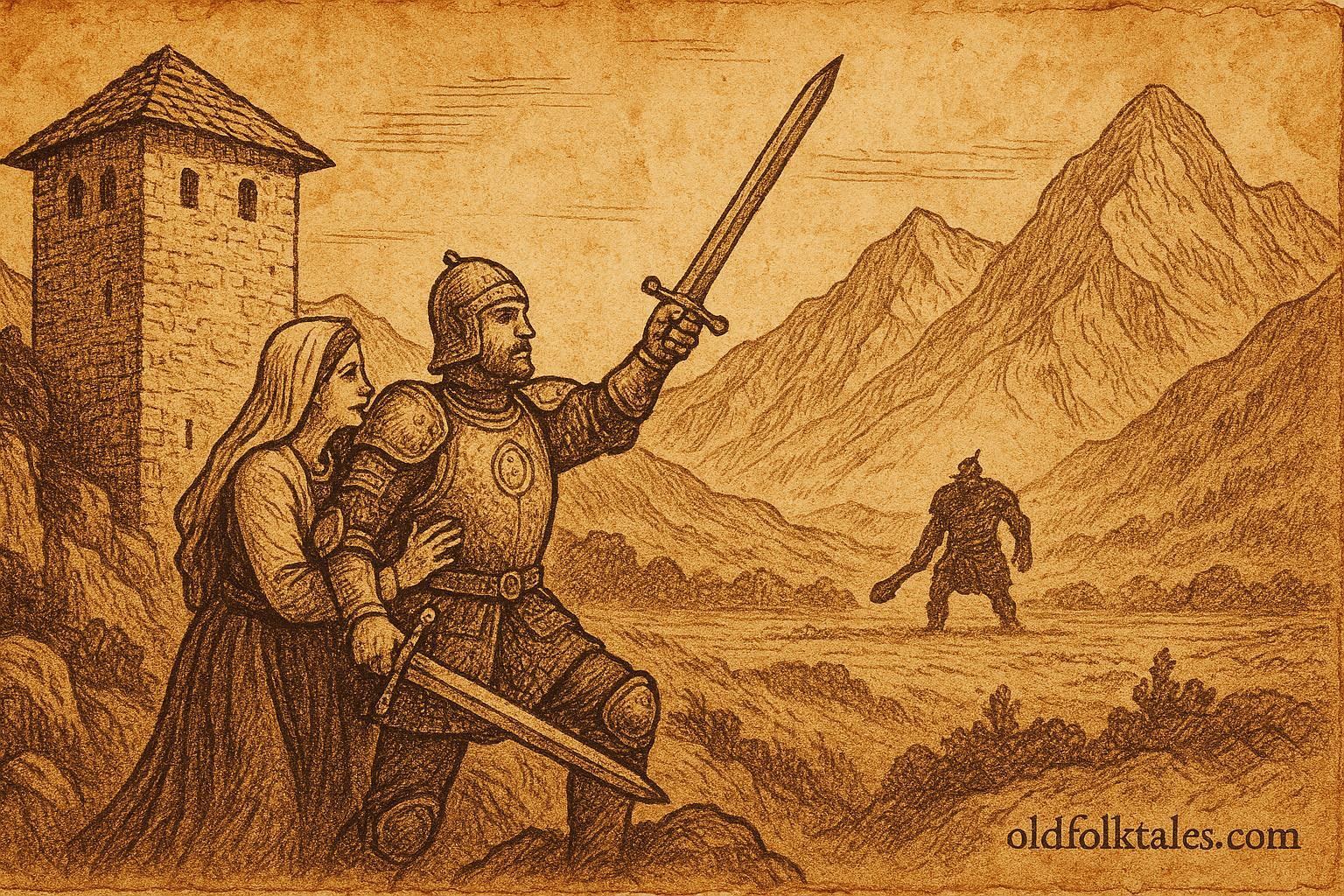
In the rugged highlands of northern Albania, where stone towers rise above deep valleys and mountain winds carry the sound of ancient songs, there lives one of the most powerful heroes of the Albanian epic cycle: Gjergj Elez Alia.
His story belongs to the Epic Cycle of the Kreshniks, the heroic frontier warriors of Albanian oral tradition. It was later recorded and presented to modern readers by Robert Elsie in Albanian Folktales and Legends. Yet long before it was written, it was sung by lahuta players in mountain gatherings, passed from one generation to the next as a testament to honor, endurance, and sacrifice.
Step into the enchanted forests and mystical realms of the Slavic imagination
This is the story of a man who rose from nine years of suffering to fight one final battle.
The Wounded Hero
Gjergj Elez Alia was once among the greatest of warriors. His name carried weight across the mountains. He had defended borders, protected villages, and stood firm where others faltered.
But in a terrible battle, he was struck by nine grievous wounds.
The injuries did not kill him, but neither did they heal.
For nine years he lay in his stone tower, unable to rise. His body bore pain like iron embedded in flesh. His strength, once legendary, seemed reduced to memory.
Only one person remained faithfully at his side: his sister.
She tended his wounds. She brought water. She kept vigil through winters of biting cold and summers of relentless heat. She spoke gently to him when the pain was unbearable. She did not abandon him.
The tower stood quiet, as though holding its breath.
The Threat to the Land
While the hero lay wounded, word spread of a monstrous invader approaching the region.
A great foreign warrior, described in the epic as towering, fierce, and merciless, rode toward the highlands demanding tribute. Villages trembled. Men feared confrontation. None dared challenge him.
He sent a message:
Either send a maiden as tribute, or face destruction.
Fear gripped the community.
The people gathered in despair.
There seemed no champion left among them.
And so, the demand reached the tower of Gjergj Elez Alia.
The Sister’s Tears
His sister entered the room where he lay and wept.
He heard her sorrow and forced his voice to rise.
“Why do you weep?” he asked.
She tried to remain silent. But grief cannot be hidden long.
She told him of the invader. Of the tribute demanded. Of the shame and terror spreading among their people.
She feared the foreign warrior would claim her.
She feared dishonor for the entire land.
The hero lay still.
For nine years he had not stood.
For nine years his wounds had bound him to the bed.
But something stronger than pain stirred within him.
Honor.
Rising from Nine Years of Pain
Gjergj Elez Alia asked for his armor.
His sister protested.
“You cannot stand,” she said. “Your wounds will reopen.”
But he answered firmly:
“If I do not rise, who will?”
Slowly, agonizingly, he lifted himself from the bed.
The effort alone seemed to shake the tower walls.
His wounds burned. His limbs trembled. Blood seeped from scars long dormant.
Yet he stood.
His sister armed him piece by piece. Helmet. Sword. Shield.
Each movement cost him strength.
But each step forward restored something deeper than muscle, his identity.
He was not merely a wounded man.
He was a defender of his people.
The Battle
The monstrous invader waited in the open field.
When Gjergj Elez Alia approached, even the enemy marveled at the sight of a man so pale and marked by suffering stepping forward to challenge him.
The duel began.
Steel struck steel.
The ground shook beneath their force.
Gjergj fought not with the vitality of youth, but with the resolve of one who has already endured death many times in spirit.
The invader’s blows were fierce.
Gjergj’s were precise.
Though weakened, he drew upon nine years of pain and turned it into fury.
At last, with a final surge of strength, he struck down the monstrous foe.
The invader fell.
The land was freed.
The Final Sacrifice
Victory, however, did not restore what had been lost.
Gjergj Elez Alia stood wounded beyond recovery.
The strength that had lifted him from his bed now drained away.
He returned to his tower, not in triumph, but in fulfillment.
He had done what honor required.
He lay once more upon his bed.
This time, he did not rise again.
The sister who had tended him for nine years mourned him. The people honored him. Songs were composed to carry his name through centuries.
He had given everything, his strength, his final breath, for his homeland.
And that is why his name endures.
The Meaning of Gjergj Elez Alia
In the Epic Cycle of the Kreshniks, heroes embody more than physical strength. They represent moral obligation to community.
Gjergj Elez Alia’s nine wounds symbolize prolonged suffering and endurance. His rise represents resilience beyond physical limitation. His death affirms that true heroism is not survival, it is sacrifice.
He fights not for glory.
He fights because no one else can.
And that is enough.
Moral Lesson
Gjergj Elez Alia teaches that honor demands action even in the face of overwhelming pain. True heroism lies not in invincibility, but in rising when one’s community calls—no matter the personal cost.
Knowledge Check
1. Where does the story of Gjergj Elez Alia originate?
Northern Albania, within the Epic Cycle of the Kreshniks.
2. How long did the hero lie wounded?
Nine years.
3. Who remained loyal to him during his suffering?
His devoted sister.
4. Why did he rise from his bed?
To defend his people from a monstrous invader demanding tribute.
5. What is the central theme of the legend?
Honor, sacrifice, and defense of homeland.
6. Who recorded this epic for modern audiences?
Robert Elsie in Albanian Folktales and Legends (2001).
Source: Robert Elsie, Albanian Folktales and Legends, 2001.
Cultural Origin: Northern Albania (Epic Cycle of the Kreshniks).