Along the stony coastlines and island villages of Croatia, where the Adriatic glitters beneath vast skies, old tales once traveled by word of mouth from hearth to harbor. Among the most luminous of these stories, recorded in the nineteenth century within South Slavic collections by Vuk Karadžić and preserved in Croatian Dalmatian oral tradition, is the legend of the Sun Bridegroom.
It is a story of love that reaches beyond earth, of a promise broken, and of a journey across the wide fabric of the cosmos.
The Girl Who Looked Toward the Sky
In a small coastal village bordered by olive groves and white stone houses, there lived a girl whose beauty was matched only by her quiet wonder. While others watched the sea, she often gazed upward.
At dawn, she admired the first golden rays cresting the hills. At midday, she felt warmth settle gently on her face. At sunset, she lingered long after others had gone indoors, watching the sky blaze with fire.
The villagers would say, half in jest, “Take care, child. If you stare too long at the Sun, he may claim you.”
She would smile, but something in her heart stirred.
The Proposal from the Sky
One summer, when the air shimmered with heat and cicadas sang in the fig trees, a stranger came to the village.
He was radiant in presence, though dressed simply. His eyes seemed to hold light within them.
He approached the girl’s family with a formal request.
“I seek your daughter’s hand,” he said.
The parents were astonished. “Who are you?”
“I am the one who warms your fields and guides your days.”
Understanding dawned slowly.
The stranger was no mortal man.
He was the Sun.
Fear and awe mingled in the household. Yet the girl felt no dread. She felt recognition, as though something long promised had arrived.
After counsel and wonder, the marriage was agreed.
The Celestial Palace
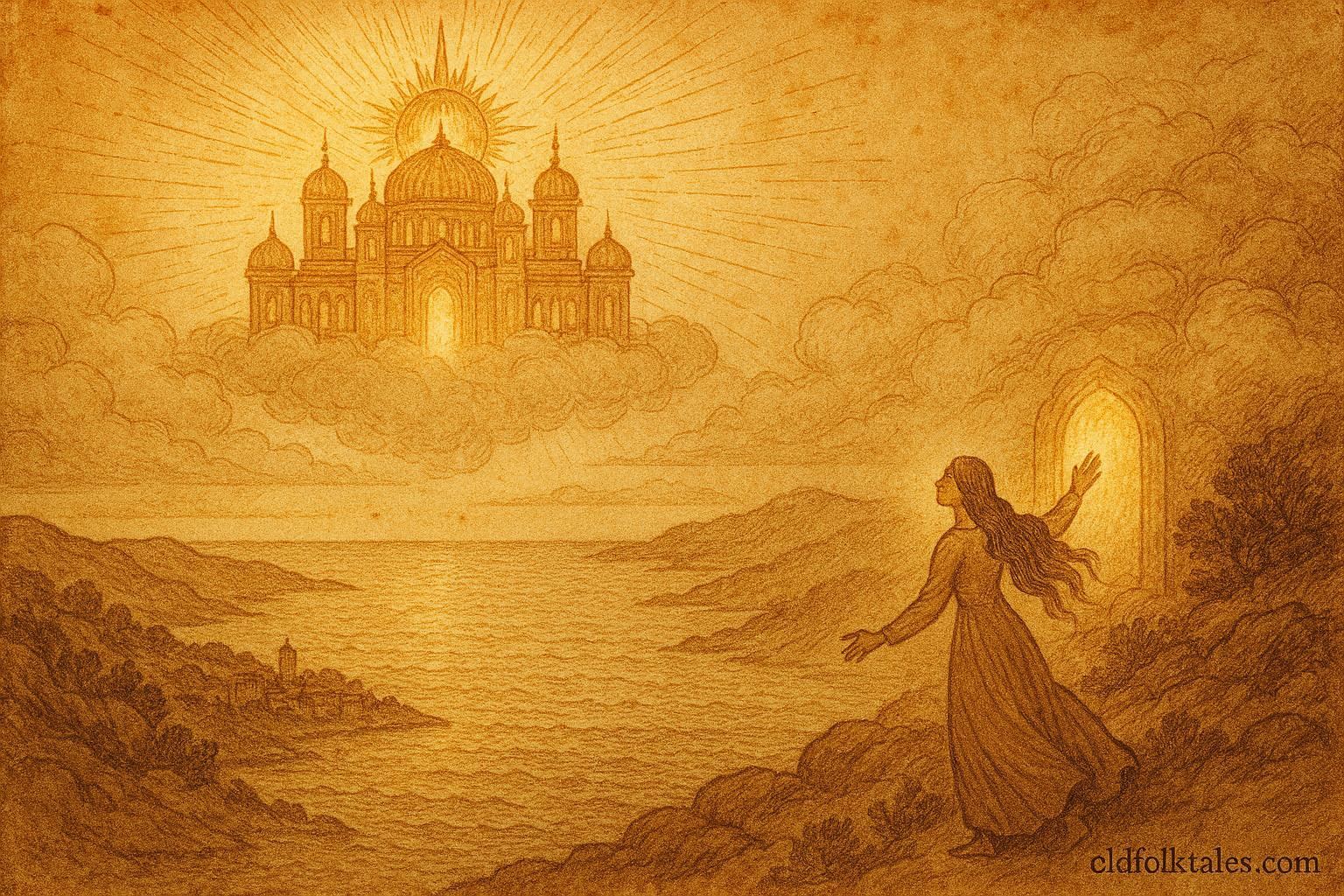
On the morning she departed, the sky glowed brighter than ever before. A path of light seemed to stretch from earth upward.
The Sun Bridegroom took her hand.
Together they ascended beyond cloud and air to a palace of brilliance suspended in the heavens. Its walls shimmered like molten gold. Its halls echoed with warmth. From its windows she could see mountains, seas, and villages far below.
The Sun spoke gently.
“You shall dwell here in joy. But heed one command: do not open the chamber at the western edge of the palace.”
He did not explain further.
She agreed.
For a time, she lived in splendor. She walked radiant corridors. She watched the turning of seasons from above. She felt both beloved and honored.
Yet the forbidden chamber lingered in her thoughts.
The Breaking of the Rule
Curiosity grows strongest where knowledge is withheld.
One day, when the Sun traveled his daily path across the sky, she stood before the western door.
Her heart beat quickly.
She told herself she would only look briefly.
She opened it.
Inside lay a vast darkness unlike the warmth of the palace. Within that shadow she glimpsed suffering on earth, fields scorched by drought, storms unrestrained, human grief illuminated too starkly by light.
The chamber held the balance of day and consequence.
By opening it, she disrupted the harmony meant to remain unseen.
The door slammed shut.
At once, the palace dimmed.
When the Sun returned, sorrow touched his luminous face.
“You have broken the sacred order,” he said quietly. “You must leave until balance is restored.”
In an instant, she found herself cast back to earth.
The Long Journey
She awoke upon a distant shore, far from her village.
The warmth she once felt at her side was gone.
Determined to seek forgiveness, she began to wander.
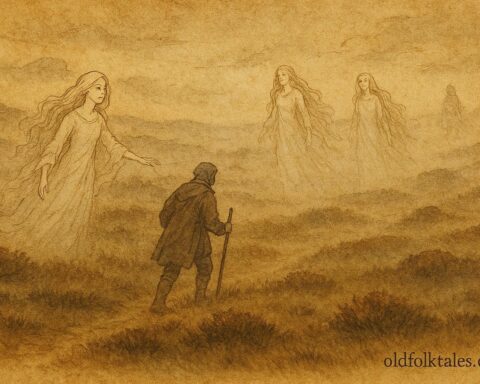
She crossed forests and climbed mountains. She endured hunger and cold. In lonely valleys she wept, not for lost splendor, but for broken trust.
Along her path she encountered helpers.
An old woman at a crossroads gave her a spindle that spun thread of light. A shepherd offered bread and guidance toward the east. A bird, bright as flame, told her to follow the rising dawn.
Each helper appeared briefly, offering what she needed, then vanished.
The journey tested not her strength alone, but her humility.
Trials of the Elements
To reach the Sun once more, she had to pass through realms governed by wind, cloud, and fire.
In the land of storms, she learned patience, waiting until tempests subsided.
In the valley of night, she trusted faint starlight rather than fear.
At the edge of flame, she did not recoil but stepped forward with steady heart.
Each trial restored a fragment of the balance she had disturbed.
Her love matured, from admiration into understanding.
Reunion
At last, she reached the horizon where earth meets sky.
The Sun descended slowly toward her.
He did not blaze as before; his light softened.
“You have learned,” he said.
She bowed her head.
“I sought knowledge without wisdom,” she answered. “I understand now that love requires trust.”
The Sun extended his hand once more.
This time, their union was not one of wonder alone, but of mutual respect.
She returned to the celestial palace, not as a curious girl, but as a partner aware of cosmic order.
The western chamber remained closed.
And she did not approach it again.
The Meaning of the Sun Bridegroom
In Dalmatian and broader South Slavic oral tradition, celestial marriage symbolizes the union between mortal fragility and cosmic power.
The forbidden chamber represents boundaries necessary for harmony. The journey embodies repentance and growth. Magical helpers reflect divine guidance offered to those who seek redemption sincerely.
The tale teaches that obedience is not blind submission, but respect for balance greater than oneself.
Moral Lesson
The Sun Bridegroom teaches that love requires trust and humility. Curiosity without wisdom brings consequence, but sincere repentance and perseverance restore harmony.
Knowledge Check
1. Where does this folktale originate?
Croatia, within Dalmatian and broader South Slavic oral tradition.
2. Who recorded related South Slavic folktales in the 19th century?
Vuk Karadžić.
3. What sacred rule does the bride break?
She opens a forbidden chamber in the Sun’s palace.
4. What must she do after breaking the rule?
Wander distant lands seeking forgiveness.
5. What themes define the story?
Obedience, consequence, love, and redemption.
6. What do the magical helpers symbolize?
Guidance and divine assistance during repentance.
Source: South Slavic collections recorded by Vuk Karadžić (1815–1841 publications); Croatian variants preserved in 19th-century Dalmatian oral tradition.
Cultural Origin: Croatia (Dalmatian and broader South Slavic oral tradition).