Long ago, in the rolling hills and deep forests of Hungary, there lived a young hero named Miklós. Known for his quiet strength and thoughtful nature, he often wandered the wildlands, tending his tasks and helping those in need. Yet fate, as it often does in the tales of old, drew him into a peril beyond human comprehension: he fell into a hidden chasm and found himself trapped in the underworld, a shadowed realm of jagged rocks, narrow tunnels, and eerie half-light that seemed to drain courage from the heart of any mortal.
Days passed as Miklós wandered, searching for a path upward. He had heard whispered stories of travelers lost forever in this world below, their spirits fading like mist in morning sunlight. Hunger and exhaustion gnawed at him, but his resolve did not waver. In the dim distance, he noticed movement, shapes larger than any bird, yet smaller than mountains, nestled in a rocky hollow. As he drew closer, he realized they were the chicks of a mighty griffin, the legendary griffmadár, whose golden feathers shimmered even in the dim light of the underworld.
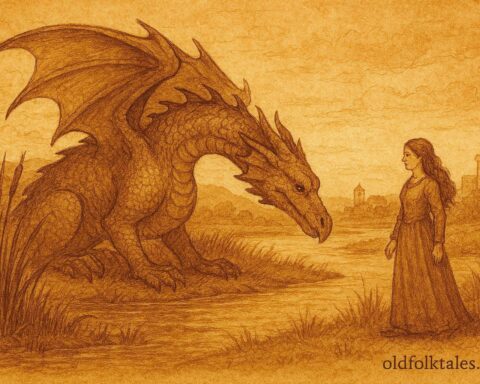
But danger stalked the shadows. A fearsome dragon, scales glinting with firelight, had discovered the griffin’s nest and sought to devour the young. Miklós’ heart surged with a mixture of fear and determination. Though the dragon dwarfed him in size and might, he knew he could not turn away. Summoning every ounce of courage, he leapt into the fray, using his wits and agility to divert the dragon. He guided the griffin chicks to safety beneath the crevices of the rock, where the dragon’s fiery breath could not reach them.
The battle was tense, each second stretching like hours. Miklós dodged snapping jaws and scorching claws, remembering the old tales of heroes who triumphed not through strength alone, but through cleverness, compassion, and daring hearts. At last, the dragon, frustrated and beaten by Miklós’ ingenuity, retreated into the dark tunnels, leaving the nest unharmed. Exhausted but resolute, Miklós sank to his knees, his chest heaving, and looked upon the griffin’s eyes. They were intelligent and radiant, filled with gratitude and recognition of his bravery.
The griffin, a towering creature with wings of gold and silver and eyes like molten amber, spoke in the language of the ancients, a voice felt more than heard. “Miklós,” it said, “you have saved my young. In return, I shall carry you back to the upper world, but the journey will demand courage, trust, and sacrifice. Are you willing to place your life in my wings?”
Miklós nodded, his resolve unshaken. “I will do what is needed to return to my people,” he said.
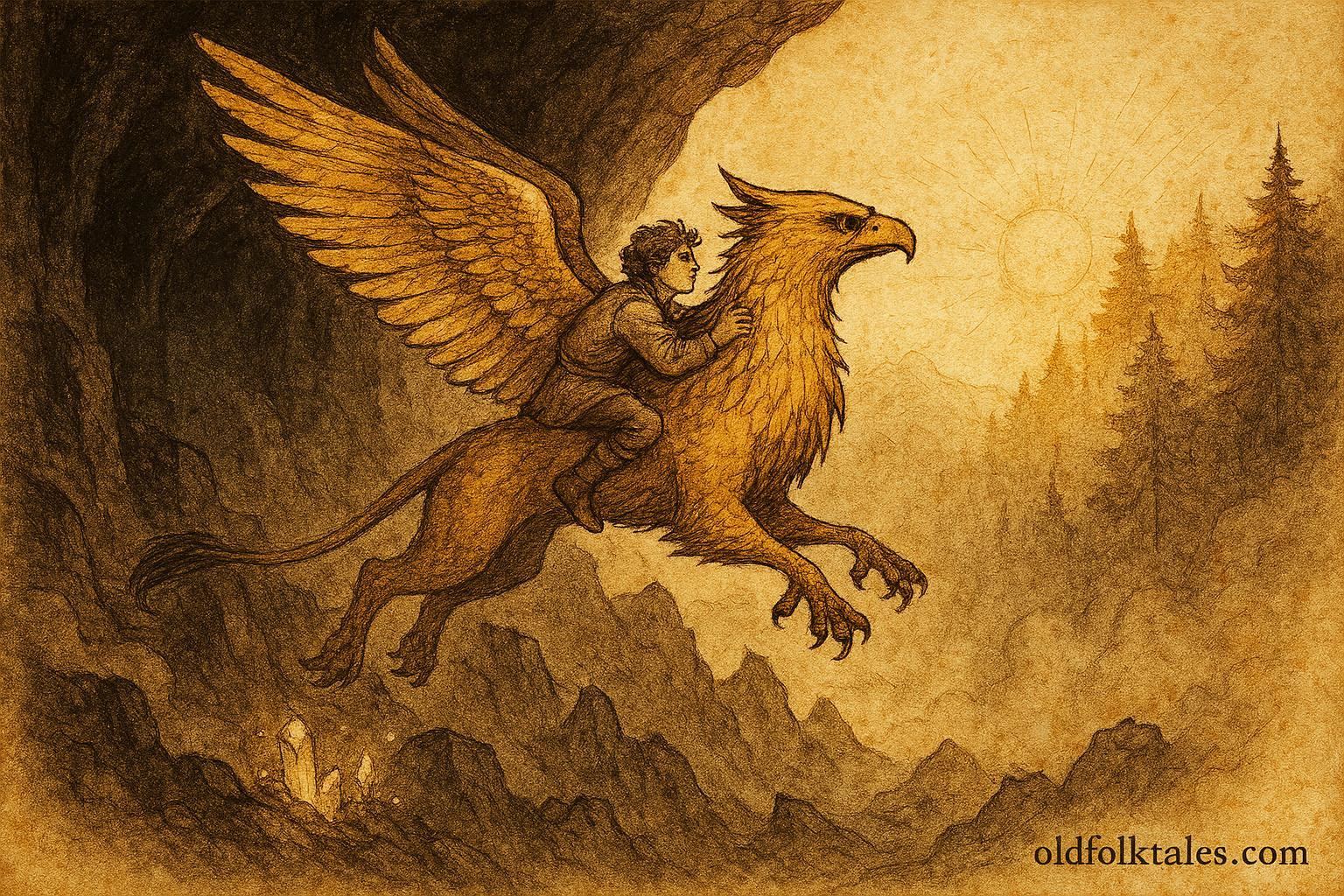
With a powerful sweep of wings, the griffin lifted him into the narrow shaft that led toward the surface. The ascent was treacherous. Jagged rock formations tore at the edges of the chasm, gusts of wind threatened to throw them off balance, and the air grew thinner with each surge upward. At moments, Miklós felt his strength failing, his limbs trembling from fear and exertion. Yet the griffin’s steady flight, the warmth of its golden feathers, and the memory of the lives he had saved kept him pressing onward.
Halfway to freedom, the griffin paused, hovering above a vast underground cavern, filled with roiling mist and glowing crystals. “Miklós,” it said, “there is one task more. To ascend fully, you must relinquish your pride and give up something precious, as a token of trust. Only through sacrifice may the bonds between us remain strong.”
Miklós thought of his family, his home, and the life he had momentarily left behind. But he realized that the greatest gift he could give was humility, his willingness to trust in forces greater than his own strength. Closing his eyes, he unclenched his fists, letting go of all fear, hesitation, and pride, offering the griffin his obedience and faith.
The creature roared, a sound like thunder rolling across mountains, and then surged upward with renewed force. The walls of the chasm fell away, replaced by open skies, the scent of pine forests, and the first rays of the sun glimmering over the horizon. Miklós, awed and exhilarated, realized he had returned to the surface, alive and transformed. His heart, strengthened by fear, compassion, and humility, had grown wiser in the shadowed depths of the underworld.
The griffin lowered him gently to the forest floor, its eyes meeting his. “Remember, hero,” it said, “courage and compassion are the wings that carry mortals beyond the limits of fear. Honor life, protect those who cannot protect themselves, and you shall always find allies in unexpected places.”
Miklós thanked the griffin, watching as it spread its immense wings and soared into the open sky, glinting like a living sun against the morning light. From that day forward, he shared the story with all who would listen, teaching that true heroism is measured not by personal glory, but by the courage to act for others, the humility to trust, and the willingness to face peril with a pure heart. The legend of Miklós and the griffin became one of the enduring tales of the Hungarian countryside, inspiring generations to come.
Moral Lesson
The tale teaches that courage and compassion, combined with humility and trust, are more powerful than brute strength. True heroism involves selflessness, protection of the vulnerable, and faith in forces beyond oneself. Acts of kindness often invite reciprocity, even from the most formidable and mystical allies.
Knowledge Check
-
Who is the hero of the story?
-
Answer: Miklós, a young Hungarian shepherd.
-
-
Which creature does Miklós save in the underworld?
-
Answer: The griffin’s chicks.
-
-
What challenge must Miklós face to return to the upper world?
-
Answer: He must trust the griffin, endure a dangerous ascent, and make a personal sacrifice.
-
-
What qualities does the tale emphasize for overcoming peril?
-
Answer: Courage, compassion, humility, and selflessness.
-
-
What role does the griffin play in the story?
-
Answer: Protector and guide, rewarding Miklós’ bravery by helping him escape the underworld.
-
-
What is the cultural origin and source of the tale?
-
Answer: Hungarian folklore; traditional motif recorded in 19th-century collections (c. 1885).
-
Source: Traditional Hungarian folktale motif recorded in 19th-century collections (c. 1885)
Cultural Origin: Hungary (Magyar folklore influenced by Eurasian mythic imagery)