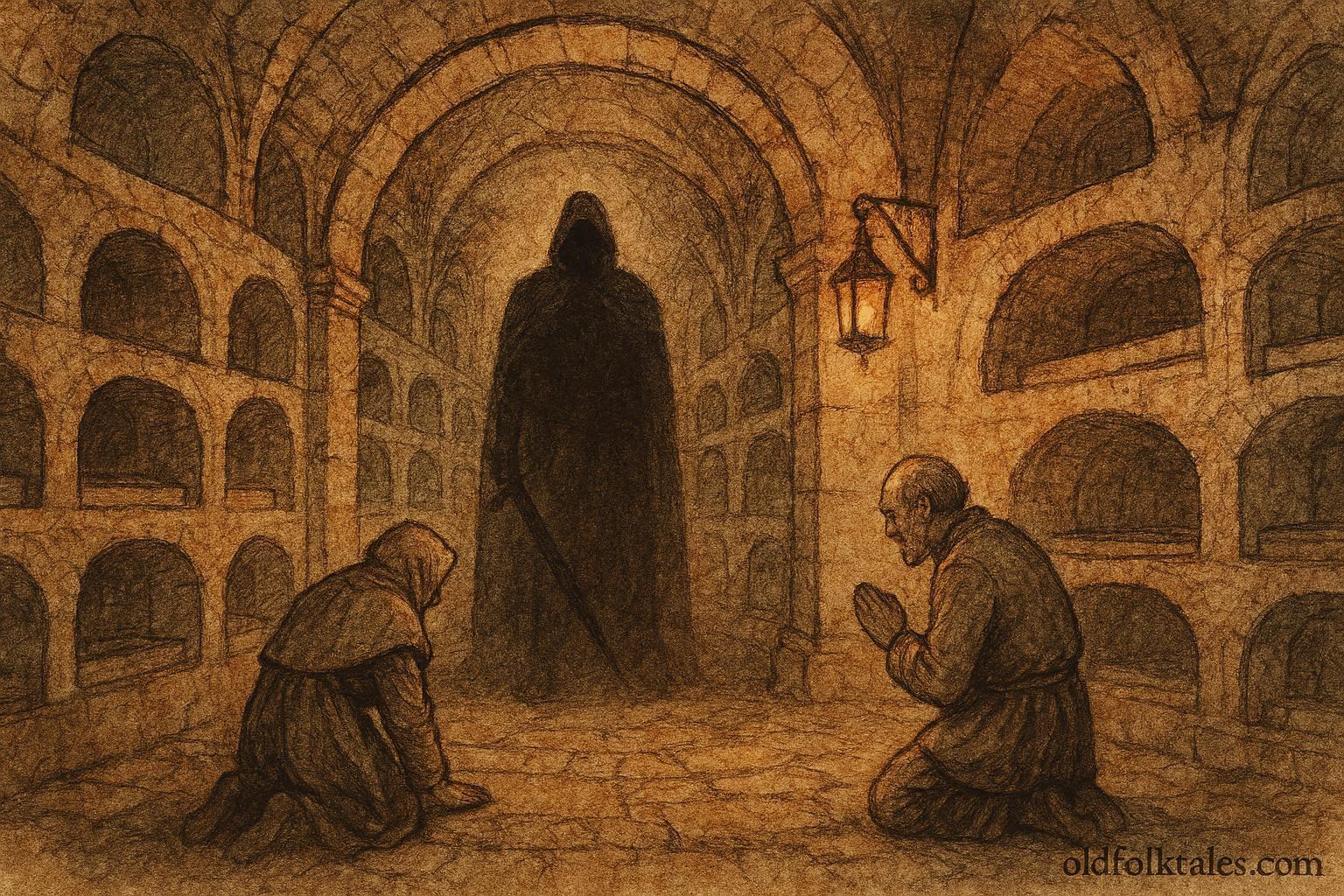
Beneath the quiet streets of Rabat, where limestone houses glow honey-gold in the Mediterranean sun, there lies another world, cool, silent, and carved into stone. The ancient catacombs, linked to Malta’s early Christian past, stretch in winding corridors beneath the earth. Niches line their walls. Arched chambers open into shadow. Air hangs heavy with stillness. For generations, the people of Rabat believed these underground passages were not empty. They spoke in lowered voices of Il-Ħares tal-Katakombi, the Guardian of the Catacombs.
No one claimed to have seen him clearly. Some said he was a tall shadow that moved against the torchlight. Others whispered he was felt rather than seen, a sudden chill, a sense of being watched, the echo of footsteps where none should be. He was not a monster, nor a wandering ghost. He was something older in spirit: a protector.
Discover the moral heart and wild spirit of the north through timeless Nordic storytelling
The elders taught that the catacombs were sacred ground. The dead rested there in peace, placed carefully in stone niches by grieving hands many centuries before. Families once gathered there to pray and remember. These were not empty caves but holy spaces shaped by faith and memory.
And sacred places demand respect.
The stories began long ago, when the tunnels were less explored and fear of the unknown lived close to the heart. Travelers who entered the catacombs out of curiosity sometimes returned pale but unharmed. They spoke of strange echoes and confusing turns, yet they found their way back to daylight.
But there were other tales.
It was said that men who entered with greedy intent, seeking relics, trinkets, or imagined treasure, met a different fate.
One such story tells of two men from a neighboring village who heard rumors that valuables had once been buried with the dead. They scoffed at the warnings of the Rabat villagers.
“Spirits?” one laughed. “Shadows cannot stop us.”
They entered the catacombs at dusk, carrying lanterns and tools. At first, the corridors seemed simple enough, low ceilings, cool walls, orderly rows of carved resting places. Their laughter echoed loudly, disrespectful in the hollow space.
But as they ventured deeper, the tunnels seemed to change.
Passages that had appeared straight now curved unexpectedly. Chambers that should have led outward opened into further branching corridors. Their lantern light flickered though no wind stirred.
“Did we pass this arch before?” one muttered.
They turned left, then right, retracing steps, or so they thought. Yet the stone walls seemed unfamiliar. The silence grew oppressive, broken only by the uneven rhythm of their own breathing.
Hours passed.
The air felt heavier. The flame of their lantern dimmed. One man swore he saw movement at the edge of the light, a tall shape slipping behind a column. The other insisted it was imagination.
But neither could explain why every path led them deeper instead of outward.
Panic replaced bravado.
Their voices, once loud with mockery, grew strained. “We should leave,” one whispered.
“We are trying,” the other snapped.
They walked faster. Then slower. They marked walls with chalk, only to discover the marks vanished, or appeared in places they had not yet visited.
The tunnels had become a maze without mercy.
At last, exhausted and trembling, they sank to their knees in one of the burial chambers. Surrounded by the silent resting places of the dead, their arrogance dissolved.
“We meant no harm,” one cried into the darkness.
“We were foolish,” the other admitted. “Forgive us.”
The catacombs answered with silence.
But the air shifted.
Their lantern flame steadied. A faint draft brushed past them, not cold, not hostile, but guiding. When they rose and followed the subtle current, they found themselves moving along a corridor they were certain they had not seen before.
This passage sloped gently upward.
Moments later, they glimpsed something miraculous: the faint glow of evening light spilling down a stairwell.
They stumbled out into the open air just as night settled over Rabat. They did not speak of treasure again.
From that day forward, they warned others: the catacombs were not a place for greed.
In contrast, there were stories of those who entered with reverence, pilgrims, historians, villagers honoring ancestors. These people sometimes felt the same presence, but not as fear. Rather, it was a quiet awareness, as if unseen eyes ensured their safe passage.
A woman who went to pray for her departed father once told how she lost her sense of direction for a moment, only to feel compelled to turn back, and in doing so, she found the exit more quickly than expected.
An elderly man who guided visitors through the chambers said he always paused before entering, bowing his head slightly. “One must greet the guardian,” he would say. “Not aloud. In the heart.”
To the people of Rabat, Il-Ħares was not evil. He did not punish for cruelty’s sake. He corrected imbalance. He guarded the boundary between sacred and profane.
The catacombs represented more than stone corridors. They were a threshold between worlds, the living and the dead, the present and the ancient past. To cross that threshold without humility was to invite confusion. To cross it with respect was to walk safely.
Over time, as scholars documented Maltese traditions and folklore, the legend of the Guardian of the Catacombs found its place among the island’s stories. It was not merely a tale of fear, but of moral order.
Sacred space demands reverence.
Memory demands protection.
The dead demand dignity.
Even today, visitors who descend into the cool chambers beneath Rabat often remark on the stillness. Sound carries strangely. Footsteps echo longer than expected. The stone absorbs more than noise, it absorbs intention.
Whether one believes in spirits or not, the lesson lingers in the air.
Some say Il-Ħares still walks those corridors, not as a shadow to terrify, but as a silent reminder that certain places are not ours to claim, only to respect.
And so the legend endures beneath the Maltese sun, carved as deeply into cultural memory as the catacombs themselves are carved into stone.
Explore the warmth and wit of Mediterranean storytelling, where love and wisdom intertwine
Moral Lesson
This Maltese folktale teaches that sacred spaces must be treated with reverence. Disrespect born of greed leads to confusion and hardship, while humility and honor bring safe passage. Moral accountability extends beyond the visible world.
Knowledge Check
-
Who is Il-Ħares in Maltese folklore?
A guardian spirit believed to protect the sacred catacombs beneath Rabat. -
What happens to those who enter the catacombs with greedy intentions?
They lose their way in endless underground corridors until they repent. -
How are respectful visitors treated?
They pass safely, often feeling guided rather than threatened. -
What do the catacombs symbolize in the story?
Sacred space, memory of the dead, and the boundary between worlds. -
What is the central theme of the legend?
Respect for the dead and moral accountability in sacred places. -
Where and when was this legend documented?
In Studies in Maltese Folklore (1964).
Source: Joseph Cassar Pullicino, Studies in Maltese Folklore (1964).
Cultural Origin: Rabat, Malta (linked to early Christian catacombs).