In the Highlands of Scotland, where mountains descend sharply into dark lochs and the Atlantic wind moves restlessly across the heather, there are waters that appear calm but are never truly still. The people of the glens learned long ago that not every ripple upon a loch is born of wind alone. Some disturbances rise from deeper, older forces. Among these is the each-uisge, the water horse.
Unlike the kelpie of rivers and burns, the each-uisge is said to haunt both freshwater lochs and the salt waves of the sea. It is a creature of shifting forms and patient hunger, a spirit as ancient as the mist that curls along the Highland shores.
Those who have lived near lonely waters speak of it in quiet voices.
It does not always appear as a beast.
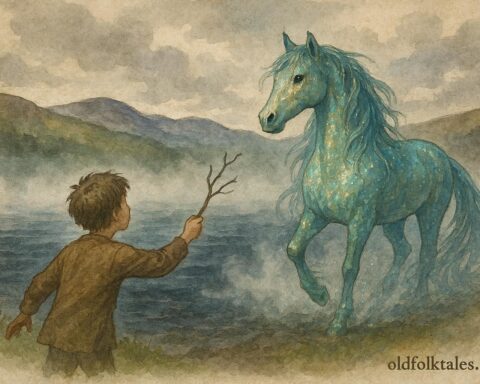
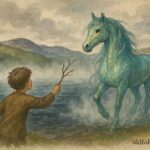
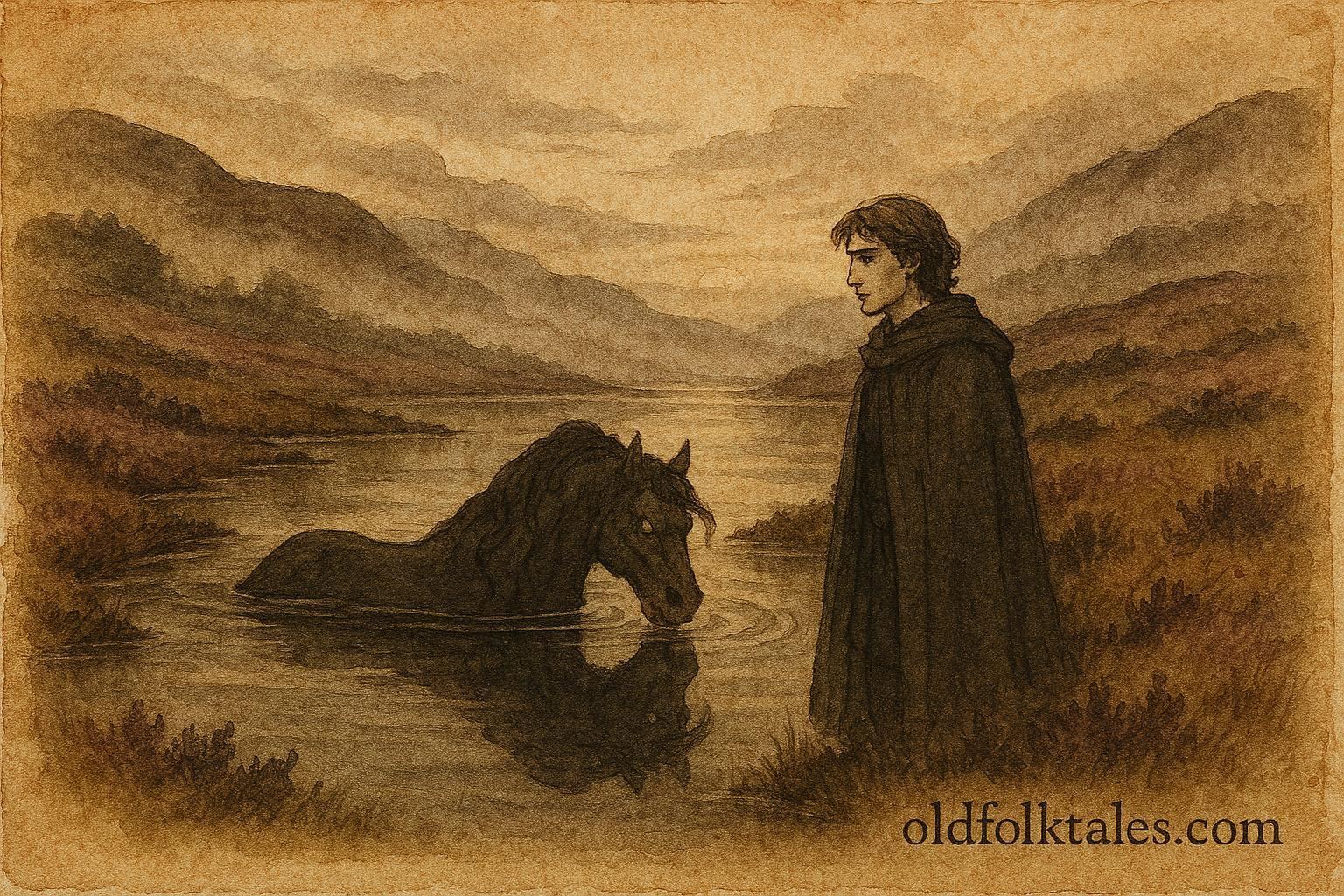
Often, it comes first as a horse, sleek, strong, and finer than any creature bred by mortal hands. Its coat gleams like wet obsidian. Its mane falls thick and dark against its neck. It stands untethered by the water’s edge, grazing peacefully as though it had wandered from some distant farm.
To the weary traveler or the curious child, such a sight stirs wonder rather than fear.
And therein lies the danger.
There was once, so the story goes, a young man from a croft near a lonely loch in the Western Isles. He was known for his boldness and for the restless spirit that often drew him toward the shore at dusk. Though elders warned him against lingering by the water after sunset, he laughed off their caution. He had walked the hills since boyhood. What harm could a quiet loch bring?
One evening, as the sky turned violet and the last light clung to the peaks, he saw a horse standing alone near the reeds. It was the finest creature he had ever beheld. No rope bound it. No mark of ownership showed upon its flank.
He approached slowly, murmuring soothing words.
The horse did not shy away. Instead, it lowered its head as if inviting his touch. Its skin, when he laid his hand upon it, felt warm and strangely smooth.
Too smooth.
For in some tellings of the each-uisge, it is said that once a man sets himself upon its back, his hands adhere to its hide as though fastened by unseen glue. The creature waits for that moment of trust, that shift of weight, that careless confidence.
But this young man had heard stories in childhood. Stories of horses that ran not upon earth but into the sea. Stories of riders carried screaming beneath dark waters.
As he moved to mount the animal, a flicker of unease stirred within him. He noticed then that though the horse stood near the loch, its hooves left no true impression in the damp ground. The reeds bent strangely around its legs, as if reluctant to touch it.
He stepped back.
In that instant, the horse’s calm demeanor shifted. Its eyes darkened, not with the softness of a grazing animal, but with something calculating and cold. Its lips drew back slightly, revealing teeth too sharp and too numerous for any earthly steed.
The young man did not hesitate again.
He fled toward the rise of land beyond the loch. Behind him, he heard a sound like tearing wind. When he dared to glance back, the horse was no longer a horse.
The form rippled and elongated. Its body grew grotesque, its mane twisting like seaweed in storm-tossed surf. Its face stretched into something neither fully beast nor wholly spirit. With a roar that seemed to churn the water itself, it lunged toward the shore.
But it did not pursue far.
For the each-uisge is bound to its waters. It may roam near them, tempt beside them, but it cannot long stray from the loch or sea that is its dwelling. The young man reached higher ground, breathless but alive.
Others were not so fortunate.
In another village, it is said that a stranger once appeared among the people, a handsome man with dark hair and eyes that shone like the depths of a winter tide. He spoke gently. He laughed easily. He danced at gatherings and earned the admiration of many.
One maiden in particular found herself drawn to him. He walked her often along the shore, where the waves curled against the rocks. His voice carried stories of distant places and hidden wonders beneath the sea.
Yet there were signs she did not at first understand.
His skin was cool, even in the warmth of summer. When he smiled, there was a flicker, brief and unsettling, behind his gaze. And always, always, he urged her closer to the water.
“Come,” he would say. “Let me show you where the tide pools shine brightest.”
It was her older brother who grew suspicious. Watching from a distance one evening, he saw the pair standing at the water’s edge. The stranger’s reflection upon the surface did not align with his human shape. Where the maiden saw a man, the water revealed something elongated and unnatural, like the shadow of a great horse shifting beneath the waves.
The brother shouted a warning.
Startled, the maiden stepped back. In that heartbeat of interruption, the stranger’s form shuddered violently. His hands tightened, not gently now, but with sudden force.
The brother rushed forward, seizing his sister’s arm and pulling her from the stranger’s grasp. The tide surged unnaturally high, crashing against the rocks in a spray of foam.
Before their eyes, the handsome figure dissolved into a monstrous shape, a great, dark water horse rising partially from the sea. Its mane lashed like wet kelp, its body gleaming and terrible. With a scream that mingled with the roar of the waves, it plunged back into the depths.
From that day, the villagers spoke openly of what they had nearly lost.
The each-uisge, they said, is more treacherous even than the river kelpie. It does not merely dwell in narrow streams but commands the vastness of lochs and open sea. It is stronger, more cunning, and less bound by simple patterns.
Some claim that if one cuts a piece from its bridle, should it appear bridled, or if one can seize control of it before mounting, the creature may be subdued. Yet such tales are rare and uncertain. More often, survival comes not through bravery but through recognition.
The wise in the Highlands teach that beauty alone should never earn trust. A fine horse by still water, a charming stranger who lingers too near the tide, these are not always blessings.
There are places in the Western Isles where the lochs lie dark and deep, their surfaces unbroken by even a ripple of fish. Fishermen avoid certain coves after dusk. Children are warned not to wander when the mist settles low and thick.
For the each-uisge waits.
It waits with patience older than the stone circles and the ruined brochs upon the hills. It waits for curiosity, for vanity, for the simple human belief that danger wears a monstrous face.
But in the Highlands, danger often wears beauty first.
And only those who question what they see, who heed the unease in their hearts and the wisdom of their elders, walk away from the water unharmed.
Moral Lesson
The Each-Uisge teaches that not all threats appear frightening at first glance. Deception often comes cloaked in beauty or charm. Vigilance, humility, and respect for ancient warnings are the safeguards that preserve life.
Knowledge Check
1. What is the each-uisge in Scottish folklore?
The each-uisge is a shape-shifting water spirit from the Highlands and Western Isles that appears as a horse or handsome stranger to lure victims.
2. How is the each-uisge different from a kelpie?
Unlike river kelpies, the each-uisge inhabits both freshwater lochs and the sea and is considered more powerful and dangerous.
3. What happens when someone mounts the water horse?
Victims become stuck to its back and are carried into deep water, where they meet a tragic fate.
4. What warning signs reveal the each-uisge’s true nature?
Strange reflections, unnatural behavior, cold skin, or unease near water can signal its deception.
5. What themes define this Highland legend?
Deception, danger of appearances, vigilance, and respect for nature’s power.
6. Where does the each-uisge legend originate?
It comes from the Highlands and Western Isles of Scotland.
Source: Adapted from Superstitions of the Highlands and Islands of Scotland (1900) by John Gregorson Campbell.
Cultural Origin: Highlands and Western Isles, Scotland.