In the far north of Scotland, where the land of Sutherland stretches wide beneath brooding skies and wind-swept moors, there was once a time when fear lay heavy upon the people. The hills were vast and beautiful, the lochs deep and silent, and the sea restless along the coast, but none of these stirred dread as did the creature that had taken hold of the land.
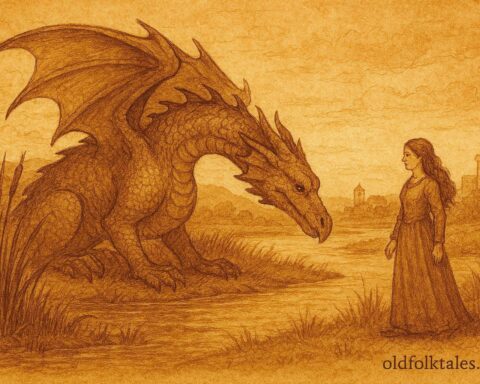
It was a dragon.
Not a creature of distant fairy-tale kingdoms, but a terror rooted in Highland soil. It was said to dwell among rocky crags and lonely glens near the lands of Co, a district watched over by its laird, a man known not only for his rank, but for his steady mind and fierce loyalty to his people.
Experience legends where mountains breathe magic and heroes face moral choices that shape destiny
The dragon had come without warning.
At first there were only whispers: sheep found scattered and lifeless upon the hillside; cattle missing from byres; scorched patches of earth where heather once bloomed. Shepherds spoke of a shadow passing over the sun, vast wings beating against the sky. Then came the sighting, long and scaled, coiling across a ridge at dusk, its eyes glinting like embers.
The creature descended upon fields and crofts alike. Its breath burned hot enough to blacken stone. Its roar rolled like thunder across the glen, sending livestock into panic and children running to hearthside shelter. Trade faltered. The roads emptied. No man dared travel alone.
The people looked to their laird.
The Laird of Co was not reckless. He did not boast of slaying beasts nor rush headlong into danger for the sake of glory. He listened first. He walked among his tenants, hearing their fears. He studied the land carefully, noting where the dragon struck and how it moved.
Some urged him to gather warriors and storm the crags at once. Others spoke of abandoning their homes until the beast moved on. But the laird understood something vital: brute force alone would not defeat such a creature. Strength must be matched with thought.
He rode out quietly one morning before dawn, accompanied only by a trusted servant. From a rise overlooking a narrow glen, he observed the dragon’s lair, a jagged cleft in the rock above a deep hollow. Below it ran a burn that cut sharply through the earth, forming steep banks and hidden trenches.
The laird watched for hours.
By midday, the dragon emerged. It did not fly immediately but crawled heavily down the slope to drink from the burn. Its scales flashed dull green and iron-grey in the light. Its movements were powerful, yet not swift upon the ground. The laird noticed how it favored certain paths, routes worn by repeated passage.
When he returned home, he summoned the strongest men of the district. He did not ask for blind courage; he explained his plan carefully.
They would not charge the dragon upon open moor. Instead, they would shape the land itself into a weapon.
Under the laird’s direction, the men labored in secrecy. They deepened the natural trench beside the burn, widening and concealing it with turf and brush. Stakes were driven into the earth at its base. Heavy timbers were positioned where the dragon would be forced to pass if driven from its lair.
The plan required patience.
On the chosen day, the laird rode alone toward the crags. He carried no banner, no shining armor to glint in the sun. Instead, he bore a strong spear and shield, and at his side hung a well-forged sword. His purpose was not to challenge the dragon in pride, but to provoke it.
He called out from below the lair, his voice echoing across the rocks.
The dragon stirred.
Its head rose first, then its long body uncoiled with dreadful grace. Smoke curled faintly from its nostrils. It saw the solitary figure below and descended, fury awakening in its glowing eyes.
The laird did not flee in panic. He retreated steadily, keeping just beyond the reach of flame. The dragon followed, enraged by the insult of defiance. It lunged forward, its great body crushing brush and stone alike.
Step by step, the laird led it toward the narrow glen.
At the burn, the dragon paused to breathe fire, scorching the ground where the laird had stood moments before. But its rage clouded caution. It pressed onward, heavy claws tearing at the earth.
Then came the misstep.
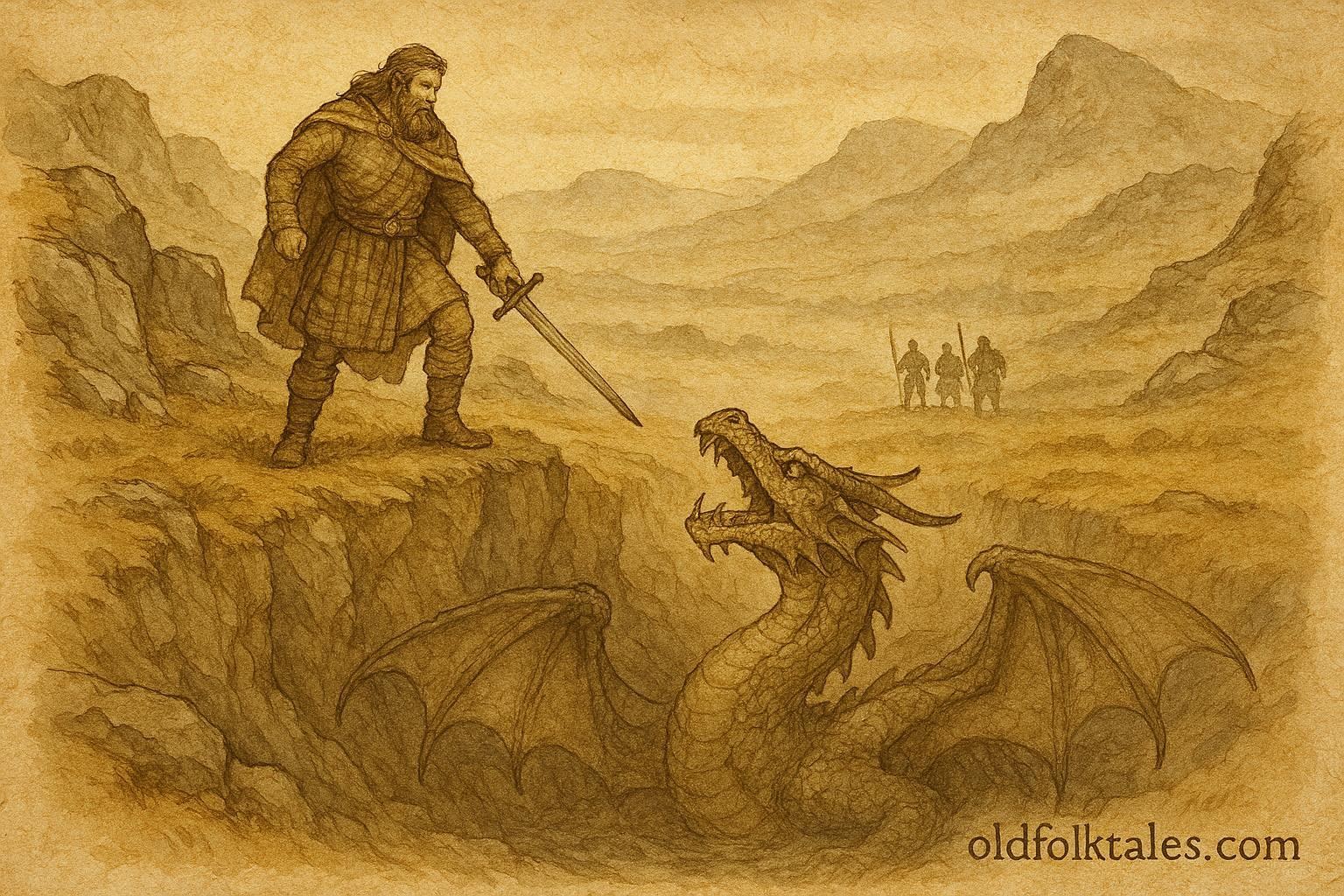
The concealed trench gave way beneath its weight. The dragon plunged forward, its bulk driving it down into the deepened hollow. Stakes pierced between its scales. Its wings flailed against the steep banks, unable to gain lift in the confined space.
At that signal, the hidden men of Co sprang from cover.
They did not scatter or shout wildly. They followed the laird’s command precisely. From above, they hurled stones and spears, striking at the creature’s head and neck where scales thinned. The dragon thrashed, roaring so fiercely that the hills seemed to tremble. Fire burst upward, but the narrow trench trapped much of the flame.
The laird descended the bank with steady resolve.
Seizing his moment, he drove his spear into the vulnerable place beneath the dragon’s jaw. The beast convulsed, its roar faltering into a ragged cry. Again he struck, this time with his sword, aiming where the neck met the chest.
At last, the dragon’s movements slowed.
The earth grew still.
Smoke drifted upward and faded into the Highland wind.
For a long moment, no one spoke.
Then the laird climbed from the trench, weary but unbroken. Around him, his people stared in astonishment, not only at the fallen beast, but at the manner of its defeat. It had not been conquered by reckless charge or single combat fueled by pride. It had been overcome by planning, unity, and courage guided by wisdom.
Word spread quickly through Sutherland. The terror that had shadowed the land was gone. Fields were reclaimed. Livestock grazed again without fear. Travelers returned to the roads.
The dragon’s remains, it is said, were left as a warning, a reminder that even the fiercest chaos can be subdued when a community stands together under steady leadership.
The Laird of Co did not boast of his deed. He returned to his duties, tending the land and people as before. Yet his name lived on in Highland telling, not simply as a dragon-slayer, but as a protector who understood that bravery alone is not enough, wisdom must guide it.
And in the quiet glens of Sutherland, when mist settles low and wind moves through the heather, some say the land still remembers the day when strategy triumphed over fire.
Journey into the charm of British wit and Irish wonder through centuries of folk tradition
Moral Lesson
The Laird of Co and the Dragon teaches that courage guided by wisdom is stronger than brute force. True leadership protects the community through careful thought, unity, and responsibility.
Knowledge Check
1. Who was the Laird of Co?
He was a Highland leader in Sutherland who protected his people by defeating a dragon through strategy rather than reckless combat.
2. How did the dragon terrorize Sutherland?
It destroyed livestock, scorched land with fire, and spread fear across the glens and moors.
3. How did the laird defeat the dragon?
He used planning and teamwork, luring the dragon into a concealed trench before striking at its weak point.
4. What themes are central to this Scottish legend?
Courage, leadership, protection of community, and triumph of wisdom over chaos.
5. What does the dragon symbolize in Highland folklore?
It represents destructive chaos and threats to stability within the community.
6. Where does this folktale originate?
It comes from Sutherland in the Northern Highlands of Scotland.
Source: Adapted from The Book of Scottish Story (1929) by Douglas Hyde, drawing from older Highland tradition.
Cultural Origin: Sutherland, Northern Highlands, Scotland.