In the green heart of Powys, where valleys fold gently between wooded hills and clear streams wind through meadow and moss, there lies a place long regarded as holy ground. The people of the region speak of it with reverence, for it is bound to the memory of a woman who chose solitude over splendor, peace over power. Her name was Melangell.
Long before her name was spoken in prayer, she was said to be of noble birth, the daughter of a king from across the sea. Her father had planned a marriage for her, an alliance meant to strengthen kingdoms and secure influence. But Melangell’s heart was not drawn to courtly life or earthly bonds. She desired instead a life devoted wholly to God, free from the constraints of royal expectation.
Explore the wit and wisdom of Western Europe, where humor and virtue often go hand in hand
When her father pressed her toward marriage, she made a decision that would shape her destiny. She fled.
Traveling far from her homeland, she crossed into the rugged beauty of Wales. There, in a secluded valley ringed by forested slopes and softened by birdsong and running water, she found refuge. It was a quiet place, untouched by the noise of courts or conflict. Here she built for herself a small cell of prayer and began to live in solitude.
For years, she remained hidden among the trees. She prayed, tended the land lightly, and lived simply, clothed in humility rather than silk. The creatures of the valley grew unafraid of her presence. Birds perched near her dwelling. Small animals passed without fear. Peace settled in that hollow as naturally as mist upon the grass at dawn.
But beyond the valley, the world carried on in its customary ways.
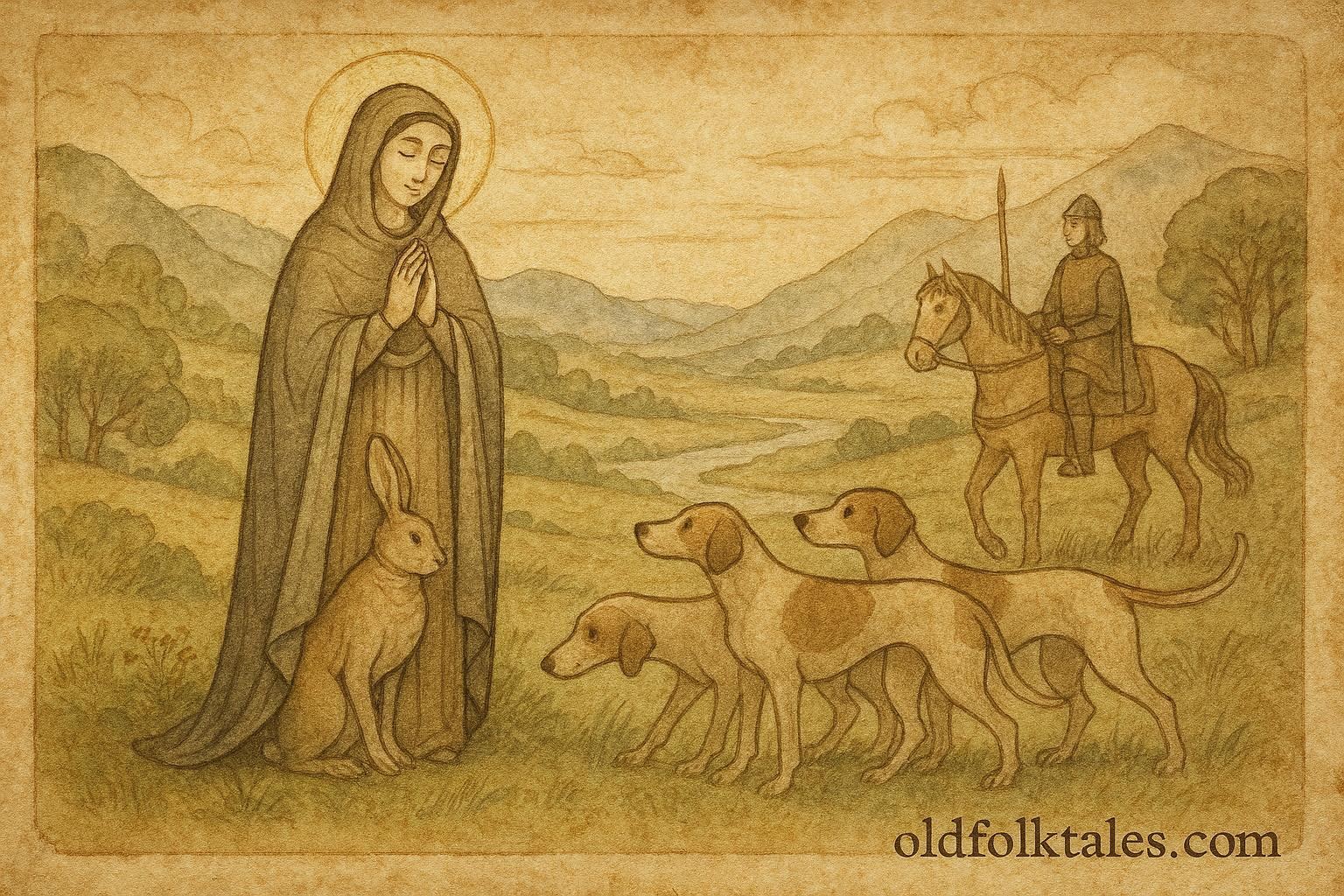
One day, a prince of Powys rode out to hunt. Accompanied by hounds and retainers, he pursued a hare across the rolling countryside. The chase was swift and relentless, the hounds’ cries echoing against the hills as they pressed the small creature forward.
The hare fled in terror, darting through brush and over uneven ground. Its path led, by chance or providence, into the very valley where Melangell dwelt.
Breathless and desperate, the hare rushed toward the holy woman as she stood at prayer. Without hesitation, it ran beneath her cloak, pressing itself close against her feet.
Moments later, the hounds burst into the clearing.
Yet as they approached Melangell, something extraordinary occurred.
The hounds halted.
Though trained for the hunt, though driven by instinct and command, they would not attack. They circled uncertainly, whining softly, their fierce purpose dissolving into confusion. No matter how their handlers urged them on, they refused to touch the hare sheltered beneath the woman’s cloak.
The prince himself soon arrived, astonished to see his hounds disobeying so completely.
Before him stood Melangell, calm, unarmed, her expression serene. At her feet, beneath the folds of her garment, trembled the hare. The hounds lay back, subdued as though restrained by unseen hands.
The prince demanded to know why she interfered with his hunt.
Melangell answered not with defiance, but with quiet conviction. She explained that she had sought only to live in peace, apart from the world’s violence. The creature had come to her for protection, and she would not surrender it to death.
The prince observed the scene carefully. He saw the unshaken stillness of the woman. He saw the unnatural submission of the hounds. In that moment, he recognized that this was no ordinary encounter. Something sacred lay within the valley, a holiness that commanded even beasts trained for blood.
Moved by what he witnessed, the prince made a decision.
He declared that the valley would be granted to Melangell as a sanctuary. No hunting would be permitted there. No harm would come to the creatures that sought refuge within its bounds. The land would belong not to sword or sport, but to peace.
And so the valley became a place of protection.
In time, others joined Melangell. A small religious community formed, devoted to prayer and service. A church rose upon the site, and Melangell became known as a protector, not only of animals, but of those seeking safety from harm.
The hare remained forever linked to her name.
In Welsh tradition, the hare has long carried layers of meaning. It is swift, elusive, and vulnerable. In this legend, it became a symbol of innocence preserved through compassion. That it chose Melangell as its refuge was seen not as accident, but as sign.
As years passed, stories of the event spread throughout Powys and beyond. Pilgrims traveled to the valley, believing it to be a place where divine mercy had touched the earth. The sanctuary endured, respected even in times when laws and rulers changed.
Unlike tales of dragons slain or enemies defeated, the story of Saint Melangell carries no clash of weapons, no triumphant shout of conquest. Its power lies in restraint, in a moment when violence was halted not by force, but by sanctity.
The prince’s choice stands as a turning point. He could have insisted upon his right to the hunt. Instead, he recognized a greater authority at work. In honoring the holiness before him, he transformed a place of pursuit into a haven of peace.
Even centuries later, the valley in Powys is remembered for that moment. The quiet woods, the soft grass, and the gentle slope of the hills seem to echo with the memory of hounds stilled and a hare spared.
Saint Melangell’s story endures because it speaks to something timeless: that true strength may lie not in domination, but in protection; not in the chase, but in the shelter offered to the vulnerable.
And in the hush of the Welsh valley where she once stood, one may imagine a small hare resting safely beneath a cloak, while the world beyond learns the meaning of mercy.
Moral Lesson
Saint Melangell and the Hare teaches that compassion has the power to transform even acts of violence into moments of grace. True holiness protects the vulnerable and creates sanctuary where fear once reigned.
Knowledge Check
1. Who was Saint Melangell?
Saint Melangell was a holy woman who fled royal life to live in solitude in Powys, Wales.
2. What happened during the prince’s hunt?
A hare sought refuge beneath Melangell’s cloak, and the hunting hounds refused to attack her.
3. Why did the prince grant the valley as sanctuary?
He recognized divine protection at work and honored the holiness of Melangell’s life.
4. What does the hare symbolize in this legend?
The hare represents innocence and vulnerability protected through compassion.
5. What themes define this Welsh story?
Sanctuary, peace over violence, holiness in nature, and sacred protection of animals.
6. Where does this legend originate?
It comes from Powys in Wales and is preserved in British saintly tradition.
Source: Adapted from Lives of the British Saints (1907–1913) by Sabine Baring-Gould and John Fisher.
Cultural Origin: Powys, Wales.