In a small, sun-baked village nestled among the rolling hills of southwestern Bulgaria, there lived a poor farmer named Todor. His life was quiet, shaped by the rhythm of the seasons, the stubborn soil, and the needs of his modest herd. Though the villagers often laughed at his simplicity, Todor was content, valuing honesty, hard work, and the loyalty of his faithful horse, Bela.
Bela had been by Todor’s side since he was a boy, carrying him through fields, hills, and even the occasional misadventure. But no one, not even Todor himself, could have anticipated the extraordinary event that would transform the ordinary rhythms of their lives.
One crisp morning, as the sun spread gold across the fields, Todor approached Bela to saddle him for work. To his astonishment, Bela spoke.
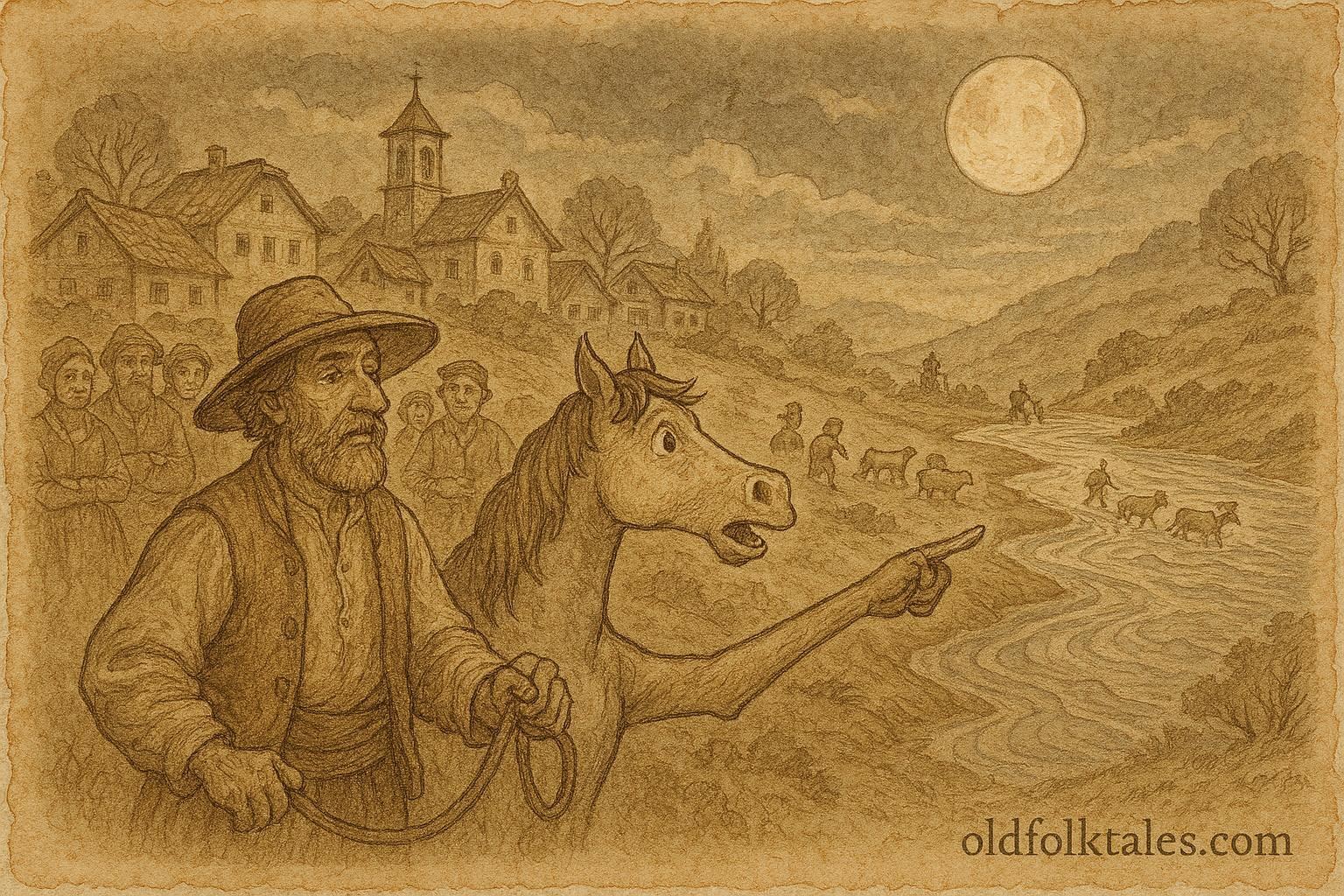
“Todor,” the horse said, his voice low and steady, “the village faces danger. A flood threatens the western pasture, and the grain store may be breached. You must act, but only with cleverness, not force, can the disaster be averted.”
Todor stumbled back, eyes wide, certain that the midday heat had muddled his senses. “Bela,” he stammered, “surely you jest. Horses do not speak.”
But Bela repeated the warning, with such clarity and urgency that Todor knew this was no dream or trick of the mind. He listened attentively as the horse outlined a plan: the villagers should reinforce the western dikes with straw and stone, divert water with temporary trenches, and secure livestock to higher ground.
Grateful but apprehensive, Todor tried to convince the villagers to heed Bela’s counsel. However, they laughed.
“A talking horse?” they scoffed. “Have you lost your wits, Todor? You are a simple man; your horse is a simple beast. Why should we trust such nonsense?”
Though frustrated, Todor did not give up. He gently guided Bela to the edge of the fields, allowing the horse to demonstrate his intelligence. Bela pointed with his hoof to the exact sections of the dike that were weakest and suggested how to build the diversions most efficiently. Still, the villagers murmured doubts, shaking their heads at what they called childish superstition.
Yet Todor had faith, not in magic alone, but in friendship and in listening to those who, though unusual, offered wisdom. Working quietly through the night, he implemented Bela’s instructions, reinforcing the dikes and preparing for the flood.
When the first torrents came, the villagers were astonished. Water surged into the western pastures, yet the dikes held firm. Grain remained dry, livestock safe, and the floodwaters were guided harmlessly around homes and fields. Todor’s clever solutions, suggested by Bela, had saved the village from disaster.
Only then did the villagers approach Todor, their voices trembling with newfound respect. “We mocked your horse,” they admitted, “but it seems his wisdom has saved us all.”
Todor smiled gently. “It is not magic alone,” he replied. “It is friendship, humility, and the courage to listen, even when advice comes from the unexpected, that preserves life and land.”
From that day forward, Bela was no longer seen as a simple beast. The villagers treated him with respect, and Todor’s farm prospered, not because of luck, but because he had trusted the bond between man and horse, listening carefully, thinking creatively, and acting with wisdom.
Even as tales of talking animals spread through neighboring villages, the story of Todor and Bela endured, celebrated not for the marvel of the horse’s speech alone, but for the values it imparted: humility, vigilance, and the reward that comes from honoring friendship, even in forms one might not expect.
In the quiet hills of southwestern Bulgaria, the story is still told beside hearths and under starlit skies. Children are reminded that guidance may come in strange forms, wisdom is often hidden where we least expect it, and that listening with patience and respect can prevent calamity and bring honor to the humble.
Moral Lesson
The Tale of the Talking Horse teaches that wisdom can come from unexpected sources. Faith in friendship, humility in action, and the courage to heed unusual guidance are as powerful as bravery or strength in averting disaster.
Knowledge Check
1. Who is the hero of this folktale?
Todor, a humble farmer of southwestern Bulgaria.
2. What magical ability does Bela, the horse, possess?
Bela can speak, giving warnings and clever solutions to impending dangers.
3. How do the villagers initially react to Bela’s advice?
They doubt and mock him, refusing to believe a horse could speak or guide them.
4. What lesson does Todor demonstrate by following Bela’s guidance?
He shows the importance of humility, trust, and listening to wisdom, even from unlikely sources.
5. What themes are central to the story?
Wisdom through friendship, clever problem-solving, humility, and respect for the unusual.
6. Where and when was this folktale collected?
Southwestern Bulgaria, collected by Dimitar and Konstantin Miladinov in 1861.
Source: Adapted from Bulgarian Folk Tales by Dimitar and Konstantin Miladinov, 1861.
Cultural Origin: Southwestern Bulgaria.