In the sun-drenched lands of Thessaly, where olive groves shimmered in the wind and the Aegean waves lapped against rocky shores, there lived a devoted couple, Alcyone and Ceyx. From the first moment their eyes met, the bond between them was unbreakable. Their love was the kind that poets would later envy: steadfast, deep, and pure. The villagers often whispered of it, claiming that even the gods themselves must have watched them with admiration.
Alcyone was known for her gentle spirit and unwavering devotion, tending to their home and weaving dreams into reality with her careful hands. Ceyx, a man of honor and courage, was devoted to his wife beyond all else. Yet, like many mortals, he was not immune to pride and ambition. One fateful day, news arrived of a distant kingdom in need of aid, and Ceyx, driven by a desire to prove his valor, resolved to set sail despite a grave warning.
A mysterious oracle had cautioned him: “The sea carries both glory and doom. Should you venture forth, the waves may claim more than your life.” Yet Ceyx, confident in his skill and steadfastness, dismissed the warning. Alcyone, sensing a shadow of unease, begged him to reconsider. “Ceyx,” she pleaded, “the gods do not favor rash journeys. Hear their warning and spare yourself!” But he, resolute in his pride and sense of duty, embraced her tightly and promised to return.
And so, with the dawn’s first light, Ceyx departed, his ship slicing through the shimmering waters. Alcyone watched until he was but a speck on the horizon, her heart heavy with foreboding. Days passed, and no word reached her. Every crashing wave against the shore seemed to echo the fear in her chest. She sought solace in prayer, invoking the gods of Thessaly, hoping that divine favor would guard her beloved.
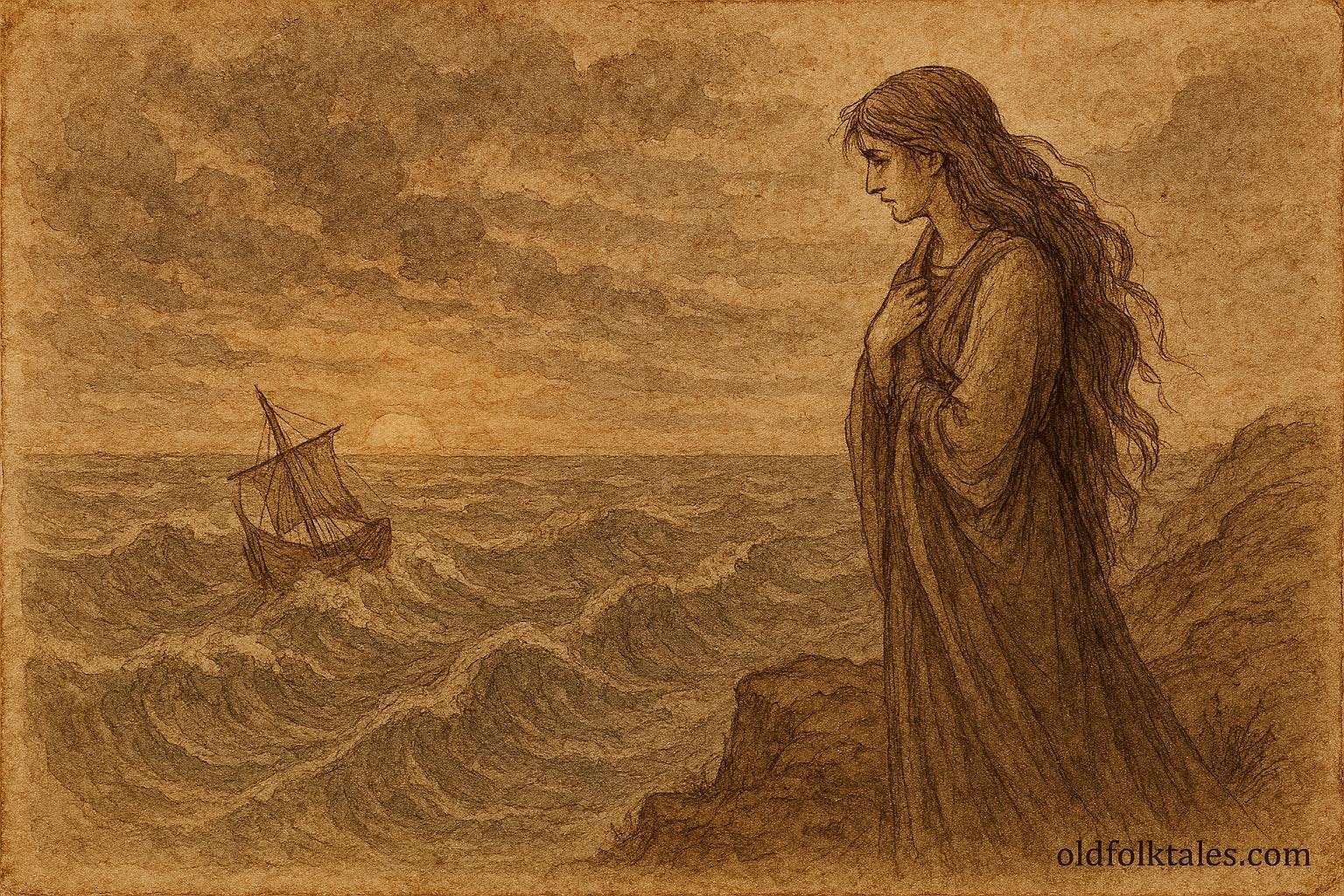
Then came the day the unthinkable happened. A storm of furious intensity, summoned by the wrath of gods displeased with Ceyx’s arrogance, swept over the sea. Ships were tossed like twigs, and even the strongest sailors fell prey to the merciless waves. Alcyone, pacing the shoreline with wild hair and tear-streaked cheeks, watched in horror as the tempest claimed her husband. A messenger of the sea, wind-tossed and trembling, finally brought the tragic confirmation: Ceyx was lost.
Alcyone’s grief was a tempest unto itself. She wandered the cliffs and beaches, calling his name into the roaring winds, her cries blending with the tumult of the sea. Friends and villagers implored her to seek comfort, but she would not eat, would not sleep, and would not leave the shore. Her devotion was absolute; her sorrow, boundless.
One evening, with the sun sinking into a fiery horizon and the waves glittering like molten gold, Alcyone could bear it no longer. Overcome by despair and longing for her husband, she threw herself into the sea, surrendering her mortal form to the abyss. The waters, once cruel and merciless, received her with a strange gentleness, and for a moment, it seemed that love and grief alone governed the tides.
The gods, moved by the purity of their devotion, took pity on the two lovers. With divine hands, they transformed Alcyone and Ceyx into kingfishers, small but graceful birds that skimmed the water’s surface. In this new form, they could remain together forever, circling the shores and rivers of Thessaly, their love eternal. Their plaintive cries became the soft, melodic calls of the kingfisher, a reminder to mortals of loyalty, love, and the consequences of ignoring divine wisdom.
From that day onward, whenever the winds whispered over the waves, villagers swore they could hear Alcyone’s and Ceyx’s calls. Lovers would gaze at the kingfishers, recalling the story of devotion that transcended mortality. The sea, once a place of death and punishment, became a symbol of continuity, of love enduring beyond the limits of human life, and of the delicate balance between pride and reverence for higher powers.
Even centuries later, the tale of Alcyone and Ceyx endured, retold by poets and parents alike. It reminded all who heard it that true devotion carries its own weight, that grief can consume as fiercely as love, and that mercy, when granted by higher powers, transforms tragedy into eternal beauty.
Discover the spiritual depth and wisdom hidden in the ancient folklore of Eastern and Balkan Europe
Moral Lesson
The story of Alcyone and Ceyx teaches that unwavering devotion and loyalty can transcend death, but that mortal pride and disobedience carry consequences. True love is tempered by respect for divine guidance, and grief, though profound, may lead to transformation and continuity beyond mortal life.
Knowledge Check
1. Who are the main characters in this folktale?
Alcyone and Ceyx, a devoted husband and wife of Thessaly, Greece.
2. What action led to Ceyx’s tragic fate?
He ignored a divine warning and sailed into a stormy sea, defying the gods’ caution.
3. How does Alcyone respond to Ceyx’s death?
She mourns deeply, refusing comfort, and ultimately throws herself into the sea.
4. How are Alcyone and Ceyx transformed by the gods?
They are changed into kingfishers, allowing them to remain together eternally.
5. What themes are central to the story?
Loyalty and love, grief and devotion, divine justice and mercy, transformation.
6. Where and when was this tale recorded?
Ancient Greece, Thessalian tradition, recorded in Metamorphoses by Ovid, c. 8 CE.
Source: Adapted from Metamorphoses by Ovid, c. 8 CE.
Cultural Origin: Ancient Greece (Thessalian folklore).