In a quiet village nestled among the rolling hills of rural Romania, there lived a young boy unlike any other in his family. While his siblings labored in the fields and helped with chores, the boy wandered with a pencil and scraps of parchment, drawing cats. The villagers whispered that he was strange, and his own family often dismissed him, calling him idle and impractical. Yet the boy found joy in the quiet stroke of his pencil and the delicate curves of the feline forms he brought to life on paper.
His parents had tried to mold him into their vision of a useful son, urging him to help with plowing, tending animals, and gathering firewood. But the boy could not resist the pull of his art. Wherever he sat, on the worn bench by the hearth, beneath the gnarled branches of a village oak, or beside the rushing stream, he drew cats. Some were sleek and playful, others fierce and watchful; some crouched as if ready to pounce, while others curled up in deep, serene slumber. Each drawing seemed to carry its own life, as if the boy’s devotion had breathed spirit into the ink.
Experience legends where mountains breathe magic and heroes face moral choices that shape destiny
One day, after another futile attempt to make him conform, his parents sent him away to the monastery at the edge of the village. “Perhaps the monks will straighten you out,” they said, “or at least keep you from wasting your days.” The boy, clutching his drawings, obeyed silently, grateful to have a quiet place to practice his art without interruption.
The monastery was a solemn place of stone walls and shadowed corridors, with an air of reverence and occasional fear. The monks, though initially puzzled by the boy’s fascination with cats, tolerated his odd habits, giving him a small cell where he could draw in peace. Day after day, the boy filled pages with his feline companions, each one more intricate than the last, until the room seemed alive with their silent presence.
One evening, the abbot summoned the boy. “Beyond the eastern gate lies an abandoned temple,” he said gravely. “It is said to harbor a terrible creature that has claimed the lives of travelers foolish enough to enter. We need someone to investigate, to discover whether it can be cleansed or contained.”
The boy’s heart trembled at the thought, but he recalled the cats he had drawn, each alert, each ready to confront danger. With only a satchel of parchment and his pencils, he set out toward the deserted temple. Twilight descended, painting the forest in deep blues and purples, and the wind whispered among the ancient oaks. Shadows danced across the crumbling stone path, and the boy’s imagination seemed to swirl with the shapes of his cats, their eyes glinting in the dim light.
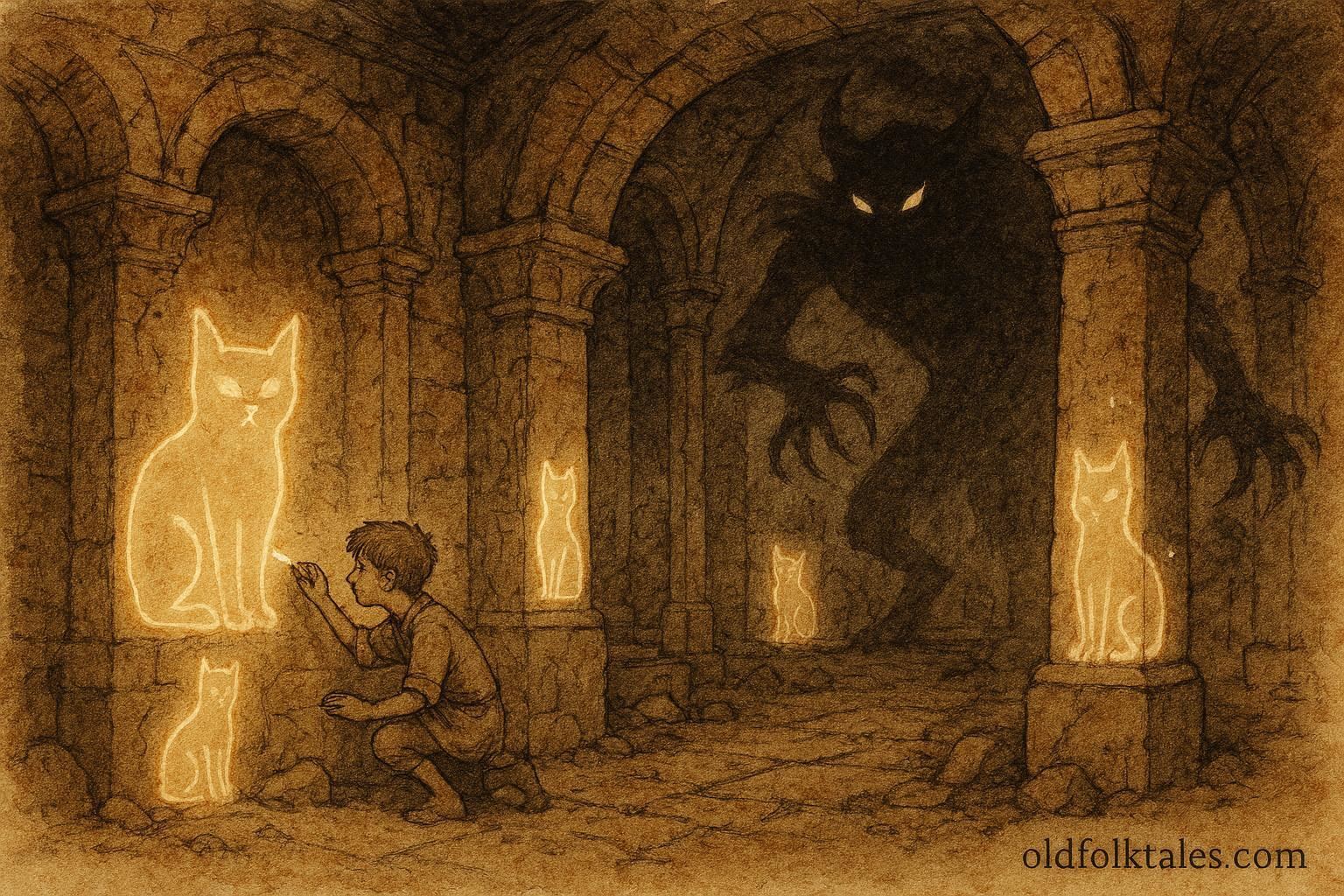
When he reached the temple, the air was thick with dust and an ominous chill. The wooden doors creaked on their ancient hinges, and inside, the boy could hear faint, unnatural sounds, a scraping, a scuttling, the low rumble of something vast moving in the darkness. Fear rose in his chest, yet he remembered the guidance of his own creations. Taking out his parchment, he drew cats along the walls, on the pillars, and across the floor: fierce, watchful, and alert. Each stroke was precise and deliberate, every tail and claw positioned to guard and confront.
As he completed his work, the temple grew silent. The boy listened, heart pounding, as a monstrous shadow emerged from the gloom, a creature long spoken of in fearful whispers, with long limbs, jagged teeth, and eyes like burning coals. It lurched toward him, its hunger and malice unmistakable. But when it reached the expanse of walls covered in cats, it paused. The drawings, alive with the boy’s devotion and attention to detail, seemed to spring from the parchment in spirit. The creature recoiled, hissed, and skittered back into the shadows, unable to attack the boy, who stood trembling yet resolute.
By dawn, the temple was calm. The boy had not fought with sword or spell, but with patience, skill, and ingenuity. The monks, arriving after hearing of his courage, found the boy unharmed and the creature gone, chased away or trapped by the power of his art. From that day forth, he was no longer regarded as strange or useless. The villagers and monks alike recognized that his talent and perseverance were as valuable as any physical strength or labor, and that his cleverness had turned what seemed like weakness into protection and wisdom.
The boy continued to draw, yet now with pride and respect. His art was no longer merely a pastime, it had become a tool, a shield, and a testament to the power of devotion and patience. And whenever he looked at his drawings of vigilant cats, he remembered how the creatures he imagined had saved him from danger, proving that even the smallest talents, when nurtured, can have mighty effects.
Moral Lesson
The tale teaches that true strength lies not only in physical skill but in creativity, patience, and attention to one’s talents. What others may dismiss as trivial can hold profound power when pursued with dedication. Ingenuity and careful thought can overcome even the most frightening challenges.
Knowledge Check
1. Who is the main character in the story?
A young boy neglected by his family who finds joy and strength in drawing cats.
2. What is the magical aspect of the boy’s drawings?
The cats he draws protect him from the dangerous creature in the abandoned temple.
3. What lesson does the boy’s adventure teach?
Patience, creativity, and perseverance transform apparent weaknesses into strengths.
4. Where is the folktale set?
Rural villages and an abandoned temple in 19th-century Romania.
5. What is the central theme of the folktale?
Ingenuity, devotion to one’s talent, and the power of creativity as protection.
6. Who collected this version of the story?
I. C. Fundescu, in Basme și povestiri, 1875.
Source: Adapted from Romanian folk tradition, collected by I. C. Fundescu, Basme și povestiri (1875)
Cultural Origin: Romanian rural folklore, 19th century