In a small Serbian village nestled between rolling hills and dark pine forests, there once lived a man so poor that even the wind seemed to pass over his cottage without stopping. His roof sagged, his hearth burned low, and the fields he tended yielded barely enough grain to quiet his hunger. Though he worked from dawn until dusk, fortune never favored him.
The villagers pitied him, yet pity does not fill a bowl. Each winter grew harsher than the last, and the man began to fear that his life would slip away in quiet misery. It was in the depth of such desperation that temptation found him.
One bitter evening, as frost crept along the ground and the moon hung thin and sharp in the sky, a stranger appeared at his door. The stranger was well-dressed in black, with polished boots that bore no trace of mud, though the road outside was thick with it. His eyes glinted strangely in the firelight.
“You seem burdened,” the stranger said smoothly. “Perhaps I can help.”
The poor man, weary and cold, did not ask too many questions. When the stranger revealed himself as the Devil, offering wealth, comfort, and knowledge in exchange for apprenticeship, the man’s heart trembled. He knew the Church’s warnings. He had heard the priests speak of pacts and eternal consequences. Yet hunger is a persuasive voice.
“What must I do?” he asked.
“You will serve me for seven years,” said the Devil. “You will learn my arts and assist in my dealings. When the term ends, you shall belong to me, unless, of course, you prove clever enough to free yourself.”
The Devil smiled as if the last words were a joke.
The man hesitated only briefly before agreeing. A contract was sealed not with ink, but with a whisper and a handshake that felt colder than winter.
Apprenticeship in Darkness
From that night forward, the man followed the Devil across villages, towns, and lonely crossroads. He learned tricks that twisted perception and bent reality. He learned how to appear where he was not, how to disguise truth with illusion, and how to plant temptation like a seed in the hearts of others.
The Devil delighted in showing him how easily humans strayed. He revealed how greed could overpower kindness, how pride could undo wisdom, and how fear could silence virtue. The apprentice watched carefully, saying little.
Yet he noticed something else.
The Devil was powerful, but not all-knowing. He relied heavily on arrogance. He assumed that mortals were foolish and predictable. He delighted in grand gestures but overlooked small details.
And the apprentice, though poor, had always survived by noticing small details.
Years passed. The man enjoyed comforts he had never known: warm clothing, plentiful meals, a purse heavy with coin. Yet he never forgot the contract. Each passing year echoed louder in his mind.
Six years came and went.
When the seventh year began, the Devil grew increasingly smug.
“Soon,” he would say, “your lessons will end permanently.”
The apprentice bowed respectfully, but inside his thoughts sharpened like a blade.
The Final Task
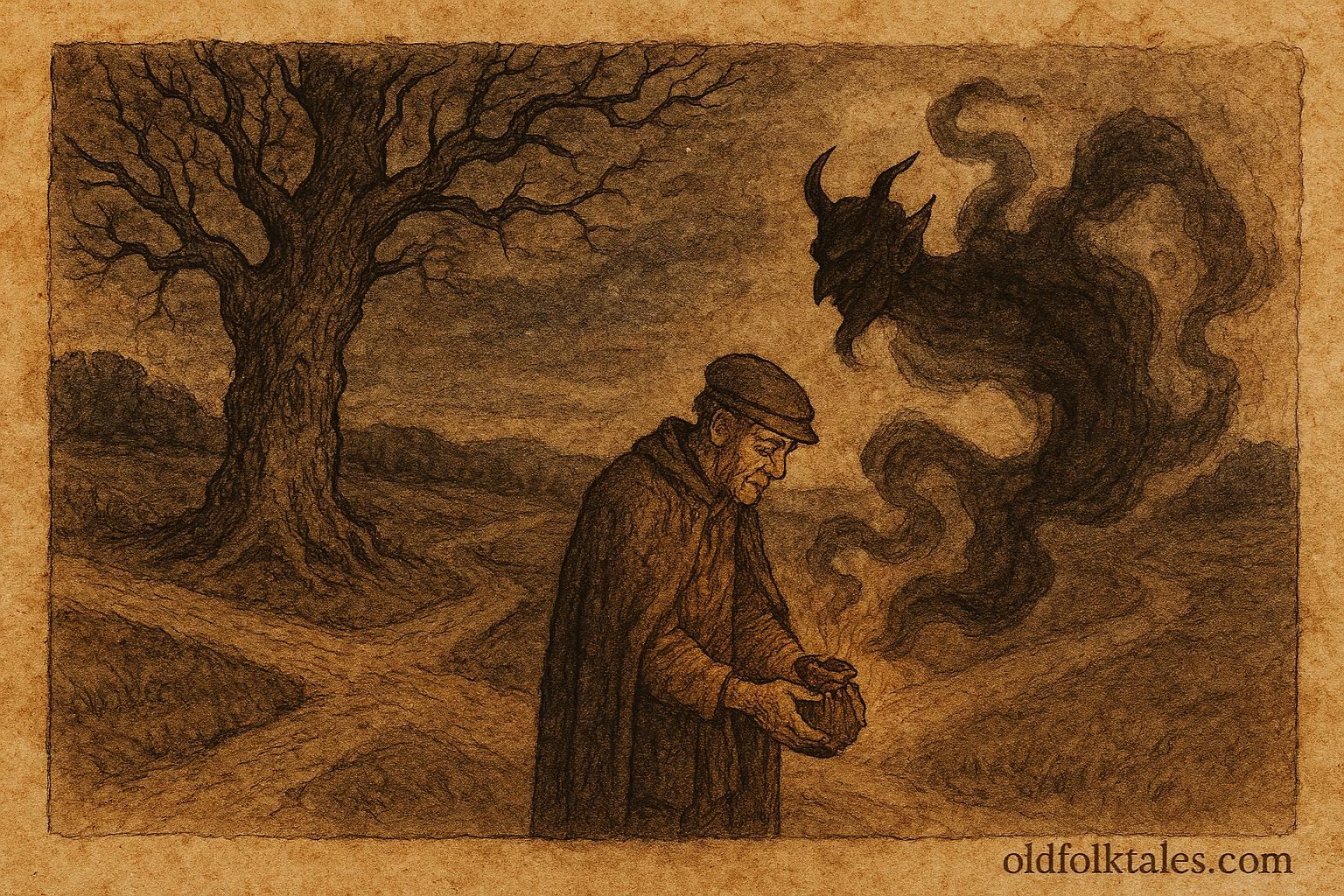
On the final night of the seventh year, the Devil brought his apprentice to a lonely crossroads beneath a twisted oak tree.
“It is time,” the Devil declared. “Before you are mine forever, you must complete one final task. A farmer in the next village refuses temptation. He prays, works honestly, and will not bargain. Break him. If you succeed, I may reward you. If you fail, your soul is sealed.”
The apprentice nodded.
But instead of approaching the farmer with darkness, he approached with subtlety. He observed the man for several days. The farmer was not wealthy, nor particularly powerful. He simply valued honesty above gain.
The apprentice realized brute temptation would fail.
So instead, he devised a trick, not against the farmer, but against the Devil.
He returned to the crossroads and said, “Master, I have planted doubt in the farmer’s mind. But to complete the work, I require proof of your trust. Show me how you would tempt such a man, so I may imitate you perfectly.”
The Devil, swollen with pride, laughed. “You still have much to learn.”
To demonstrate his cleverness, the Devil transformed himself into a golden coin and dropped to the ground along the farmer’s path.
“See?” the Devil’s voice echoed faintly from the coin. “When he picks me up, greed begins its work.”
But the apprentice acted swiftly. He snatched the coin and slipped it into a small leather pouch sewn tightly shut with blessed thread he had quietly acquired months before.
Inside the pouch, the Devil raged and thundered, but he could not escape. The blessed thread burned like iron bars.
The apprentice stood at the crossroads, heart pounding.
“You taught me illusion,” he said calmly. “You taught me patience. You taught me that pride blinds even the powerful.”
The Devil roared, his voice muffled. “Release me!”
“On one condition,” the apprentice replied. “You will tear our contract and swear never to claim me.”
There was a long silence. Then, at last, the Devil relented.
The contract appeared in a curl of smoke. The apprentice held it over the pouch.
“Swear it,” he demanded.
“I swear,” the Devil hissed.
The parchment burst into flame, dissolving into ash. Only then did the apprentice cut the pouch open.
The Devil sprang forth in fury, but bound by his oath, he could not touch the man. With a final glare, he vanished into the night, leaving behind only the smell of sulfur and scorched earth.
Freedom Restored
The former apprentice stood alone beneath the oak tree, no longer poor, no longer bound. He returned to his village not as a servant of darkness, but as a man sharpened by hard lessons.
He did not boast of his triumph. Instead, he worked honestly, using what knowledge he had gained not to deceive, but to protect himself and others from deception.
The villagers noticed a quiet strength in him. He no longer feared hardship, nor was he dazzled by sudden fortune. He understood temptation because he had walked beside it.
And so, he lived, not rich beyond measure, but free.
In time, the tale spread across Serbian villages, told by hearth fires and in monastery courtyards. It was recounted with humor, for there is something satisfying in seeing arrogance defeated. Yet it was also told with caution, for not every bargain ends so well.
Moral Lesson
This Serbian folktale teaches that intelligence, patience, and courage can overcome even great evil. Temptation may promise relief from hardship, but true freedom comes from resilience, clear thinking, and moral strength. Pride destroys the wicked, and wit protects the wise.
Knowledge Check
1. Why does the poor man agree to become the Devil’s apprentice?
He seeks escape from poverty and hardship, believing the pact will improve his life.
2. What does the apprentice learn during his service?
He learns deception, illusion, and how temptation works on human weakness.
3. How does the apprentice ultimately defeat the Devil?
He uses cleverness and blessed thread to trap the Devil after provoking him to transform into a coin.
4. What role does pride play in the story?
The Devil’s arrogance blinds him, allowing the apprentice to outsmart him.
5. What is the central theme of the folktale?
Intelligence and moral resilience can overcome evil and temptation.
6. What is the cultural origin of this story?
Serbian oral tradition influenced by Christian folklore, recorded in the 19th century.
Source: Serbian oral tradition recorded in 19th-century collections (1840s–1850s)
Cultural Origin: Serbian folklore with Christian influence