In a quiet Serbian village bordered by rolling hills and dark whispering forests, there lived three sisters in a modest cottage of whitewashed stone and timber. Their home stood at the edge of tilled fields, where wheat ripened under the summer sun and frost silvered the earth in winter. Though their family was neither wealthy nor noble, the sisters were known throughout the village for their beauty and spirited conversation.
Each evening, after the day’s chores were done and the hearth glowed warm with embers, the sisters would sit together spinning flax and speaking of the futures they imagined for themselves. As is often the way in youth, their thoughts turned toward marriage and fortune.
One night, beneath the soft flicker of candlelight, the eldest sister lifted her chin proudly and said, “If I were to marry, it would be to the king’s baker. I would have bread warm from the ovens each morning, golden loaves richer than any feast in the land.”
The middle sister laughed lightly. “That is too small a dream. I would marry the king’s chief steward. Then I would dine at the palace tables and wear fine garments of velvet and silk.”
The youngest sister had remained quiet, her hands steady at her spinning. When her sisters pressed her for an answer, she spoke gently but firmly. “If I marry,” she said, “it will be to the king himself.”
Her sisters burst into disbelief, teasing her for daring to dream so boldly. Yet she did not blush or retreat from her words. She simply smiled, as though she trusted something unseen.
What the sisters did not know was that the king himself had been traveling through the countryside in disguise that very evening. Curious about the lives of his people, he had wandered near their cottage and overheard every word through the open window.
The next day, royal messengers arrived in the village. To the astonishment of all, the king summoned the three sisters to his court. Trembling yet resolute, they were brought before him. There, he revealed what he had heard and declared that each would have her wish.
The eldest married the royal baker, gaining ovens full of fragrant bread. The middle sister wed the chief steward and found herself surrounded by luxury. And the youngest, as boldly foretold, became the king’s queen.
For a time, harmony reigned. The palace gardens bloomed bright with roses, fountains sparkled beneath the sun, and the young queen carried herself with quiet grace. Yet fortune has a way of stirring envy where once there was sisterly affection.
When the queen bore her first child, a son as radiant as dawn, the king rejoiced. Bells rang across the kingdom. But jealousy, long simmering in the hearts of the elder sisters, darkened their thoughts.
Summoned to assist their sister during her confinement, they entered the royal chambers with smiles that masked resentment. When the child was born, strong and healthy, they exchanged glances heavy with silent malice.
Under cover of night, while the queen lay exhausted, they carried the newborn away. In his place, they set a lifeless bundle and declared that the queen had given birth to something unnatural. Shocked and confused, the king struggled between love and doubt. Though he did not punish his queen, sorrow clouded his heart.
The innocent child, meanwhile, was cast adrift in a wooden chest upon the river. Yet fate, as it often does in tales of old, guarded him carefully. The chest floated gently downstream until it was found by a humble miller and his wife. Childless and kind, they took the boy in as a gift from heaven and raised him as their own.
Years passed, and the boy grew into a noble and handsome youth. Though raised in modest surroundings, there was something unmistakably regal in his bearing.
Back at the palace, the queen bore a second son. Again, her sisters were present. Again, envy overcame them. And once more, a healthy child was replaced and cast upon the river. Like his brother, he was rescued and raised by the same miller’s family, who marveled at their good fortune.
When the queen bore a third child, a daughter with eyes bright as starlight, the pattern repeated. The cruel deception was carried out yet again, and the infant princess was set adrift. She too was saved and brought to the miller’s home.
Thus the three royal children grew together, unaware of their true heritage. They worked in the fields, learned kindness and diligence, and formed a bond stronger than iron.
One day, as the siblings sat beneath a broad oak tree, a traveler passed by and spoke of wonders beyond imagination. He told them of a magical golden bird whose song revealed truth, of a tree that bore fruit of shining silver and gold, and of a fountain whose waters sparkled like diamonds. These marvels, he said, could be found only by the brave.
The children felt their hearts stir. Though they could not name it, destiny called to them.
The eldest brother set out first in search of the golden bird. He journeyed across forests and over mountains until he reached a distant castle where the bird was said to dwell. But he failed to heed the guidance given to him along the way and was turned to stone for his impatience.
When he did not return, the second brother followed. He too reached the castle but allowed pride to cloud his judgment. He suffered the same fate.
At last, the sister, gentle yet resolute, chose to go. Unlike her brothers, she listened carefully to the counsel offered by those she met. She showed humility and patience where they had rushed forward.
At the enchanted castle, she moved with wisdom. When she found the golden bird, its feathers gleaming like sunlight, she did not act rashly. Following the guidance she had received, she succeeded where her brothers had failed. The spell broke. Her brothers were restored from stone, and together they obtained the golden bird, the wondrous tree, and the glittering fountain.
When they returned home, their garden transformed into a place of marvels. The golden bird sang songs that seemed to carry hidden meaning. People from near and far came to witness the wonders.
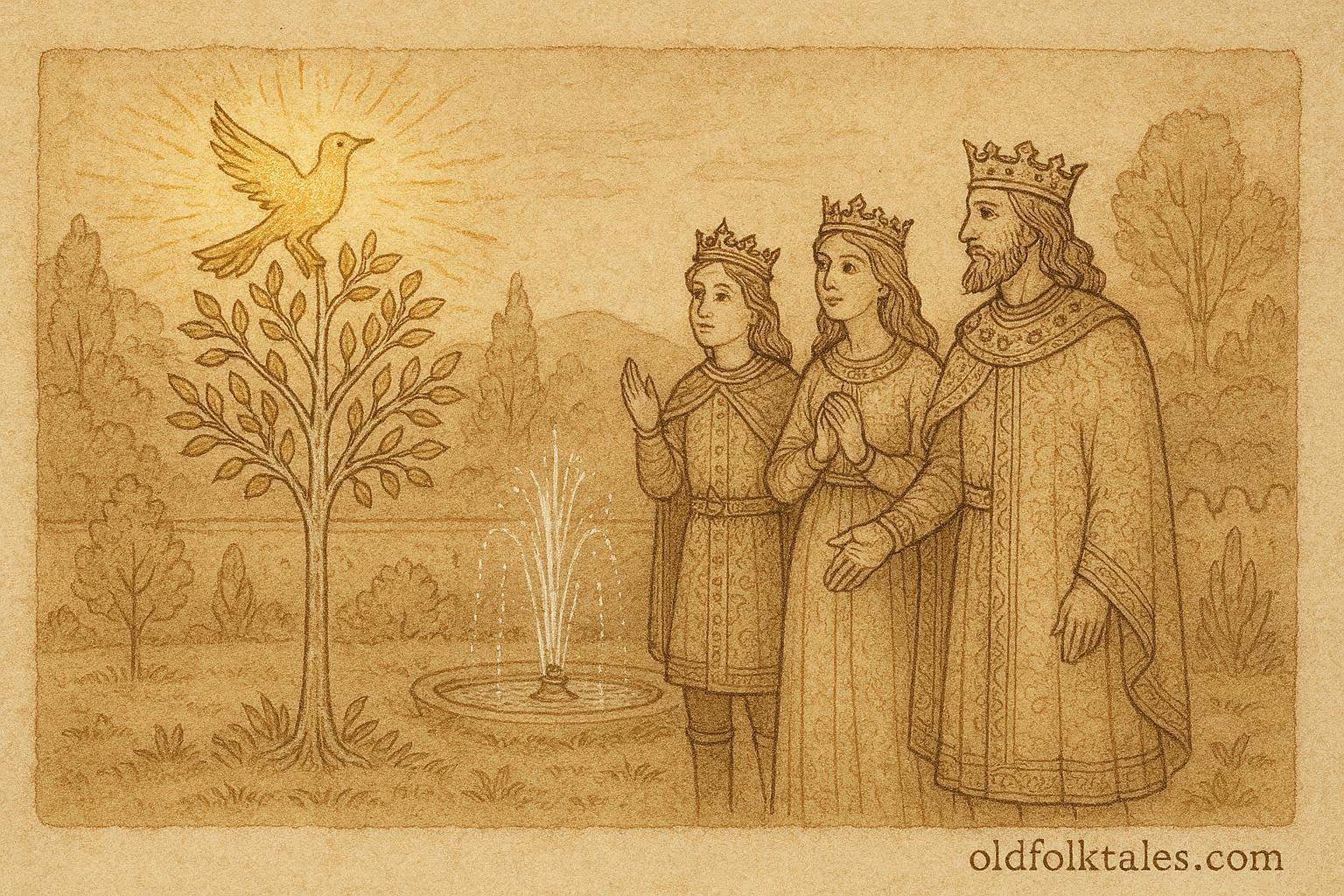
News of these marvels reached the king. Intrigued, he visited the miller’s home to see for himself. As he stood in the enchanted garden, the golden bird began to sing—not of distant lands, but of betrayal, of infants set adrift, and of truth long buried.
The king’s heart trembled as the bird revealed all. He looked upon the three youths before him and recognized his own likeness in their faces.
Summoning the queen’s sisters, he demanded the truth. Overwhelmed by fear and the undeniable evidence of the bird’s song, they confessed their crimes.
Justice was swift. The elder sisters were punished for their betrayal, and the queen was restored to honor. The royal children were brought to the palace at last, welcomed as prince and princess.
Peace returned to the kingdom. The garden of golden marvels flourished within palace walls, a living reminder that truth cannot be buried forever.
And so, destiny, though delayed by envy and deceit, fulfilled itself through patience, courage, and sincerity.
Moral Lesson
Jealousy and deceit may appear powerful for a time, but truth endures. Humility, patience, and sincerity guide destiny more surely than ambition or pride. In the end, loyalty to what is right restores balance and reveals justice.
Knowledge Check
1. What is the central theme of The Three Sisters and the Golden Bird?
The story centers on fate, jealousy, loyalty, and the ultimate triumph of truth over deception.
2. Who rescues the royal children in this Serbian folktale?
A humble miller and his wife rescue and raise the three children after they are cast into the river.
3. What role does the golden bird play in the story?
The golden bird symbolizes truth and revelation, exposing the sisters’ betrayal.
4. Why do the elder sisters betray the queen?
They are driven by jealousy and resentment over her marriage to the king.
5. How does the youngest sibling succeed in the quest?
She shows patience, humility, and wisdom, unlike her brothers who act rashly.
6. What does this Serbian folktale teach about destiny?
It teaches that destiny unfolds through virtue and sincerity, even when delayed by wrongdoing.
Source: Collected by Vuk Stefanović Karadžić (1821–1853).
Cultural Origin: Serbian folktale, Serbia.