In the villages of Belarus, where winter stretches long across fields and forests, there are nights when the cold seems to press its face against every wall. Snow lies heavy upon thatched roofs. Chimneys breathe slow columns of smoke into pale skies. The world outside grows still and hushed, as though listening.
On such nights, when frost tightens its grip and the air inside the cottage crackles with the warmth of the hearth, something delicate and wondrous begins to form upon the windowpanes.
Children are always the first to notice.
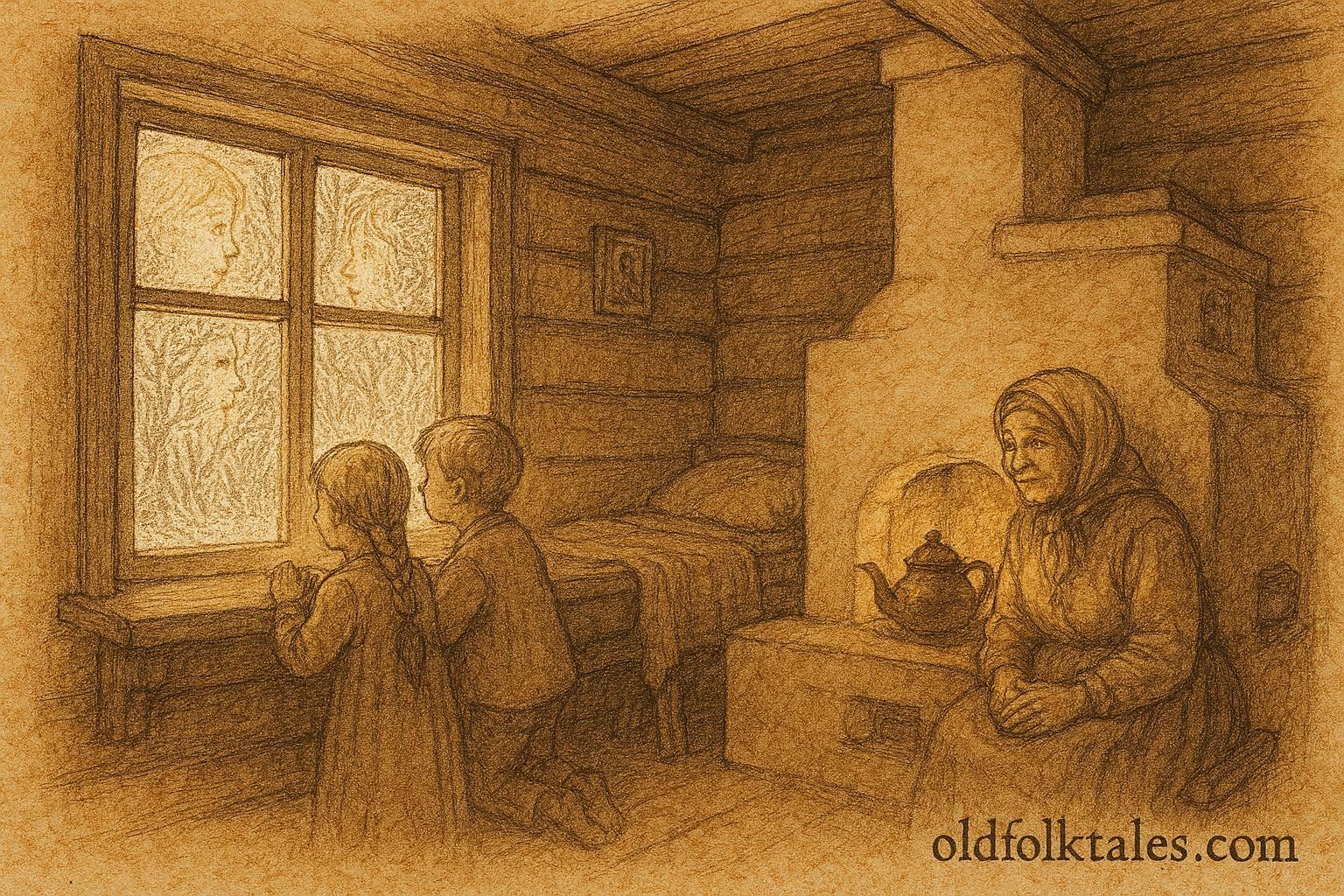
They wake before dawn, when the fire has burned low and the light is soft as milk. Drawing close to the window, they see not merely frost, but forests traced in silver, branches spreading like veins across the glass. There are faces too, faint yet unmistakable. Eyes shaped in ice. Profiles bending among the crystalline trees.
They call them the Frost Children.
The Elder’s Explanation
In one such village, bordered by birch groves and frozen streams, a family lived in a timber house warmed by a broad clay stove. The grandmother of the household, stooped yet sharp-eyed, had seen more winters than anyone could easily count.
Each year, when the first deep frost arrived, the youngest children pressed their noses to the window and whispered excitedly.
“Babushka,” they would ask, “who makes the frost draw pictures?”
The grandmother would lower herself onto the wooden bench and beckon them close.
“They are not pictures,” she would say softly. “They are stories.”
The children would widen their eyes.
“Long ago,” she explained, “before glass filled our windows and iron sealed our doors, the spirits of winter moved freely between the living and the departed. When the air grows still and pure, the frost spirits come to remind us of those who walked before us.”
She would gesture toward the patterns etched across the pane.
“See how the branches twist? Those are the forests our ancestors crossed. See that face there? That is someone who once sat by this very hearth. The frost does not paint at random. It remembers.”
The children would watch in awe as morning light touched the ice, making it glow like lace spun from silver thread.
The Ritual of Remembrance
In that village, remembrance was not an afterthought. It was woven into daily life.
At certain winter evenings, especially when the nights were longest, the family set aside a small portion of bread and salt near the stove. A candle was lit. Names were spoken aloud: grandfathers, grandmothers, those lost to illness, those taken by time.
The grandmother would murmur blessings, thanking them for the land, for the roof overhead, for the fire that did not fail.
“It is not the offering that matters most,” she would tell the children. “It is that we remember.”
And each year, without fail, the frost returned. Its patterns grew intricate, lively, almost joyful. Some mornings, the children swore they saw entire villages within the ice—tiny cottages and winding rivers captured in delicate white lines.
The household prospered modestly. The cow calved safely. The grain held through winter. No great riches came, but neither did ruin.
The Family Who Forgot
Not far from that home lived another family, distant relatives, who had grown weary of old customs.
The father, practical and impatient, dismissed talk of frost spirits as superstition.
“It is only cold and moisture,” he said. “Nothing more.”
His wife, once attentive to ritual, found herself too occupied with mending and market days. The children learned quickly not to speak of faces in the frost, for they were told such notions were foolish.
When winter came and the first frost crept across their windows, the youngest child cried out in delight.
“There is a forest on the glass!”
But the father laughed. “Ice grows as it will. It is no forest.”
No candle was lit that evening. No bread set aside. No names spoken into the quiet.
The frost patterns the next morning were thinner than usual. Sparse.
The following night, the cold deepened further. The wind moved like a low whisper through the eaves. Yet the window remained nearly bare, only faint streaks where once there had been branching beauty.
Within weeks, small misfortunes began to gather.
A jar of preserved berries cracked in the cellar. The cow fell ill. A shipment of grain spoiled when dampness seeped into the sacks. None of these troubles alone seemed extraordinary. Yet together, they cast a shadow over the household.
And still, no remembrance was offered.
One bitter dawn, the youngest child approached the window again.
“There are no Frost Children,” she whispered.
The pane was clear as summer glass.
The Elder’s Visit
News of the absent frost reached the grandmother in the neighboring house. She wrapped her shawl tightly and walked through the snow to visit.
Inside, she felt the difference immediately. The air was warm enough, the fire steady. Yet something intangible had withdrawn.
She stood before the bare window and sighed.
“You have forgotten,” she said quietly.
The father bristled. “We have done nothing wrong. The cold is colder this year. That is all.”
The grandmother shook her head.
“Cold alone does not drive away memory.”
She asked that a candle be brought. Reluctantly, they obliged. She placed it near the window and set a small crust of bread beside it.
“Speak the names,” she urged.
Silence lingered.
At last, the wife spoke her mother’s name. Then a grandfather’s. Hesitantly, the father added the name of his own father, long gone.
The flame wavered.
That night, frost crept once more along the edges of the glass.
It did not bloom fully at once. The patterns were fragile, uncertain. But over the next evenings, as remembrance was repeated, the ice returned with growing intricacy.
Branches extended. Faces reappeared.
The youngest child laughed with relief.
“They have come back!”
The grandmother nodded. “They never truly left. They waited.”
Nature as Storyteller
In Belarusian hearth culture, winter is not merely endured, it is listened to. The crackle of firewood, the sigh of wind through shutters, the formation of frost, each carries meaning.
The Frost Children of the Windowpane are not feared. They do not lure or threaten. They remind.
They speak without sound, tracing ancestral memory in silver lines. They turn cold glass into a canvas of continuity, linking the living with those who came before.
And when neglect dulls remembrance, it is not punishment that follows, but absence. A thinning of connection. A quiet withdrawal.
The villagers came to understand that prosperity was not born solely from labor, nor misfortune solely from chance. Between the living and the departed ran a thread as fine as frost itself.
To honor that thread was to keep warmth within the walls.
The Return of Fortune
In the household that had nearly forgotten, small improvements followed the return of ritual.
The cow recovered. The grain dried properly near the stove. The father, once dismissive, began pausing at the window each morning. He would not admit to seeing faces—but he studied the branching patterns longer than before.
On the coldest night of that winter, frost covered the pane in dazzling complexity. The designs shimmered like a forest at dawn, every twig precise, every curve deliberate.
The grandmother visited again and stood with the children before the glass.
“Do you see?” she asked.
The eldest child nodded slowly. “They are telling us something.”
“Yes,” the grandmother said. “They are telling us we belong.”
Discover Polish, Russian, Ukrainian, and Belarusian folktales where magic and morality meet
Moral Lesson
Memory sustains more than the past, it protects the present. When tradition and remembrance are honored, warmth and balance endure. Neglecting those who came before us weakens the unseen bonds that hold a household together. Respect for ancestors keeps both spirit and fortune alive.
Knowledge Check
1. Who are the Frost Children in Belarusian folklore?
They are winter frost spirits believed to paint ancestral stories on windowpanes during the coldest nights.
2. What happens when a family neglects remembrance rituals?
The frost patterns disappear, and misfortune gradually enters the household.
3. What does the frost symbolize in this folktale?
It symbolizes ancestral memory, continuity, and the connection between the living and the departed.
4. Why are candles and bread used in the story?
They represent traditional acts of remembrance and respect for ancestors in Belarusian hearth culture.
5. What lesson does the skeptical father learn?
He learns that tradition carries meaning beyond practicality and helps maintain balance and fortune.
6. Where does this winter folktale originate?
It comes from Belarusian winter folklore tied to village hearth culture.
Source: Belarusian folktale, Belarus. Recorded in Materials on Belarusian Ethnography (1891) by Evdokim Romanov.
Cultural Origin: Belarusian winter folklore, village hearth tradition.