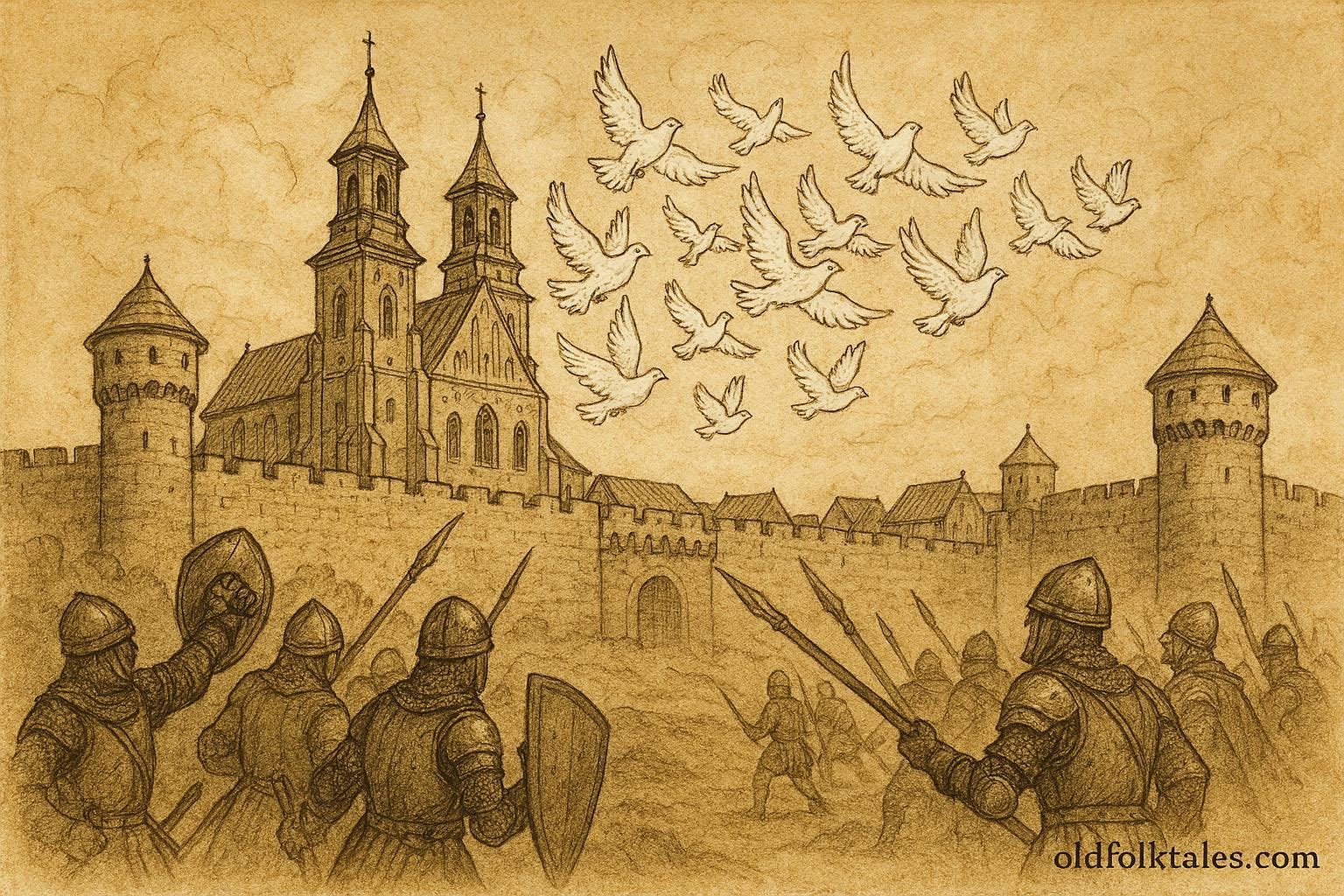
In the heart of Greater Poland stands the ancient city of Gniezno, long honored as the first capital of the Polish realm. Its cathedral towers rise above red rooftops and cobbled streets, watching over a land shaped by early kings, solemn coronations, and the steady growth of a nation.
But in the chronicles of old, there is a tale not only of rulers and armies, but of birds.
White pigeons, luminous against the sky, whose wings once shielded the city in its hour of danger.
The City of First Kings
Gniezno was more than a city of stone and timber. It was a cradle of monarchy, a place where early Polish rulers were crowned and laid to rest. Within the cathedral rested sacred relics and the memory of beginnings.
Travelers approaching the city often remarked upon the flocks of white pigeons that circled its highest tower. They nested among the cathedral’s arches, cooing softly in the dawn light. To the townspeople, these birds were not mere creatures of habit.
They were symbols.
Some said they represented peace. Others whispered that they were souls, guardians bound to the fate of the city itself.
The Threat from Beyond the Walls
In one turbulent age, when rival forces sought to test the strength of the young Polish realm, Gniezno faced siege. Armed invaders encircled the city, their banners dark against the horizon.
The cathedral bells rang in warning. Citizens gathered behind fortified walls. Soldiers prepared what defenses they could, though their numbers were few.
Within the cathedral, clergy knelt in prayer. Before the altar, candles flickered beneath sacred relics that had witnessed generations of devotion. The people knew that if Gniezno fell, it would not only be a military loss, but a wound to the spirit of the nation.
Outside, the besieging army advanced.
The Descent of the Pigeons
As dawn broke on the day of the expected assault, a strange hush fell over the city. The air grew still. Even the usual cooing from the cathedral tower seemed absent.
Then, as the first battering ram was drawn toward the gates, a sudden rush of wings filled the sky.
From the highest tower of Gniezno Cathedral burst a vast flock of white pigeons. Not dozens, but hundreds. Their wings flashed silver in the morning light as they wheeled above the invaders.
The soldiers below faltered, startled by the sudden movement. The birds did not scatter aimlessly. They descended in sweeping arcs, circling low over helmets and horses.
Some men shielded their eyes. Others cried out that they could not see clearly, as wings beat close around their faces. Horses reared, unnerved by the dense swirl of feathers.
The sky itself seemed alive.
From the city walls, defenders watched in astonishment. The pigeons formed shifting patterns overhead, at times like a great white banner unfurled across the heavens.
Confusion spread among the attackers. Orders were shouted but drowned in the thunder of wings. Dust rose, mixing with feathers in a blinding haze.
And then, just as suddenly as they had descended, the pigeons rose again, climbing high above the field.
By the time the invaders regained order, doubt had already taken root. Whispers passed among them: that the city was protected, that heaven itself had intervened.
Before nightfall, the siege was abandoned.
Spirits of Ancient Rulers
In the days that followed, the people of Gniezno spoke in reverent tones of what they had witnessed.
The pigeons returned to their tower as though nothing extraordinary had occurred. They nested quietly, cooing as before.
Yet no one looked upon them the same way again.
According to the legend preserved in medieval accounts, the white pigeons were believed to be the spirits of ancient rulers, guardians of Poland’s first capital. Just as early monarchs had defended the realm in life, so too did their spirits shield it in times of peril.
The cathedral tower, it was said, stood not only as a monument of stone but as a bridge between earthly power and divine favor.
And when the nation’s spiritual heart was threatened, those who had once worn crowns rose invisibly to protect it.
The Chronicle and the Memory
The story of the enchanted pigeons found its way into written chronicles in the 15th century, ensuring that the tale would not fade with passing generations.
Chroniclers recorded that Gniezno, cradle of Polish kingship, had been preserved not solely by swords and walls, but by a sign from above.
Whether one believes the pigeons to have been spirits or symbols, their appearance strengthened resolve. It reminded the people that their city was more than territory—it was identity.
The Meaning of the White Wings
To this day, pigeons circle cathedral towers across Europe. They are common sights in marketplaces and courtyards.
But in Gniezno, they carry a deeper memory.
They represent continuity between past and present. They embody the belief that a homeland’s foundation rests not only in fortifications but in shared faith and remembrance.
The legend of the enchanted pigeons speaks of unity in crisis. Of divine intervention, perhaps, but also of courage inspired by belief.
For when defenders saw the sky fill with white wings, fear loosened its grip. And when attackers saw the same sight, doubt crept into their ranks.
Thus, the pigeons served as more than birds. They were a sign, of heaven’s protection and of a people bound together by history.
Enduring Symbol
Generations later, visitors to Gniezno still glance upward at the cathedral tower. When white pigeons take flight against the Polish sky, the old tale stirs quietly in memory.
It reminds the nation of its beginnings—of the early monarchy rooted in Greater Poland, of sacred places guarded not only by walls but by spirit.
And in times when uncertainty clouds the horizon, the story returns: that even in the face of siege, help may descend from unexpected heights.
Moral Lesson
Faith, unity, and remembrance of one’s heritage form a powerful defense. When a people remain steadfast in identity and belief, protection, whether earthly or spiritual, rises to meet them.
Knowledge Check
1. What saved Gniezno during the siege in this Polish folktale?
A vast flock of sacred white pigeons descended from the cathedral tower, confusing the invaders.
2. What do the enchanted pigeons symbolize?
They symbolize spiritual guardianship, ancestral rulers, and divine protection over Poland’s first capital.
3. Why is Gniezno significant in Polish history?
Gniezno is regarded as Poland’s first capital and an early center of monarchy and coronation.
4. Where were the pigeons believed to come from?
They were believed to be spirits of ancient Polish rulers protecting the city.
5. What theme does the legend emphasize?
It emphasizes national identity, spiritual resilience, and heaven’s protection over the homeland.
6. In which historical period was this legend recorded?
It was referenced in 15th-century medieval chronicles.
Source: Polish legend, Gniezno, Greater Poland. Referenced in medieval chronicles by Jan Długosz (c. 1455–1480).
Cultural Origin: Gniezno, Greater Poland, Poland.