In the age of Kievan Rus’, when forests stretched unbroken for days and rivers carried both trade and rumor across the land, there lived a mighty bogatyr named Dobrynya Nikitich. His name was spoken with respect in princely halls and peasant huts alike, for he was known not only for strength of arm, but for loyalty and measured judgment.
He served the prince faithfully, defending the homeland against raiders, invaders, and threats that crept from shadowed places beyond the reach of ordinary men. Yet among all dangers whispered along the Dnieper’s banks, none inspired such dread as the dragon called Zmey Gorynych.
The Terror from the Mountains
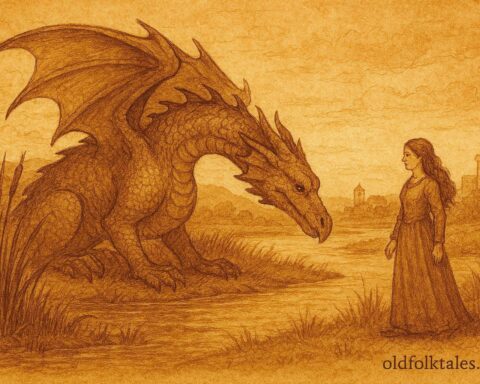
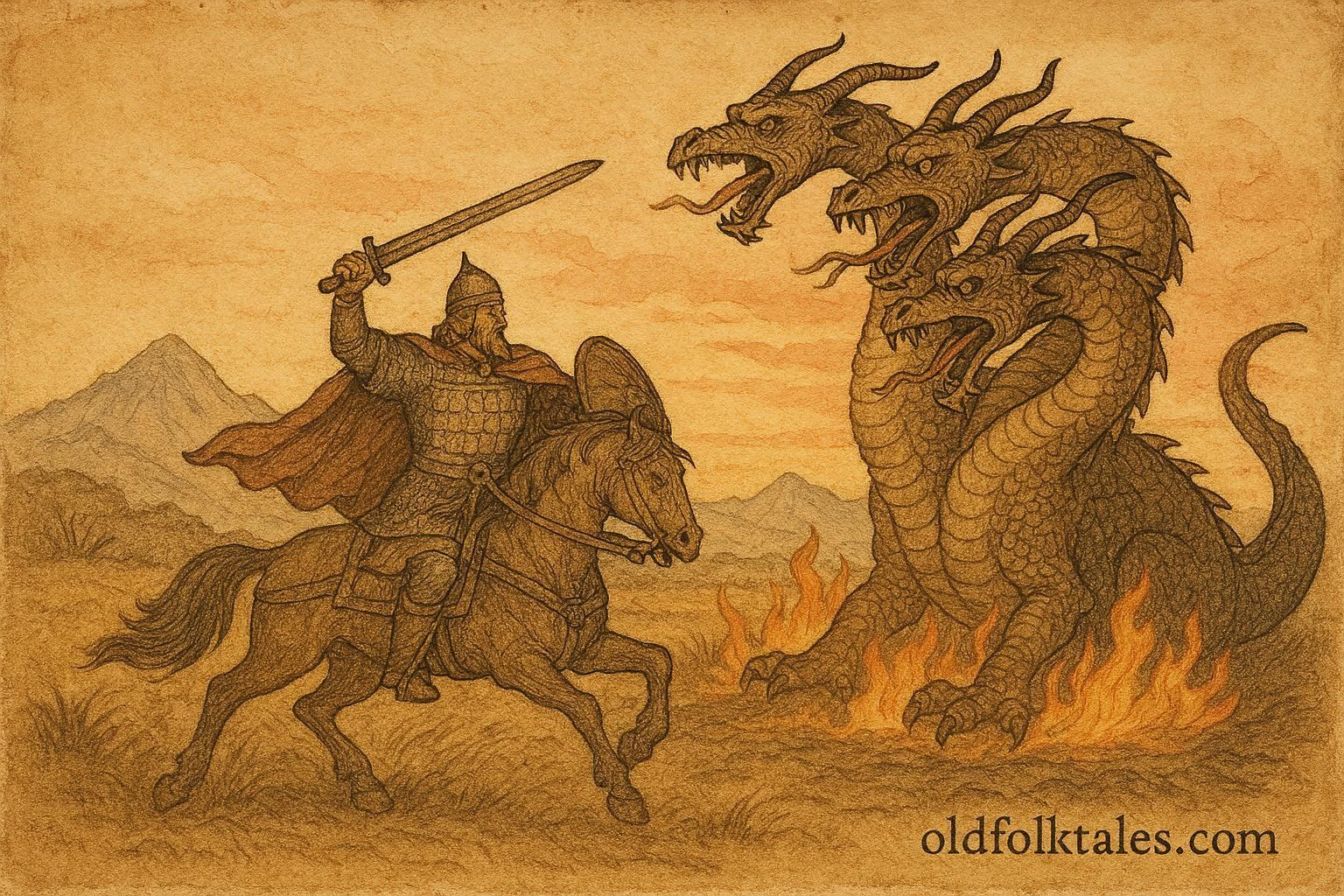
Zmey Gorynych was no simple beast of tooth and claw. In the songs of the byliny, he is described as vast and terrible, with multiple heads rising from a single scaled body. From each mouth burst fire and smoke. His wings darkened the sky when he rose, and the earth trembled beneath his descent.
He laired beyond the Sorochinsk Mountains, near riverbanks and open fields where villages once thrived. But wherever he passed, homes burned and fields were left blackened. Cattle scattered. People fled.
Worse still, the dragon was said to seize captives, among them royal maidens, carrying them to his distant lair.
When word reached the court that the dragon had again descended, fear rippled through the people. They turned, as they always did, to Dobrynya.
A Mother’s Warning
Before setting out, Dobrynya visited his mother, a wise woman who had long sensed the currents of fate. She had heard the tales and knew the dragon’s cunning.
“Do not go to the Sorochinsk Mountains,” she warned him. “Do not bathe in the Puchai River. Trouble waits where pride walks unguarded.”
Dobrynya listened respectfully, yet his sense of duty weighed heavily upon him.
“How can I remain,” he replied, “when the land suffers? A bogatyr’s strength is not his own, it belongs to the people.”
With blessing given, though reluctantly, he saddled his horse and rode toward the distant hills.
The First Encounter
The journey was long, passing through open steppes and dense woods where even the wind seemed wary. At last Dobrynya reached the Puchai River, whose waters shimmered beneath the sun.
Though warned, he allowed himself a moment’s rest. Setting aside armor and weapons, he stepped into the river to cool his body.
It was then that shadow swept across the water.
Zmey Gorynych descended with a roar that split the sky. Fire burst from his mouths, churning steam where it struck the river’s surface.
Unarmed and caught unprepared, Dobrynya seized what he could, a simple cap weighted with earth, and hurled it with force born of desperation. It struck one of the dragon’s heads, staggering the beast long enough for the hero to reach his sword.
Steel met scale. Flame met resolve.
The battle raged along the riverbank. At last, wounded and astonished by the bogatyr’s endurance, the dragon faltered.
“Spare me,” Zmey Gorynych hissed. “I will trouble Rus’ no more.”
Dobrynya, weary yet honorable, stayed his final blow.
“Swear it,” he commanded.
The dragon swore an oath and fled toward the mountains.
Broken Oaths
Peace, however, did not endure.
No sooner had Dobrynya returned than news arrived that Zmey Gorynych had broken his word. The dragon had descended again, this time abducting a princess of royal blood.
Outrage stirred across the land. The prince’s court fell silent as eyes turned once more to Dobrynya.
He did not hesitate.
“If a monster’s oath is wind,” he said, “then steel must answer.”
The Final Battle
This time Dobrynya rode not in haste, but in grim determination. He carried sword, spear, and whip, each weapon tested and true.
At the Sorochinsk Mountains he found the dragon’s lair, a scorched clearing ringed by blackened stone. Bones lay scattered like pale reminders of former struggles.
Zmey Gorynych rose to meet him, each head roaring defiance. Fire poured across the field, scorching grass to ash.
Dobrynya pressed forward despite the heat. He struck at one head, then another. When flame drove him back, he circled and struck again. The clash echoed across the hills, steel ringing against scale, earth trembling beneath wingbeats.
For three days and three nights, so the epic songs declare, they battled without rest.
On the third day, as dawn broke red upon the mountains, Dobrynya found his opening. With a mighty blow, he severed one head. Then another. The dragon writhed, fire sputtering.
At last, with a final stroke guided by unwavering will, he struck down Zmey Gorynych entirely.
The beast fell silent. Smoke drifted upward and dissolved into morning sky.
Restoration of Peace
Within the dragon’s lair Dobrynya found the captive princess and others taken before her. He freed them and led them back across the steppe.
As they approached the city, bells rang in celebration. The people gathered, not merely to honor a warrior’s strength, but to rejoice in restored safety.
Dobrynya did not boast of his victory. He returned quietly to his place at court, understanding that heroism was not spectacle but service.
The fields were replanted. Villages rebuilt. And though songs would forever recount the fall of Zmey Gorynych, they spoke equally of the duty that compelled a man to rise when others could not.
The Legacy of the Bogatyr
In the byliny of Kievan Rus’, Dobrynya Nikitich stands as one of the great bogatyri, heroes whose strength serves the community. His battle with Zmey Gorynych is more than a tale of dragon-slaying.
It is a story of responsibility.
The dragon embodies chaos and destruction. Dobrynya embodies courage shaped by duty. When the monster breaks its oath, it is not pride but obligation that sends the hero back into battle.
Thus, peace is not won once, it is defended continually.
Discover Polish, Russian, Ukrainian, and Belarusian folktales where magic and morality meet
Moral Lesson
True heroism lies in service to others. Bravery guided by duty protects the vulnerable and restores order. Strength without responsibility is empty, but strength used for the community becomes legend.
Knowledge Check
1. Who is Dobrynya Nikitich in Russian folklore?
He is a bogatyr (epic hero) from the Kievan Rus’ tradition known for defending the homeland.
2. What is Zmey Gorynych?
A fearsome multi-headed dragon who terrorizes villages and abducts royalty.
3. Why does Dobrynya fight the dragon twice?
He spares the dragon initially after an oath, but returns when the dragon breaks its promise.
4. What does the dragon symbolize in the epic?
Chaos, destruction, and threats to community and order.
5. What cultural tradition preserves this story?
It comes from the Russian byliny, epic oral poems of Kievan Rus’.
6. What central theme does the tale emphasize?
Heroism as duty and service to protect the homeland.
Source: Russian byliny (epic oral poems), Kievan Rus’. Recorded in written collections during the 18th–19th centuries.
Cultural Origin: Kievan Rus’ epic tradition.