In a certain Russian village, bordered by dark pine forests and wide open fields that shimmered silver under winter frost, there lived a merchant with his three daughters. Their wooden house stood sturdy against the wind, its carved shutters painted in fading reds and blues, a sign of modest prosperity. The merchant was often away on trade journeys, traveling dusty roads toward distant towns. Though he loved all his daughters, it was the youngest who possessed a gentleness that set her apart.
The elder sisters admired ribbons, jewels, and bright fabrics from the market stalls. They spoke often of finery and fine husbands. The youngest daughter, quiet and thoughtful, preferred the open sky and the rustle of birch leaves. She was diligent in her work and kind in her speech, and there was something inward and luminous about her spirit.
One autumn, before setting off on a long journey, the merchant gathered his daughters and asked what gifts he should bring them. The eldest asked for a necklace of precious stones. The second wished for embroidered silk from a distant city. When he turned to the youngest, she hesitated and then said softly, “Father, bring me a feather from Finist the Bright Falcon.”
The merchant frowned. He knew of no such feather. Yet he promised to look.
In bustling marketplaces and roadside inns, he searched for jewels and silk and easily found what his elder daughters desired. But nowhere did he find the feather of Finist. At last, when he had nearly abandoned hope, he encountered a strange old man at the edge of a forest clearing. The old man carried a small bundle and seemed to be waiting.
“What troubles you, merchant?” the old man asked.
The merchant explained his quest.
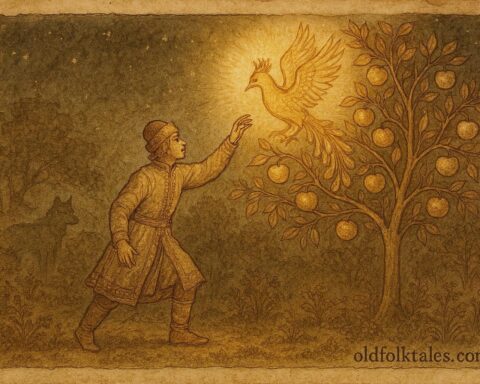
The old man smiled faintly and drew from his bundle a single radiant feather. It shimmered in the light, not like gold or silver, but with a living brightness. The merchant paid a high price for it and hurried home.
His elder daughters rejoiced over their treasures. The youngest accepted the feather with reverence and gratitude. That night, alone in her small chamber beneath the eaves, she held the feather and whispered, “If you are truly Finist the Bright Falcon, appear to me.”
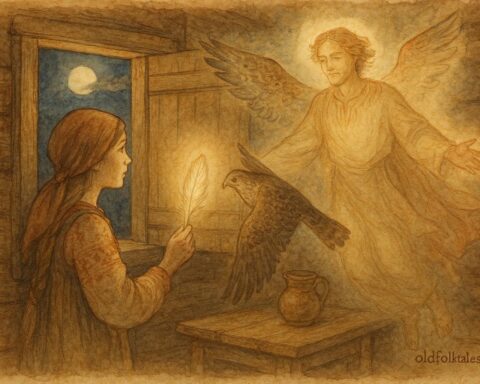
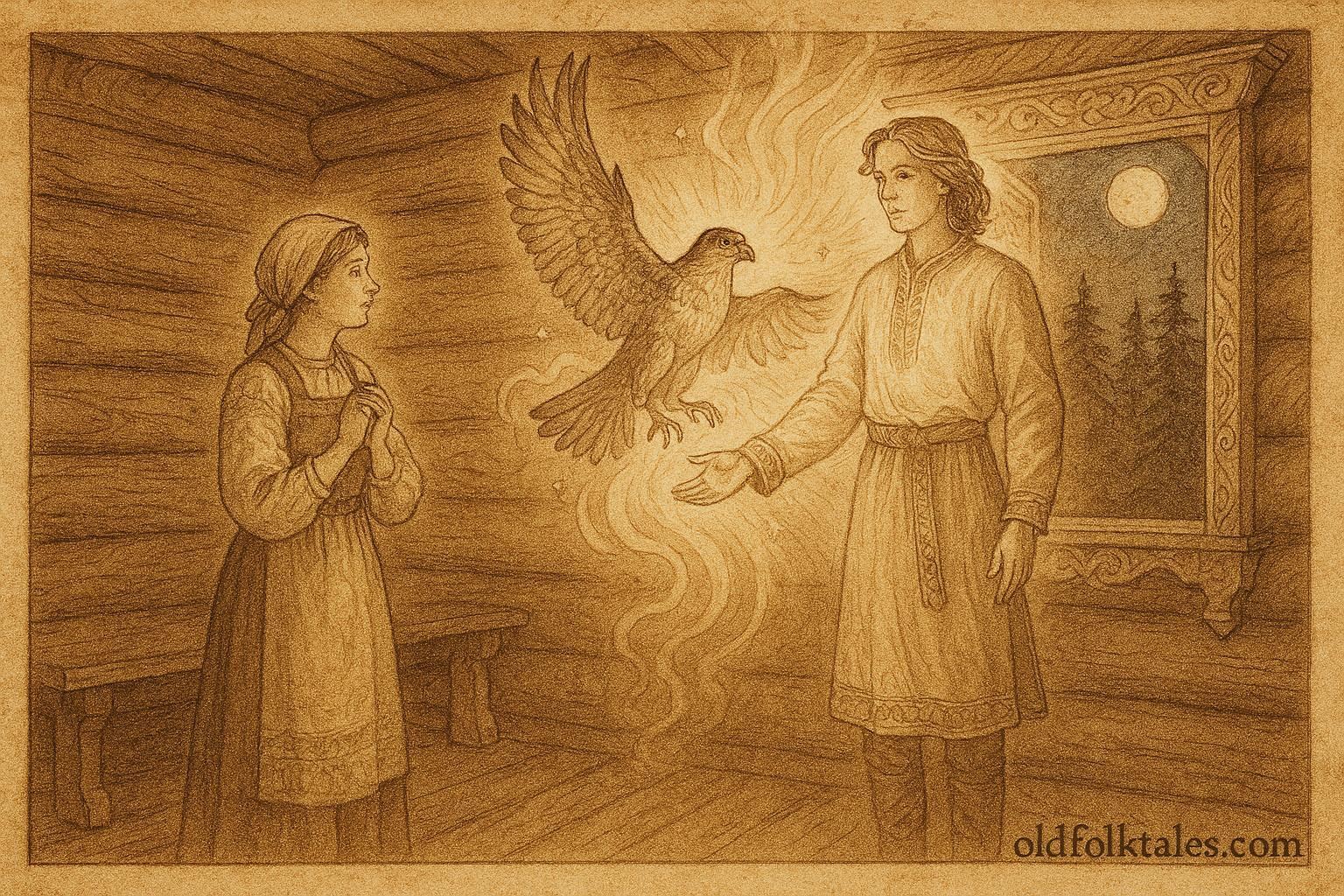
At once, the window flew open though there was no wind. Into the room swept a magnificent falcon, its wings gleaming in the moonlight. As it touched the floor, it transformed into a handsome young prince.
“I am Finist,” he said gently. “You called me, and I have come.”
From that night forward, he visited her in secret. By day he was a falcon soaring high above the forests; by night he became a prince who spoke kindly and listened deeply. The youngest daughter’s heart filled with quiet joy.
But joy rarely hides for long.
Her sisters grew suspicious of her contentment. They noticed her glow, her secret smiles. Driven by envy, they pressed her for answers. At last, they discovered the truth. Their jealousy hardened into cruelty.
One evening, while their sister slept, they placed sharp knives and needles along the window frame. When Finist returned in falcon form, he struck the hidden blades. His wings were cut, and crimson drops stained the pale wood.
Inside, the youngest daughter stirred but did not wake. Wounded and sorrowful, Finist beat his wings and cried out, “If you love me, seek me beyond thrice-nine lands, in the thrice-tenth kingdom.”
His voice faded into the night.
When morning came, the youngest daughter saw the blood upon the sill. Understanding pierced her heart. Her sisters feigned innocence, but she knew betrayal when she saw it.
She wept bitterly, yet her grief did not paralyze her. She went to her father and begged permission to travel in search of Finist.
Her father tried to dissuade her. “The world is wide and perilous,” he warned. “You are young.”
But her resolve did not waver. Seeing that he could not change her mind, he ordered iron shoes to be forged, an iron staff to support her steps, and iron caps to shield her head. Thus prepared, she set out across the vast Russian land.
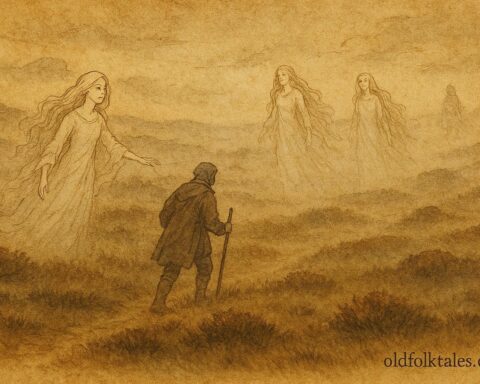
She walked through meadows where wildflowers bowed in the wind. She crossed rivers cold as glass and passed beneath forests so dense that daylight barely touched the earth. Her iron shoes wore thin; her staff bent with use. Still, she pressed on.
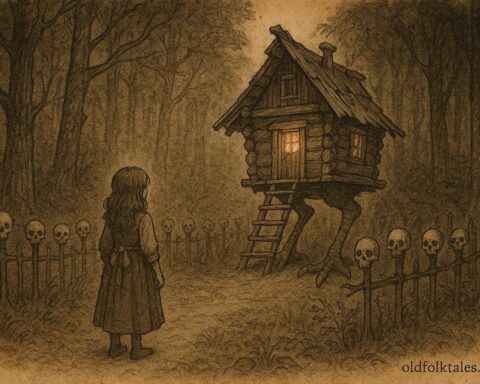
In time she came upon a hut standing on chicken legs, turning slowly in a forest clearing. Gathering her courage, she spoke the proper words, and the hut turned its door toward her. Inside dwelled an old woman, ancient and sharp-eyed.
The old woman listened as the maiden told her story.
“You seek Finist,” she said. “Your path is long. Take this silver spindle and golden distaff. When you spin, the thread will shine like the sun. It may serve you.”
The maiden thanked her and continued her journey.
She came to another hut in another forest and met a second old woman, who gave her a silver embroidery frame and golden needle that stitched patterns of dazzling beauty.
Farther still she traveled until she reached a third hut. There she received a silver dish and golden egg that spun and shimmered when placed upon it.
With these gifts and her unbreakable will, she crossed into distant kingdoms.
At last she heard news: a prince named Finist was to wed a wealthy bride. Her heart trembled, but she did not turn back.
She found work in the palace kitchens of that kingdom. When evening fell, she took out the silver spindle and golden distaff. The shining thread caught the attention of the prince’s bride.
“Sell it to me,” demanded the bride.
“It is not for sale,” the maiden replied quietly. “But grant me one night to watch over Prince Finist as he sleeps.”
The bride, curious and confident, agreed.
That night, the maiden entered the prince’s chamber. But the bride had given him a sleeping potion. No matter how she wept or called his name, he did not wake.
The second night, she offered the embroidery frame and golden needle in exchange for another vigil. Again, the prince lay motionless, drugged into deep slumber.
On the third night, she brought forth the silver dish and golden egg. Its brilliance captivated the bride, who granted her one final chance.
This time, servants whispered that someone sought the prince each night. Finist, half-aware, refused the potion.
When the maiden entered and spoke his name, his eyes opened.
Recognition dawned like sunrise.
“You have come,” he whispered.
“I walked until my iron shoes wore away,” she replied. “I crossed forests and rivers. I would have walked farther still.”
Finist rose and took her hands. The truth became known in the palace. The false bride’s greed and deception were revealed.
Finist declared before all that it was the steadfast maiden, not the wealthy suitor, who had proven her worth through loyalty and sacrifice. He chose her as his true bride.
Their wedding was celebrated with songs that echoed through the halls and out across the fields. And in time, they returned to her homeland, where forgiveness was offered but lessons were remembered.
Thus, through endurance and unwavering love, she reclaimed what jealousy had stolen.
Step into the enchanted forests and mystical realms of the Slavic imagination
Moral Lesson
True devotion is proven not in comfort but in perseverance. Love that endures hardship, resists envy, and walks faithfully through trial emerges stronger and brighter than before.
Knowledge Check
1. Who is Finist in the Russian folktale?
Finist is a magical falcon who transforms into a prince at night.
2. Why does the youngest daughter begin her journey?
She seeks Finist after her jealous sisters wound him and drive him away.
3. What do the iron shoes symbolize?
They represent endurance, sacrifice, and the long hardship required to reclaim true love.
4. How does the heroine finally awaken Finist?
On the third night, he refuses the sleeping potion and awakens when she calls his name.
5. What theme is central to this Russian folktale?
Perseverance and devotion triumph over jealousy and deceit.
6. What is the cultural origin of Finist the Bright Falcon?
It comes from Russian and East Slavic oral tradition recorded in the 19th century.
Source: Russian folktale, Russia.
Collected in the 19th century by Alexander Afanasyev (1855–1863).
Cultural Origin: Russian / East Slavic oral tradition.