In a quiet village nestled among the rolling fields and riverbanks of central Ukraine, there lived a poor peasant and his three sons. Their cottage was small, its thatched roof weathered by wind and rain, but smoke rose faithfully from the chimney each morning. The family owned little beyond a patch of land and a few worn tools, yet they endured with patience.
The two elder sons were strong and proud. They spoke confidently of their future fortunes and often mocked those they considered foolish. The youngest son, however, was different. He was simple in manner and soft in speech. He worked diligently, asked for little, and bore his brothers’ teasing without resentment. Because of his quiet nature, they often called him a fool.
One day, news spread throughout the countryside that the king had proclaimed a challenge: whoever could build a flying ship would win the hand of the princess. The king, shrewd and calculating, believed the task impossible. He intended only to amuse himself by watching ambitious men fail.
The elder brothers were quick to declare their intentions. “We shall build the flying ship,” they boasted. “And one of us shall marry the princess.”
They packed provisions and set off into the forest, laughing at the absurdity of the challenge but determined to try.
As they traveled deeper among tall oaks and whispering birches, they encountered an old man seated upon a fallen log. His beard was long and white, his clothes plain.
“Where are you going, young men?” he asked.
“To build a flying ship and marry the princess,” they answered impatiently.
“And what will you give me for advice?” he inquired gently.
They scoffed. “We need no advice from a forest beggar,” they replied and strode past him.
In the forest they attempted to cut wood, but their axes slipped, and the trees split poorly. The planks would not fit together. By evening, they had accomplished nothing but splintered boards and sore hands. Ashamed, they returned home with excuses.
Soon the youngest son asked his father for permission to try.
His brothers burst into laughter. “You? Build a flying ship? You cannot even mend a fence properly!”
Yet the father, though doubtful, saw sincerity in his youngest son’s eyes and gave his blessing.
The boy packed a crust of bread and walked into the same forest. There, just as before, the old man sat waiting.
“Where are you going, child?” the old man asked.
“To build a flying ship and seek the princess,” the boy answered honestly.
“And what have you brought to eat?” the old man asked.
“Only dry bread,” the boy replied, “but I will gladly share it.”
He broke the crust in two. As the old man took a piece, the bread became fresh and warm, as though newly baked.
The old man smiled. “Because you have shared what little you possess, I will help you. Go deeper into the forest. Strike the first tree you see and fall asleep. When you wake, your ship will be ready.”
The boy followed the instructions. He struck a tall oak, laid his head upon the mossy ground, and slept.
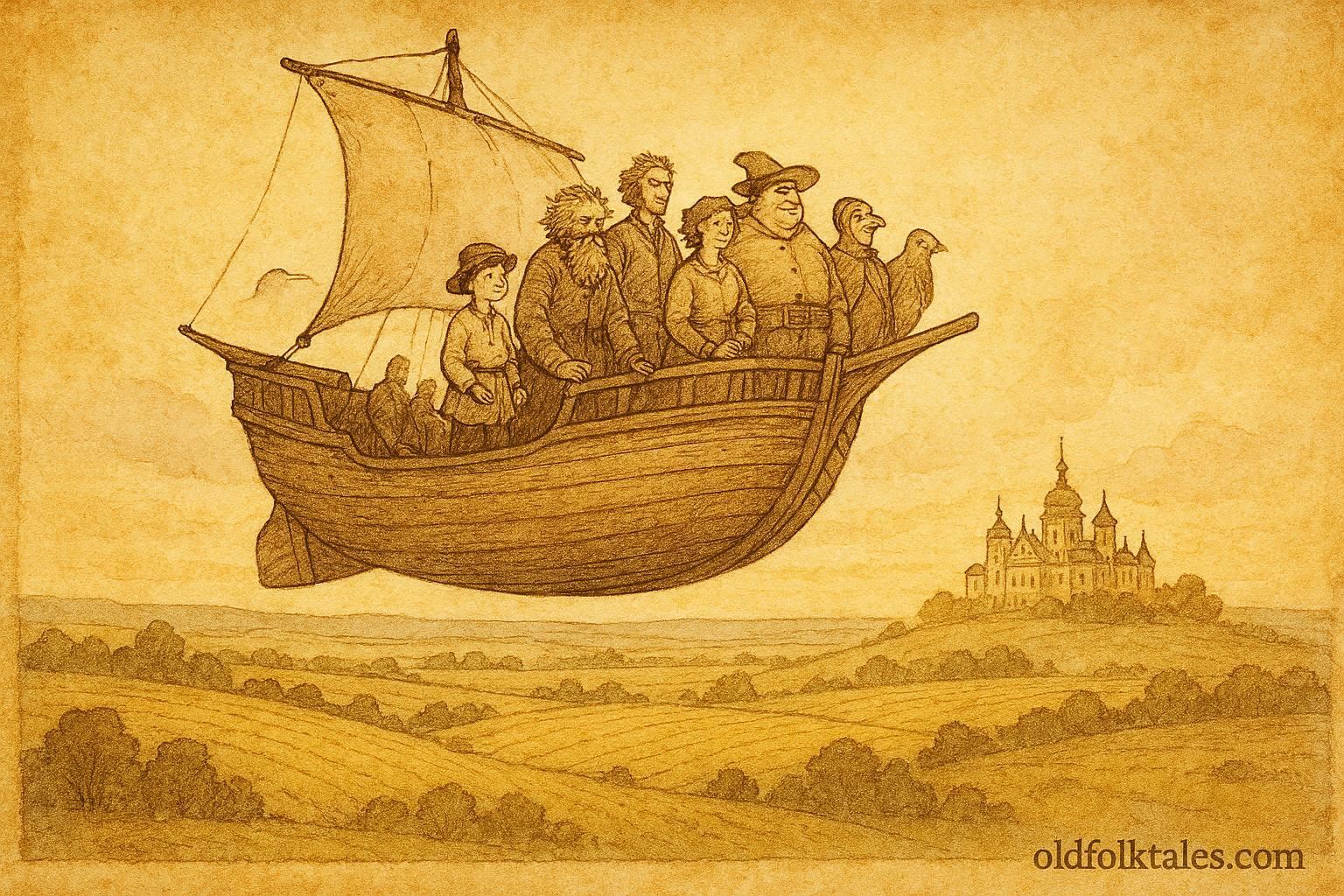
When he awoke, he found before him a magnificent ship unlike any vessel seen upon river or sea. Its hull was carved of shining wood, its sails woven of fine linen, and beneath it were no wheels nor runners. It floated gently in the air as though carried by invisible currents.
Amazed but grateful, the boy climbed aboard and set sail across the sky.
As he traveled, he encountered a man lying on the ground with one ear pressed firmly to the earth.
“What are you listening for?” the boy called down.
“I hear all that happens in the world,” the man replied. “I can hear grass growing and kings whispering in distant halls.”
“Come with me,” said the boy. “I journey to seek my fortune.”
The man agreed and climbed aboard.
Farther on, they saw another man standing with one leg tied to his ear.
“Why do you bind your leg so?” the boy asked.
“If I untie it, I will run so swiftly that I circle the earth in a single stride,” the man answered.
“Your speed may prove useful. Join us.”
The man smiled and boarded the ship.
Next, they met a marksman holding a bow though no target stood nearby.
“What do you aim at?” asked the boy.
“I can strike a bird in flight beyond sight of the eye,” the archer replied.
“Then travel with us,” said the boy.
And so he did.
They encountered another man carrying an enormous sack.
“What do you carry?” the boy asked.
“Hunger,” the man replied. “I can consume enough bread to empty a bakery.”
“You are welcome aboard,” said the boy.
Soon they found a man bearing a barrel of water.
“I am always thirsty,” he said. “I can drink lakes dry.”
“You may join us as well,” the boy answered.
Lastly, they met a man hauling a bundle of straw.
“For what purpose?” asked the boy.
“If I scatter this straw, frost will cover the earth even in summer heat.”
Recognizing that each gift had purpose, the boy welcomed him.
Thus, the flying ship carried a curious company across the sky toward the royal palace.
When they arrived, the king peered from his window and was startled to see a ship descending from the clouds. He had not expected success, least of all from a peasant’s son dressed in plain clothes.
Unwilling to grant his daughter so easily, the king devised impossible tasks.
First, he commanded, “By tomorrow morning, bring me water from the well at the edge of the world.”
The swift runner untied his leg and vanished like lightning. Reaching the distant well in moments, he filled a flask. Yet on the return journey he grew weary and slept beneath a tree.
The listener pressed his ear to the ground. “Our runner sleeps,” he announced.
The archer drew his bow and shot an arrow so precise it struck the tree beside the sleeper, waking him instantly. The runner resumed his course and delivered the water by dawn.
The king frowned.
Next, he ordered, “Consume twelve ovens of bread before sunset.”
The hungry man stepped forward and ate loaf after loaf until not a crumb remained.
The king’s eyes narrowed.
Then he commanded, “Drink twelve barrels of mead.”
The thirsty man obliged, draining each barrel and wiping his mouth contentedly.
Still dissatisfied, the king arranged one final trial. He ordered the peasant boy locked inside an iron bathhouse heated until its walls glowed red.
The companions did not despair. The man with straw scattered it around the bathhouse. At once frost blanketed the building, cooling the iron and filling the chamber with winter’s chill. Inside, the boy felt only gentle cold and waited calmly.
When the doors were opened, he stepped out unharmed.
The king could deny no longer what stood before him: cooperation, loyalty, and humility had succeeded where pride had failed.
Reluctantly at first, but bound by his word, he granted the princess’s hand to the peasant boy.
The princess herself had watched closely. She had seen not arrogance but kindness in the young man’s actions. She saw how he treated his companions as equals and how he shared credit for every victory. In time, respect grew between them.
As for the companions, they were honored guests at the wedding feast, seated beside nobles and lords. The flying ship remained a marvel in the kingdom, a symbol that fortune favors not the proud, but the generous.
And so the simple peasant boy, once mocked as a fool, rose not by cunning alone, but through humility and the strength of friendship.
Moral Lesson
True greatness does not arise from pride or status, but from humility, generosity, and the ability to work together. Even the simplest person can rise high when guided by kindness and supported by loyal companions.
Knowledge Check
1. Who helps the peasant boy build the flying ship?
An old man in the forest rewards the boy’s generosity by magically creating the ship.
2. What special abilities do the companions possess?
They can hear distant events, run at incredible speed, shoot with perfect aim, eat enormous amounts, drink vast quantities, and create frost.
3. How does the group succeed in the king’s challenges?
They combine their unique talents and cooperate rather than competing.
4. What does the flying ship symbolize in Ukrainian folklore?
It represents magical opportunity made possible through humility and virtue.
5. Why does the king set impossible tasks?
He hopes to prevent a peasant from marrying the princess.
6. What central theme defines this Ukrainian folktale?
Teamwork and humility triumph over pride and social barriers.
Source: Ukrainian folktale, Ukraine. Collected by Mykhailo Drahomanov, 1876.
Cultural Origin: Central Ukrainian heroic-fantastic folklore with Slavic mythic motifs.