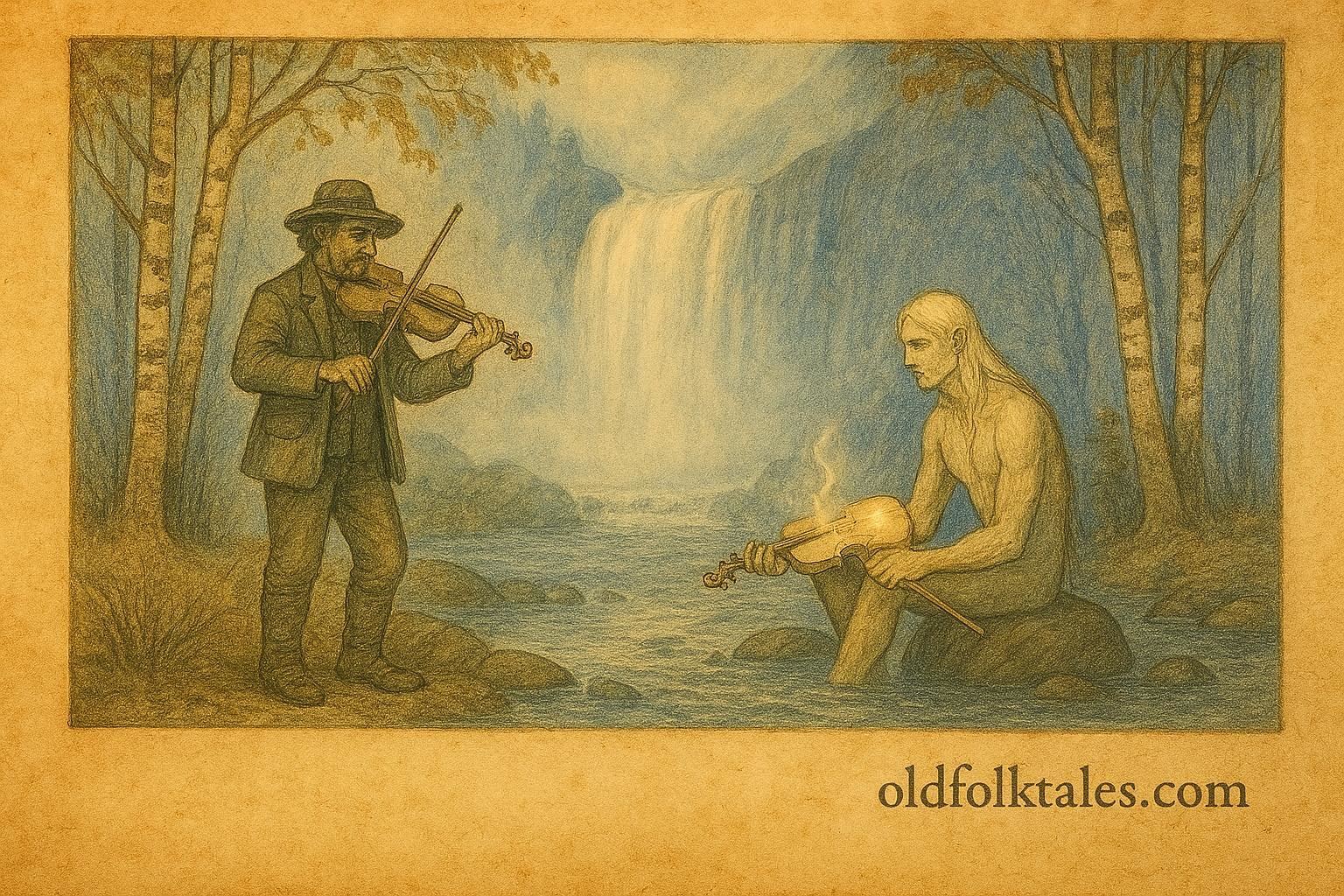
In the quiet river valleys of central Sweden, where silver waters wound through birch forests and mist lingered low over the reeds at dawn, there lived a poor farmer’s son named Anders. From childhood, Anders had loved the sound of the fiddle more than bread, more than sleep, and sometimes more than sense itself.
When he was meant to tend cattle, he practiced scales beneath the trees. When he should have repaired fences, he lingered by the riverbank, drawing melodies from worn strings. The villagers smiled kindly at his ambition, but none mistook him for a master. His playing was earnest yet ordinary.
But Anders did not want ordinary.
He had heard whispers of Näcken, the river spirit said to dwell beneath waterfalls and dark pools. Some described Näcken as beautiful and pale, seated upon a stone in the stream, drawing haunting music from a violin of his own. Others warned that his songs lured listeners into dangerous waters. Yet all agreed on one thing: none could match his skill.
Anders’s longing grew into obsession.
One autumn evening, when fog rolled thick across the river and the sky burned briefly crimson before darkening, Anders took his fiddle and ventured deep into the forest. The river narrowed into a rocky gorge, and there the water fell in a shimmering curtain over black stone.
He stood at the edge and played.
His melody trembled in the cool air, hopeful, imperfect, yearning.
At first there was only the rush of water.
Then, from the mist, another tune answered.
It was flawless.
The notes flowed like liquid silver, weaving sorrow and beauty into a single thread of sound. Anders lowered his bow in awe.
From atop a stone in the river sat a pale figure, golden hair trailing over his shoulders, bare feet resting in the water. His eyes were bright, reflective like moonlight on ice.
“Näcken,” Anders whispered.
The spirit tilted his head, smiling faintly.
“You seek something,” Näcken said, his voice as smooth as the current.
“I want to play as you do,” Anders answered. “Teach me.”
The river spirit’s smile deepened, though something unreadable flickered within it.
“Skill such as mine does not come from patience alone,” Näcken replied. “It requires devotion… and secrecy.”
“I will give both,” Anders said quickly.
Näcken studied him.
“Return each night when the moon is full. Tell no one where you go. Practice only what I teach. And above all, remember that music binds more than fingers, it binds the soul.”
Anders agreed without hesitation.
Thus began his secret lessons.
Each full moon, Anders slipped from his family’s cottage and made his way through forest shadows to the waterfall. There, perched on his stone, Näcken guided his hands. The spirit corrected every misplaced finger, refined every faltering bow stroke.
The melodies grew deeper.
Stranger.
More powerful.
Under Näcken’s instruction, Anders learned songs that stirred laughter without joy and sorrow without tears. He mastered rhythms that quickened hearts and harmonies that made listeners shiver.
Weeks became months.
Anders’s playing transformed.
When he returned to the village, he no longer sounded like the farmer’s son with simple ambition. His fiddle sang with an almost unnatural brilliance. At weddings, couples danced until breathless. At funerals, mourners wept openly. Even the oldest villagers admitted they had never heard such music.
Praise fed his pride.
But something else changed as well.
The music seemed to pull at people.
Listeners sometimes swayed too close to rivers after hearing him play near water. A shepherd once stumbled into a marsh, dazed after an evening performance. Anders told himself these were coincidences.
Yet Näcken’s warnings echoed faintly in his mind.
One winter night, as frost coated the ground and the river lay half-frozen, Anders approached the waterfall again. His breath clouded before him. Näcken’s expression was more solemn than usual.
“You have learned well,” the spirit said. “Soon you will surpass all others. But mastery demands one final devotion.”
Anders hesitated.
“What devotion?”
“Play only my songs,” Näcken replied. “Let no simple village tune pass your bow again. Forget your childish melodies. They are beneath you now.”
Anders felt a tightening in his chest.
Those “childish melodies” were the songs his mother hummed while baking bread. The tunes his father whistled during harvest. The simple dances of midsummer.
“They are not worthless,” Anders said softly.
Näcken’s eyes darkened like storm water.
“You asked for greatness. Greatness leaves small things behind.”
The wind rose sharply, rattling ice along the riverbank.
For the first time, Anders felt fear.
He understood then that the gift he had received was not merely skill, it was influence, power woven through sound. If he surrendered his old songs entirely, what else might he surrender?
His roots.
His heart.
Perhaps even himself.
“I cannot abandon them,” Anders said firmly. “I will not forget where I come from.”
Näcken’s form shimmered, anger rippling across his features.
“Then you choose imperfection.”
“I choose myself.”
The waterfall thundered louder, and the spirit’s music turned wild and dissonant, swirling around Anders like cold wind. For a moment he feared being pulled into the dark current.
But he lifted his fiddle and played.
Not one of Näcken’s haunting masterpieces.
He played a simple village waltz.
The melody was warm, imperfect, human.
It did not command or enchant. It invited.
The harsh river-music faltered.
Näcken’s expression softened, not in kindness, but in reluctant understanding.
“You have learned the final lesson,” the spirit said quietly. “True music belongs to those who keep their own soul intact.”
The mist thickened, and Näcken faded into the rushing water.
Anders stood alone beneath the winter sky.
When spring returned, his playing remained extraordinary, but it was different. He could still perform the haunting river songs, yet he chose carefully when to do so. He blended them with village tunes, honoring both skill and sincerity.
The villagers admired him not only for his talent, but for the warmth within his music.
He had not become the river’s instrument.
He had become himself.
And so, the story of the fiddler who studied with Näcken passed through the valleys of Sweden, a reminder that ambition without balance can sweep a person away like a strong current, but integrity anchors even the greatest talent.
Moral Lesson
Talent gained through shortcuts or secret bargains may bring brilliance, but without integrity it can erode the soul. True mastery lies not only in skill, but in remaining faithful to one’s origins and conscience.
Knowledge Check
1. Who is Näcken in Swedish folklore?
Näcken is a river spirit known for enchanting music and supernatural teaching.
2. What does Anders seek from Näcken?
He seeks unmatched musical mastery and artistic greatness.
3. What condition does Näcken demand?
Devotion, secrecy, and eventually the abandonment of ordinary village songs.
4. What theme does the story emphasize?
Ambition must be balanced with integrity and self-identity.
5. What risk comes with supernatural bargains?
Gifts tied to spirits may demand hidden costs affecting one’s soul.
6. Where does this folktale originate?
Central Swedish River regions, recorded in 19th-century folklore accounts.
Source: Collected in 19th-century folklore accounts by Gunnar Olof Hyltén-Cavallius, 1840s
Cultural Origin: Central Swedish River regions