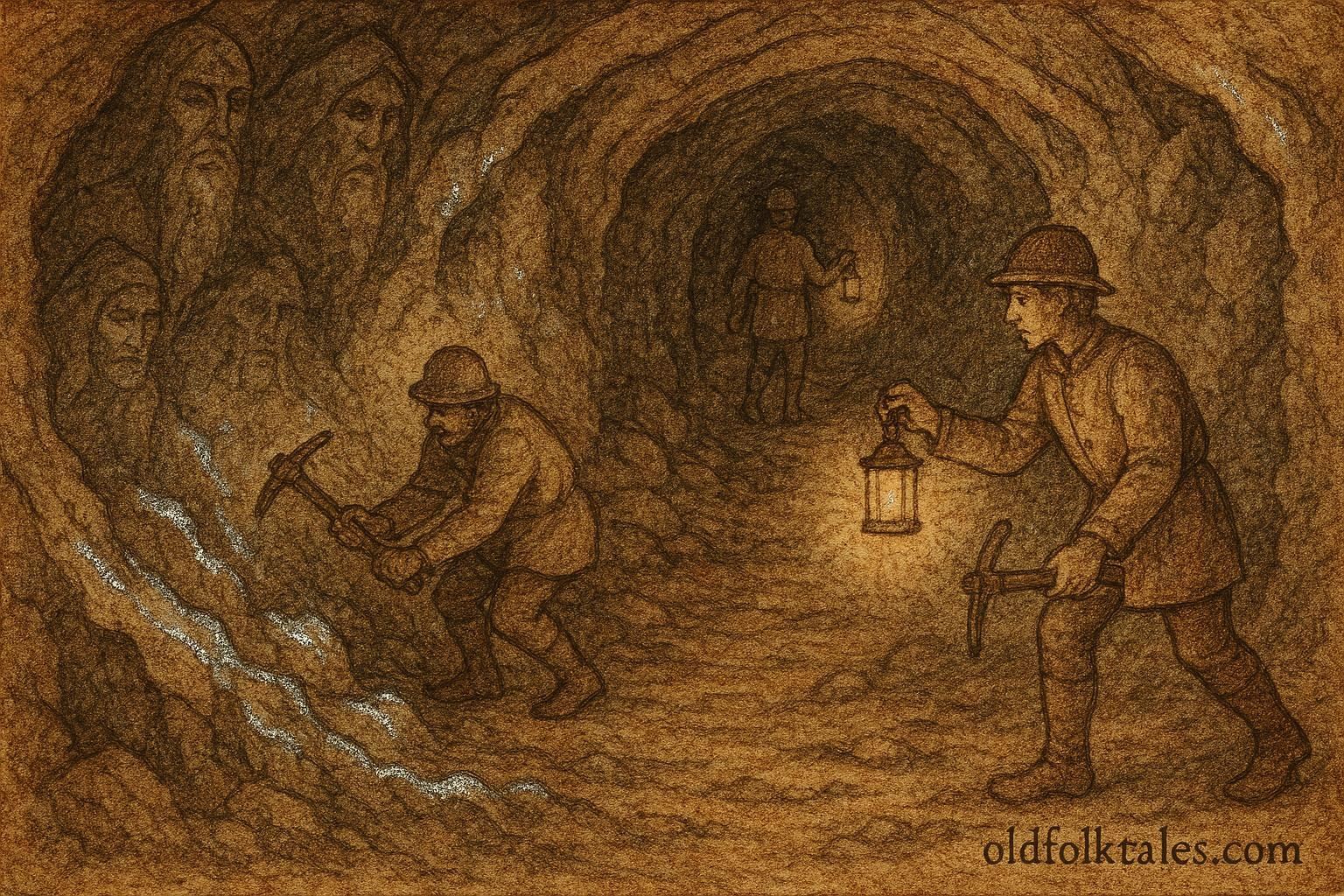
In the heart of Västmanland, in the town of Sala, there lies one of Sweden’s most storied treasures, the great silver mine. For centuries, men descended into its cold, echoing shafts, chiseling wealth from stone older than memory. But among the miners, it was always understood: silver did not belong to men alone.
Deep beneath the earth, in tunnels lit by flickering lanterns and smelling of iron and damp stone, whispers traveled as surely as hammer blows. The silver veins were guarded. Not by soldiers nor by kings, but by mountain spirits.
The elders called them gruvrået, the mine spirit, unseen watchers who ruled the underground kingdom.
Young miners often laughed at such tales. But the older men did not.
They had heard the knocks in empty tunnels.
They had felt sudden cold breath in windless shafts.
They had seen tools splinter for no reason at all.
And they knew better than to mock what they could not see.
One such miner was Lars Pettersson, a strong and ambitious man who believed more in his pickaxe than in old stories. He had worked the Sala Silver Mine since boyhood and had grown restless. He wanted more than daily wages. He wanted fortune.
“There is richer ore below,” he insisted one winter evening in the candlelit bunkhouse. “I’ve seen the vein thinning above. The true silver runs deeper.”
Old Anders, who had mined for forty years, shook his head slowly.
“The deeper tunnels are unstable,” he warned. “And the spirits do not favor greed.”
Lars scoffed. “Spirits do not break rock. Men do.”
So, when spring came, Lars gathered a small crew of younger miners and persuaded them to follow him into a lesser-worked shaft, one rumored to hold untouched silver.
At first, fortune seemed to favor him.
They discovered promising veins gleaming faintly within the stone. The silver shimmered under lantern light like threads of moonlight trapped underground.
Lars worked feverishly, urging the men onward.
“Take more,” he said. “We will be wealthy by summer.”
But as days passed, strange things began to happen.
Pickaxe heads snapped cleanly from their shafts. Lantern flames flickered without draft. Once, a support beam cracked loudly though no pressure had shifted.
The youngest miner swore he heard soft knocking behind the walls, not the echo of tools, but rhythmic taps, almost deliberate.
“Like someone answering us,” he whispered.
Lars dismissed it. “Stone settles. Wood weakens. Work.”
But one afternoon, as they carved into a particularly rich vein, the tunnel groaned, a deep, shuddering sound that seemed to rise from the bones of the earth itself.
Dust rained down. A beam split.
Only quick movement saved them from a full collapse.
They escaped with minor injuries, shaken but alive.
That night, the men refused to return.
Old Anders listened to their account and sighed.
“You have taken without asking,” he said quietly. “You have worked without respect.”
“What would you have us do?” Lars snapped.
“Remember where you stand,” Anders replied. “This is not only stone and silver. It is a realm with its own order.”
The next morning, Anders descended alone into the mine. In his coat pocket he carried a small offering: fresh bread, a pinch of salt, and a silver coin.
At the base of a quiet shaft, he placed them upon a flat rock.
“We thank you,” he murmured into the darkness. “Guide us to what we need, not what we greedily demand.”
The air felt still.
But calm.
When work resumed days later, something had changed.
Lars, though unconvinced, worked more cautiously. He reinforced beams carefully. He listened when stone shifted. He allowed breaks instead of driving the men relentlessly.
And then, almost gently, they uncovered another vein.
This one was steady and stable, running strong through solid rock. It yielded silver in abundance without groaning walls or snapping tools.
Even Lars could not deny the difference.
He noticed something else too: the faint knocking sounds had ceased.
In time, he came to understand what the older miners already knew.
The mine was not conquered.
It was negotiated with.
Years passed. Lars grew older. He told new apprentices the same stories he once dismissed. He described how greed tightened the tunnels and how humility seemed to open them.
Some miners claimed to glimpse small shadowy figures at the edge of lantern light, shapes no larger than children, vanishing behind stone pillars. Others swore they saw handprints in silver dust that did not belong to any man.
Whether spirit or superstition, none could say for certain.
But the pattern endured.
When miners rushed recklessly, collapses followed.
When they cursed and mocked, tools broke.
When they paused in gratitude and worked with care, the silver flowed.
Thus, the legend of the mountain spirits of Sala became as much a part of the mine as the veins themselves.
The wealth drawn from the earth built homes, churches, and trade across Sweden. Yet those who descended into the deep remembered that fortune was never entirely theirs.
It was shared, with forces older than memory.
And so, in the cold chambers beneath Västmanland, respect became the greatest protection of all.
Moral Lesson
Greed invites danger, but humility invites guidance. When humans respect the unseen forces of nature and practice moderation, risk turns into reward. True prosperity comes not from force, but from balance.
Knowledge Check
1. What are the mountain spirits in the Sala Silver Mine called?
They are known as gruvrået, the mine spirits who guard underground wealth.
2. What happens when miners become greedy?
Tools break, tunnels become unstable, and collapses threaten their safety.
3. How do miners show respect to the spirits?
By working carefully, avoiding greed, and leaving small offerings underground.
4. What theme does this Swedish folktale emphasize?
The balance between risk and moderation, and respect for unseen natural forces.
5. Where is the Silver Mine located?
In Sala, Västmanland, Sweden.
6. What cultural belief does the story reflect?
That nature and underground resources are governed by spiritual guardians requiring humility.
Source: Regional mining legends recorded in 19th-century Swedish folklore collections; later featured in Bland tomtar och troll, first published 1907
Cultural Origin: Sala, Västmanland, Sweden.