In the rugged highlands of Northern Albania, where the mountains rise like stone guardians and the wind carries ancient songs across the valleys, there lived a young man named Muji. At that time, he was not yet the mighty warrior whose name would thunder across the land. He was simply a shepherd’s son, strong in spirit but worn thin by hardship.
The mountains of the north are not gentle places. Their cliffs cut into the sky, their forests whisper with secrets, and their rivers carve narrow paths through stone. Life there demands endurance. Muji had grown up among these heights, tending flocks across slopes where only the sure-footed dared to walk. Yet despite his determination, his body had grown weak. Long days beneath the harsh sun and cold nights on bare ground had drained him.
Discover Polish, Russian, Ukrainian, and Belarusian folktales where magic and morality meet
One afternoon, after wandering far in search of pasture, Muji felt his strength abandon him. His limbs trembled, his breath came shallow, and the world seemed to tilt beneath his feet. He stumbled into a shaded hollow among ancient pines and lay down upon the earth. The scent of resin and wild thyme filled the air. Above him, clouds drifted slowly across a wide blue sky.
He closed his eyes, unsure if he would rise again.
It was then that she appeared.
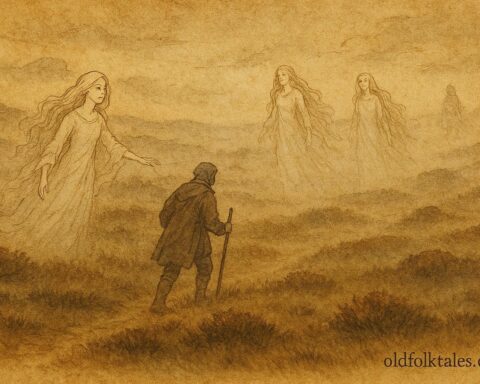
From the quiet heart of the forest emerged a Zana, a mountain fairy of great power and mystery. The Zana were known throughout the highlands, beings bound to nature, guardians of springs and peaks, unseen protectors of brave men and fierce enemies to cowards. She moved lightly over the ground, as though the earth welcomed her steps.
Her presence was neither frightening nor soft, but commanding. Her eyes held the clarity of mountain water; her hair shimmered like sunlight caught in river spray. She looked upon Muji not with disdain, but with consideration.
Here lay a young man whose spirit had not broken, though his body faltered.
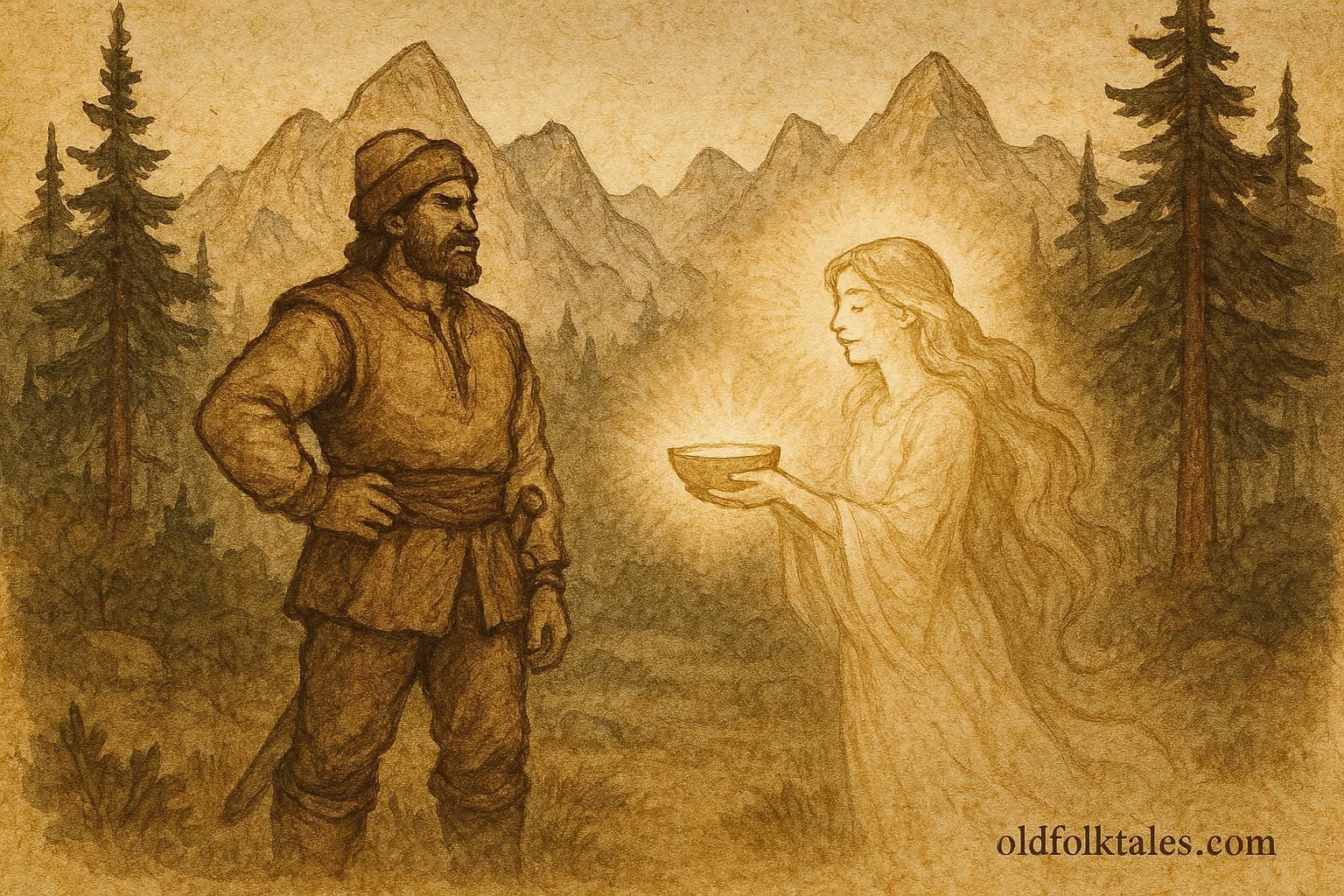
The Zana knelt beside him. She touched his brow, and her hand was cool as fresh water. Muji stirred. When he opened his eyes, he saw her standing above him, luminous against the dark green forest.
“Why do you lie here in weakness?” she asked.
Muji struggled to sit upright. Though exhausted, he did not lower his gaze.
“I have worked,” he answered simply. “But my strength is gone.”
The Zana studied him closely. In his words there was no complaint, only truth. In his eyes, no cowardice. She saw the makings of something greater, if only the spark could be kindled.
Without further speech, she summoned from the unseen realm a bowl of milk, white, pure, and gleaming faintly with power. It was no ordinary milk, but nourishment drawn from forces older than the mountains themselves.
“Drink,” she commanded.
Muji accepted the bowl with trembling hands. The milk was cool upon his lips, yet as he swallowed, warmth surged through him. It flowed into his limbs like fire tempered by light. His heart pounded with new vigor. His breath deepened. His muscles tightened with power unfamiliar yet welcome.
He finished the bowl and rose to his feet.
The weakness that had weighed upon him was gone. In its place surged strength beyond anything he had known. He felt as though he could uproot trees, split stone, command the winds themselves.
The Zana watched him carefully.
“This strength is not given lightly,” she said. “It binds you to purpose.”
Muji bowed his head, not in fear, but in respect.
“What purpose?” he asked.
“To defend these mountains,” she replied. “To protect the land and its people from those who would seize it.”
For even in those times, the northern lands faced threat. Invaders sought to cross the passes, to claim the valleys and silence the songs of the highlands. The people needed champions, men whose courage matched the harsh beauty of their homeland.
Muji felt the weight of her words settle upon him. This strength was not meant for pride, nor for idle boasting. It was a trust.
“I will defend them,” he said.
The Zana nodded once. Her task was done.
With the whisper of wind through leaves, she vanished into the forest, leaving Muji alone, but no longer the same man.
From that day forward, Muji’s name began to spread across the northern territories. Where once he had struggled to stand, he now strode across mountains with unshakable force. His arm wielded weapons with precision and might. His presence alone inspired confidence among villagers who had grown fearful of attack.
When enemies approached the highland passes, Muji stood before them like the mountains themselves. He did not seek conflict, but neither did he retreat. His strength, gifted by the Zana, proved decisive. Again and again, he defended the land from those who would claim it.
Yet he never forgot the source of his power.
In moments of quiet, he returned to the forests where he had first encountered the Zana. He listened to the wind and the rustling leaves, remembering that his strength had been nurtured, not seized. The mountains were not possessions; they were guardians and teachers.
Stories of Muji’s feats grew into songs, epic verses carried by lahuta players across villages and gatherings. He became a central hero of the Kreshnik Cycle, celebrated not only for his power but for his loyalty to his homeland.
People spoke of him as a warrior blessed by the unseen forces of the mountains. They said that when he fought, the earth itself seemed to support him. That his voice echoed like thunder in the valleys. That his courage burned brighter than steel.
But at the heart of every telling remained the same beginning: a young man brought low by exhaustion, chosen by a Zana not because he was already mighty, but because he possessed resilience and honor.
The Zana did not create his spirit, she awakened it.
And so Muji’s legend endured as more than a tale of supernatural strength. It became a story of responsibility. Of power guided by loyalty. Of a hero bound not to conquest, but to protection.
In the highlands of Northern Albania, where peaks still cast long shadows at dusk, his name lives on in epic song. The mountains remain, steadfast and watchful. And somewhere, in forested hollows and beside hidden springs, the Zana are said to linger still, guardians of courage, waiting for hearts worthy of their blessing.
Moral Lesson
True strength is a gift that carries responsibility. Power means little without loyalty, courage, and devotion to protecting one’s homeland and people.
Knowledge Check
1. Who is Muji in Albanian folklore?
Muji is a legendary hero of Northern Albania’s Kreshnik Epic Cycle, known for his supernatural strength and defense of the homeland.
2. Who granted Muji his strength?
A powerful mountain Zana, a fairy guardian of Albanian highland folklore, nurtured him and gave him enchanted milk.
3. What does the Zana symbolize in the story?
She represents divine empowerment, nature’s guardianship, and the bond between heroes and the land.
4. Why was Muji chosen by the Zana?
He was chosen for his resilience, honesty, and potential to protect his people.
5. What cultural tradition preserves Muji’s story?
His legend is part of the Northern Albanian Kreshnik Epic Cycle, preserved through oral epic poetry.
6. What is the main theme of Muji and the Mountain Zana?
The folktale highlights heroism, responsibility, and divine empowerment used for protection rather than pride.
Source: Adapted from Albanische Märchen by Maximilian Lambertz (1922).
Cultural Origin: Northern Albania (Kreshnik Epic Cycle).