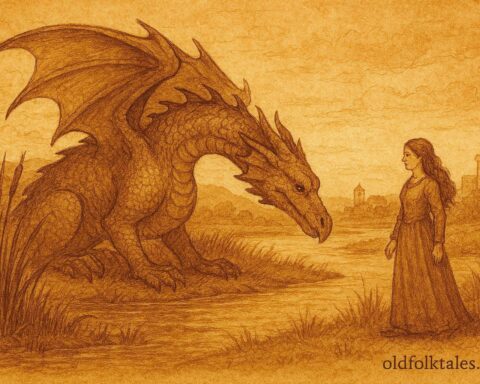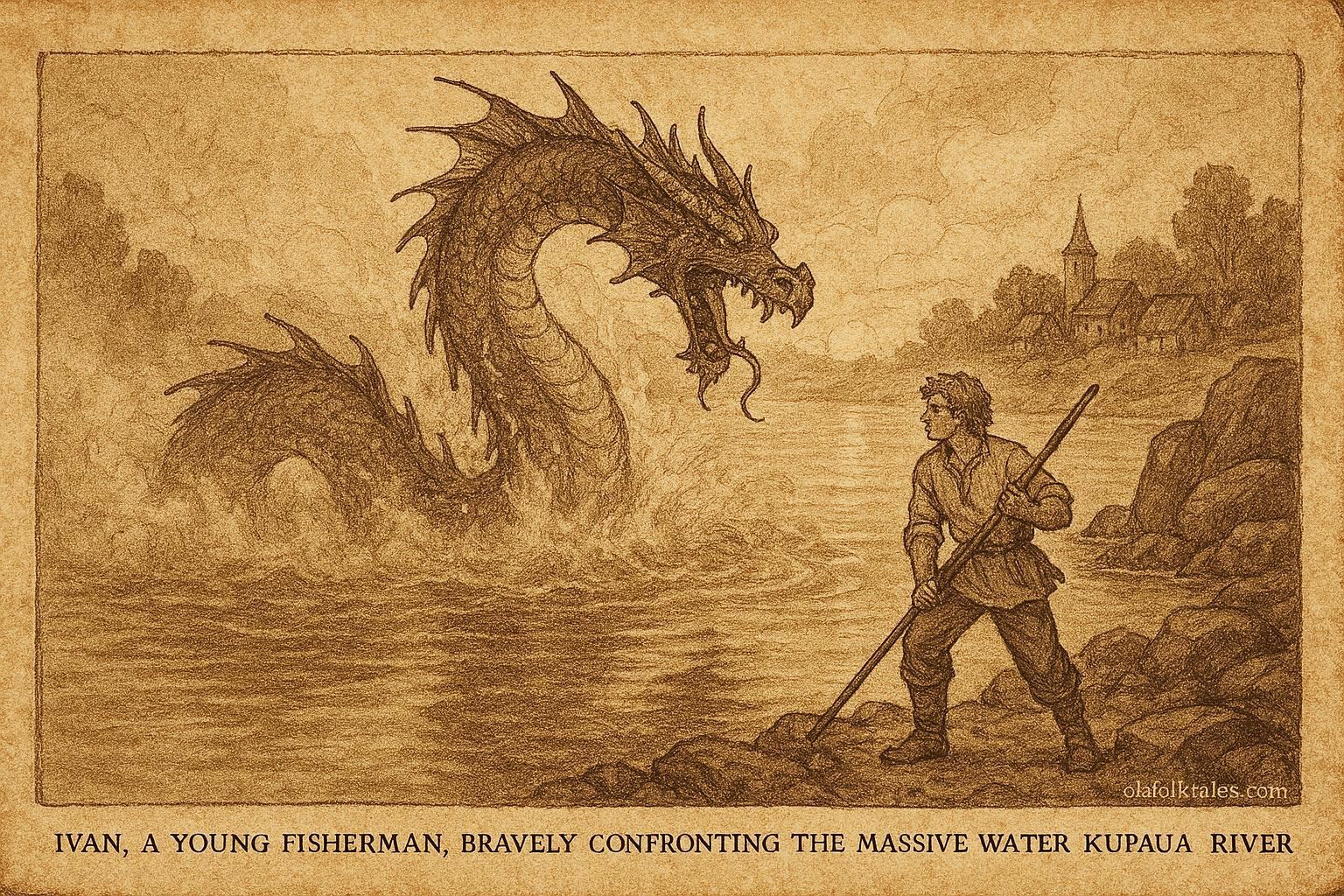
Along the twisting banks of the Kupa River, where the waters shimmered like silver under the morning sun, life had long been intertwined with the river’s moods. Fishermen cast their nets at dawn, children played along the shallows, and the elders told stories of spirits and creatures that dwelled in the dark depths. Most stories were harmless, meant to teach caution or respect for the river, but one tale had become all too real: the Water Dragon of Kupa, a monstrous serpent with scales glinting like emeralds and eyes like molten gold.
The dragon had appeared one summer, emerging from the depths during the fishing season. It overturned boats, devoured the largest catches, and frightened villagers so that many dared not approach the river. Even seasoned fishermen whispered of its roar echoing along the cliffs and groves. Fear gripped the villages along the Kupa, and desperation grew.
Discover Polish, Russian, Ukrainian, and Belarusian folktales where magic and morality meet
In one such village, near a bend of the river shaded by willows and alder trees, lived a young fisherman named Ivan. Though not the strongest man in the village, Ivan was known for his cleverness and calm mind, traits that often solved problems that strength alone could not. He watched his neighbors despairing over the ruined nets and the empty boats, and he decided that something had to be done.
Ivan spent days observing the dragon from the riverbank, noting its habits. He noticed that it rarely attacked small nets but struck when boats carried heavy catches. Its movements were swift but predictable: it always surfaced near the same rocky pool beneath a crooked willow. Ivan concluded that brute force alone would not defeat this river monster; he needed strategy.
On a misty morning, he prepared a plan. He took a small boat, laden not with fish but with a woven cage of iron and wood, baited with a single large fish. He positioned the boat where the dragon usually emerged and waited, hidden behind the willow’s sweeping branches. Soon, the water stirred. A ripple grew into a wave, and the dragon’s massive head broke the surface, eyes blazing with hunger.
The dragon lunged for the bait. At the precise moment, Ivan used a lever hidden in the boat to snap the cage shut, ensnaring the dragon’s snout. The creature thrashed violently, sending spray over the riverbank, but Ivan remained calm, speaking softly. He did not strike the dragon; instead, he sought to teach it restraint, showing that aggression would not benefit anyone.
He guided the dragon back toward the deeper river, speaking to it in the old manner taught by the elders, through songs and calls believed to convey respect and authority over river spirits. Slowly, the dragon’s thrashing lessened, its fiery eyes softening. Ivan realized that the creature was not evil, merely hunger-driven and misunderstood, responding to the village’s intrusion on its waters.
Once the dragon calmed, Ivan allowed it to retreat into a deeper part of the river, warning it in a clear, firm voice that any future aggression would be met with strategy and vigilance. The villagers, who had gathered along the bank in anxious silence, marveled at Ivan’s courage and intelligence. No one had dared to approach the dragon before, and certainly no one had shown such wisdom.
Word of Ivan’s encounter spread quickly, and the villagers adjusted their fishing practices to respect the dragon’s territory. They left offerings of fish at the rocky pool, honoring the creature and acknowledging its role in the river’s ecosystem. Over time, the Kupa River returned to a state of balance: the dragon occasionally appeared, but it no longer terrorized the village, and Ivan’s methods became legendary, teaching that courage tempered by wisdom and respect could achieve what violence could not.
Years later, Ivan’s tale was told to every young fisherman learning the river. He was remembered not only as a hero but as a man who understood that strength alone cannot protect a community; insight, patience, and reverence for nature were equally important. Children listened wide-eyed as elders recounted how the Water Dragon of Kupa, once feared, became a guardian of the river, guided by the cleverness and bravery of one young man.
Thus, the village of Kupa learned that harmony with the natural world, combined with intelligence and courage, could overcome even the most terrifying of threats. Ivan’s story endured, inspiring generations to act bravely, think clearly, and respect the unseen forces that shape the world around them.
Moral Lesson
True heroism is not measured by brute strength but by courage, cleverness, and respect for the natural world. Wisdom, strategy, and understanding can restore balance and protect communities without needless violence.
Knowledge Check
-
Who is the hero in the Croatian folktale of the Kupa River?
-
Ivan, a clever young fisherman.
-
-
What creature threatens the villages along the Kupa River?
-
A monstrous water dragon with emerald scales and golden eyes.
-
-
How does Ivan defeat the dragon?
-
Using strategy, a baited cage, and calm communication rather than brute force.
-
-
What central theme is emphasized in the tale?
-
Courage, intelligence, and respect for nature over reckless strength.
-
-
How do villagers ensure safety after Ivan’s encounter?
-
By leaving offerings and respecting the dragon’s territory.
-
-
What is the cultural origin of this folktale?
-
Croatia, Kupa River region, part of Slavic mythological tradition (19th century).
-
Source: Recorded in 19th-century Croatian folklore archives (Valjavec & Bošković‑Stulli, 1850s–1860s)
Cultural Origin: Croatia, Kupa River region, Slavic mythological tradition