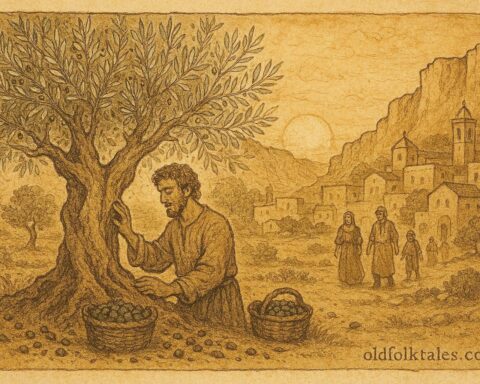
In a small village nestled among the limestone hills of rural Malta, where dry stone walls divided terraced fields and the Mediterranean wind carried the scent of salt and thyme, there lived a poor farmer named Mikiel.
His house was simple, whitewashed walls, wooden shutters faded by sun, and a hearth blackened by decades of cooking fires. Though his land was thin and the rains uncertain, Mikiel worked faithfully from dawn to dusk, tending barley and a few olive trees inherited from his father.
Life was modest but honest.
Yet in his heart lingered quiet worry. Drought had weakened his harvest, and debts pressed upon him like the summer heat. He prayed often at the small chapel outside the village, asking not for riches, but for relief.
One night, as wind rattled the shutters and the moon cast pale light across the stone floor, Mikiel dreamed.
He saw himself standing before a ruined farmhouse on the far side of the island. The building was crumbling, its roof half-fallen, its courtyard overtaken by weeds. In the center of the floor, beneath a cracked stone slab, gold coins shimmered.
He woke with his heart racing.
“It is only a dream,” he muttered, turning on his straw mattress.
But the dream returned the following night.
And again, the next week.
Each time the vision grew sharper, the angle of the broken wall, the twisted fig tree in the courtyard, the way sunlight fell across the slab of stone.
After the third repetition, Mikiel could no longer dismiss it.
The Journey Across Malta
Though Malta is small, in those days travel on foot across rocky hills and winding valleys was no small undertaking. Mikiel prepared modest provisions, bread, cheese, olives, and set out before sunrise.
Neighbors shook their heads.
“You chase shadows,” one old man warned.
“Dreams do not fill stomachs,” said another.
But Mikiel felt compelled.
He walked through villages of honey-colored stone, past fields where goats grazed and fishermen mended nets along the coast. Days passed before he reached the distant region that matched his vision.
There it stood.
The ruined farmhouse.
Its walls leaned tiredly; ivy clung to crumbling limestone. The fig tree twisted exactly as in his dream.
His breath caught.
He approached cautiously and stepped into the courtyard. The stone slab lay at its center.
Heart pounding, he began to dig.
Hours passed. Sweat soaked his shirt. His hands blistered. But beneath the slab, there was nothing.
No gold.
No chest.
Only dust and stubborn earth.
Exhausted and ashamed, Mikiel sat against the wall as the sun lowered toward the sea.
The Stranger’s Laughter
As twilight settled, a local watchman approached.
“You there,” the man called. “What business have you disturbing this ruin?”
Mikiel hesitated, then confessed his dream.
The watchman laughed, not cruelly, but knowingly.
“You are not the first to chase a vision,” he said. “If I followed every dream I had, I would dig up the entire island. Why, just last week I dreamed of treasure buried beneath the hearth of some poor farmer’s house in a village on the other side of Malta!”
He described the village.
Mikiel’s village.
He described the house, whitewashed walls, olive trees nearby.
Mikiel’s house.
The farmer felt a sudden stillness settle within him.
He did not argue. He did not explain.
Instead, he thanked the watchman and began the long journey home.
The Hearthstone
When Mikiel returned, he carried no treasure, only understanding.
For several days, he resumed his work quietly. He tended his fields. He repaired a stone wall. He listened to the wind brushing through olive leaves.
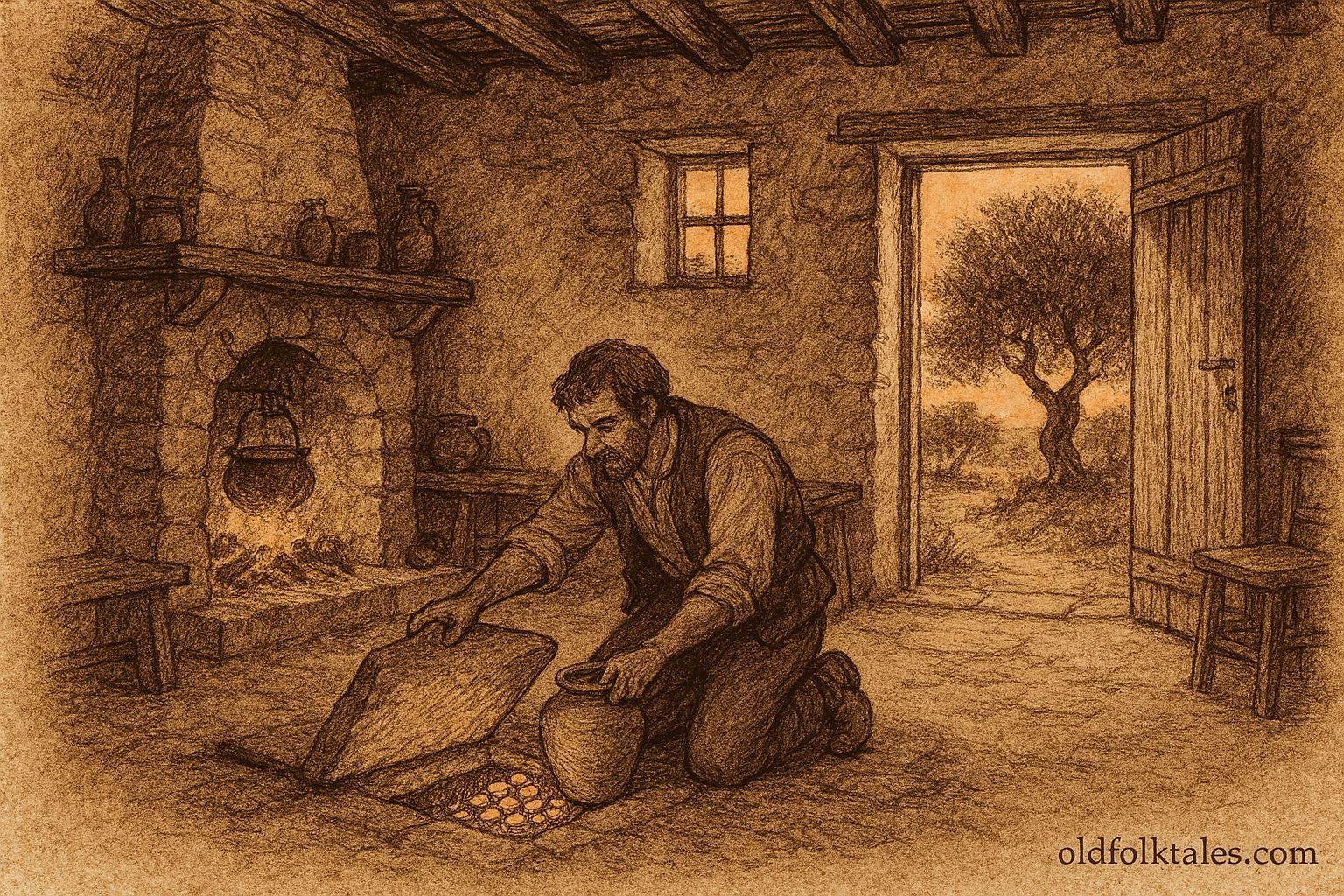
Then, one evening, when the house was still and the fire reduced to embers, he knelt before his hearth.
The stone at its center had always seemed slightly different, older than the rest.
With steady hands, he pried it loose.
Beneath lay compacted earth.
He dug slowly.
And soon, his fingers struck metal.
A clay jar, sealed and wrapped in oilcloth, emerged from the soil. Inside were silver and gold coins, aged but intact.
Mikiel trembled.
His grandfather had once spoken of times when pirates and invading forces swept across the island. Families buried their wealth to protect it, sometimes never returning to reclaim it.
These coins had waited through generations.
Not for greed.
But for need.
Wealth Reconsidered
Mikiel did not boast. He did not abandon his fields.
He paid his debts quietly. He repaired his home. He donated to the chapel that had sheltered his prayers.
And he continued farming.
When neighbors eventually learned of his fortune, they asked how he had found it.
He smiled gently.
“I traveled far to discover what lay beneath my own feet.”
The dream had not deceived him.
It had redirected him.
The Lesson of the Dream
In Maltese tradition, dreams are not always literal. They are mirrors reflecting truths hidden beneath worry and doubt.
Mikiel’s journey across the island was necessary, not because the treasure lay there, but because he needed distance to see clearly.
Had he never left, he might never have thought to search beneath his hearth.
The village elders later told the story as a reminder:
Sometimes we chase distant promise while overlooking inherited strength.
Sometimes faith must walk a long road before returning home wiser.
And sometimes the greatest wealth is not gold, but the realization that home itself holds hidden blessing.
Explore the warmth and wit of Mediterranean storytelling, where love and wisdom intertwine
Moral Lesson
True wealth often lies close to home. Patience, faith, and perseverance reveal blessings buried beneath ordinary life.
Knowledge Check
-
Why does Mikiel travel across Malta?
He follows a recurring dream of treasure beneath a ruined farmhouse. -
What does he discover at the distant ruin?
Nothing—only disappointment and reflection. -
How does he learn where the treasure truly lies?
A watchman unknowingly describes Mikiel’s own home while mocking dreams. -
Where is the treasure actually buried?
Beneath his own hearthstone. -
What larger theme does the story convey?
That home and inherited wisdom are often our greatest wealth. -
What cultural tradition does the story belong to?
Rural Maltese folklore.
Source: Studies in Maltese Folklore by Joseph Cassar Pullicino (1964)
Cultural Origin: Rural Malta