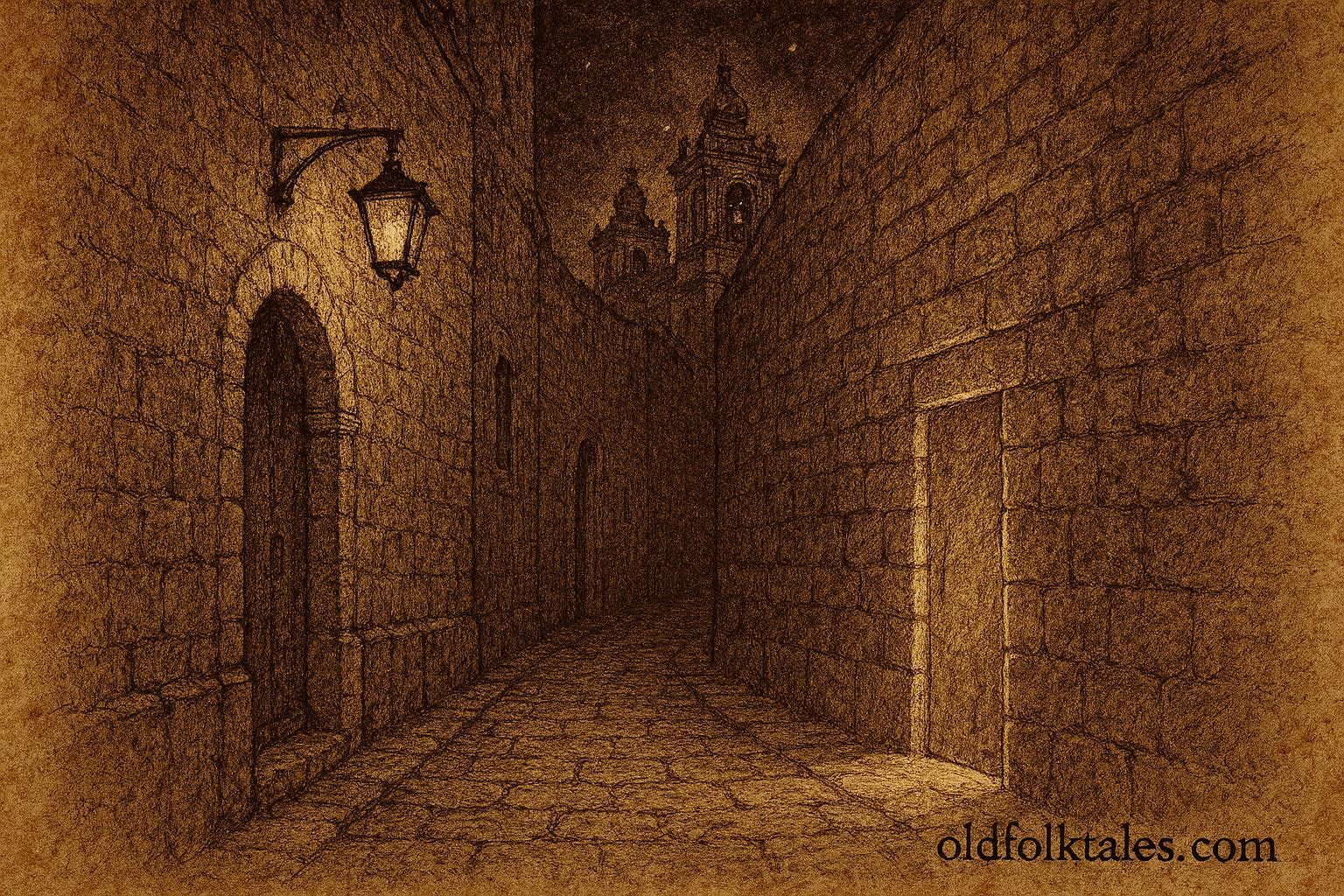
Within the silent limestone walls of Mdina, Malta’s ancient walled city, there stands an old townhouse whose balconies overlook narrow, winding streets polished smooth by centuries of footsteps. By day, the house appears unremarkable, its honey-colored façade warmed by Mediterranean sunlight, its wooden shutters closed against the afternoon glare. Yet by night, when the cathedral bells echo through the still air and the city empties into quiet shadow, the house holds a secret whispered through generations.
They say that within its upper corridor lies a hidden door.
And that at midnight, only once in a lifetime, it opens.
No one agrees on when the story began. Some claim it dates back to the time of foreign sieges, when noble families guarded both gold and knowledge. Others say it emerged from clerics who once studied in candlelit chambers beneath the city. But all versions share one truth: the door reveals something no ordinary room can contain.
It reveals truth itself.
The House in Mdina
The townhouse belonged long ago to a respected family whose name has faded with time. Its halls were lined with worn stone arches, and oil lamps once cast flickering light upon tiled floors imported from Sicily. Behind heavy wooden doors, generations had lived, married, mourned, and whispered.
Among these rooms lay a corridor few entered without reason. It ended not with a window or staircase, but with a blank wall of limestone.
At least, it appeared blank.
Children of the household would sometimes press their palms against it, swearing they felt a faint hollow beyond. Servants spoke of subtle drafts brushing their faces. But no seam, no hinge, no latch could be seen.
Until midnight.
The First Account
The earliest known telling describes a young man named Matteo, son of the household. Intelligent yet restless, he grew obsessed with uncovering the hidden door. He believed knowledge, once gained, would elevate him above his peers.
For years he searched the corridor. He traced every stone with his fingers. He listened for echoes. He waited through evenings as the cathedral clock marked the hours.
On the night of his twenty-fifth year, as the final bell struck midnight, the air shifted. The corridor grew unnaturally still. Before his eyes, a seam of light traced itself along the limestone.
A door formed where there had been none.
Matteo did not hesitate.
He stepped forward and entered.
Inside was not a chamber filled with gold nor manuscripts nor relics. Instead, the room was circular and bare, illuminated by no visible flame yet bathed in pale, steady light. At its center stood a single stone pedestal.
Upon it rested a mirror.
When Matteo approached and gazed into the glass, he did not see his reflection alone. He saw his ambitions stripped bare. He saw moments when pride guided him more than kindness. He saw the cost of decisions not yet made. He saw truths about himself that no tutor or priest had spoken aloud.
The revelation struck him with force.
When he turned away, shaken, the room dimmed. The door closed behind him.
It never opened again.
Though Matteo lived many years afterward, those close to him noticed change. His sharp arrogance softened into measured thoughtfulness. He never spoke publicly of what he saw, but neither did he pursue power recklessly again.
The Rule of Once
From that time forward, the legend hardened into rule: the door opens only once in a lifetime.
And only at midnight.
Many in Mdina dismissed it as superstition. Others quietly tested it.
Some waited in humility. Others in greed.
Yet the pattern remained consistent. Those who approached with selfish hunger found nothing. The wall stayed stone. No seam appeared. Midnight passed like any other hour.
But for those whose curiosity was mingled with responsibility, those seeking truth rather than advantage, the air sometimes shifted.
The Woman Who Sought Answers
Another telling speaks of a widow named Marija, who inherited part of the townhouse generations later. Her husband had died suddenly, leaving questions unresolved and property disputes unsettled among distant relatives.
Marija did not seek treasure. She sought clarity.
On a quiet autumn evening, she knelt in prayer before midnight. When the cathedral bells echoed through the stone streets, she stood in the corridor and waited.
The wall shimmered faintly.
The door appeared.
Inside, she found not a mirror but a table bearing letters, correspondence written by her husband, explaining intentions, decisions, and secrets he had feared to reveal while alive. The letters did not absolve every conflict, but they illuminated motives clouded by rumor.
When she stepped back into the corridor, the door sealed.
Marija resolved her affairs with steadiness and fairness. She never attempted to open the wall again.
Those Who Failed
The legend also warns of those who sought the chamber for selfish gain.
One merchant, hearing tales of revealed fortunes, camped in the corridor night after night, convinced gold awaited him. He mocked the story’s spiritual warnings.
Midnight came.
Nothing happened.
Angered, he struck the wall with iron tools, cracking plaster and bruising stone. By morning he had damaged the corridor but uncovered nothing.
He left Mdina poorer in reputation than before.
The door, the elders would say, recognizes intention.
Greed seals it tighter than stone.
What Lies Within?
Over time, speculation grew. Was the chamber magical? Divine? A test of conscience?
Clergy offered careful interpretations. Some suggested the room was a manifestation of one’s own soul, an inner reckoning made visible. Others claimed it represented divine mercy: one opportunity to confront truth before life’s path hardened.
But the people of Mdina rarely debated theology openly. They simply told the story.
And they warned their children:
“Curiosity guided by wisdom may open doors. Curiosity driven by greed closes them forever.”
The Present Silence
Today, visitors stroll through Mdina’s silent streets beneath wrought-iron balconies and cathedral domes. Few notice the townhouse tucked between taller façades.
Its shutters remain closed.
Its corridor still ends in plain limestone.
Whether the door continues to open at midnight, no one can prove. Those who have witnessed it rarely speak. Those who seek spectacle rarely succeed.
And perhaps that is the heart of the legend.
Truth is not entertainment.
It is responsibility.
Moral Lesson
Knowledge is powerful, but it carries weight. Those who seek truth with humility may receive it once, but those who pursue it for selfish gain may find the door closed forever.
Knowledge Check
-
Where is the hidden door located?
In an old townhouse corridor in Mdina, Malta. -
When does the secret door open?
Only at midnight, and only once in a lifetime. -
What determines whether the door appears?
The seeker’s intention, humility opens it, greed seals it. -
What did Matteo see inside the chamber?
A mirror revealing deep personal truths about himself. -
What central theme defines the story?
Responsibility with knowledge and the cost of revelation. -
What cultural tradition does this legend belong to?
Maltese folklore from Mdina.
Source: Documented in Maltese folklore by Ġorġ Mifsud Chircop (1996).
Cultural Origin: Mdina, Malta.