In the rugged mountains of Catalonia, where rocky peaks rise above forests of pine and oak, the massif of Sant Llorenç del Munt stands like a great stone guardian above the valleys of northeastern Spain. The cliffs are steep, the caves deep, and the winds that sweep through the ravines carry stories older than the villages themselves.
Among these stories is one that the people of the region have repeated for generations, a tale of fear, courage, and the triumph of order over chaos. It is the legend of the Dragon of Sant Llorenç del Munt.
The Mountains Above the Villages
Long before roads wound easily through the hills, the small farms scattered around the base of Sant Llorenç del Munt depended on their land for survival. Families tended vineyards and olive groves, raised sheep and goats, and harvested grain from narrow fields carved into the slopes.
Life in these mountains demanded patience and resilience. The weather could change quickly, and the terrain itself often tested those who worked it.
Yet for many years the greatest fear among the villagers was not the storms or the rocky soil.
It was something far older.
High in the caves carved into the mountainside, something had taken up residence.
Rumors of the Beast
The first signs were small enough to ignore.
A shepherd reported that several sheep had vanished during the night. At first, wolves were blamed, as they often roamed the forests of Catalonia. But the tracks left behind did not resemble those of wolves.
Then a farmer discovered his goat pen broken open and several animals gone without explanation.
Soon other stories followed.
At dusk, travelers claimed they saw a massive shadow gliding across the rocky cliffs above the valley. Some heard strange echoes rolling through the mountains, deep rumbling sounds that did not resemble thunder.
One evening, a shepherd returning late from the hills rushed into the village square pale with fear.
He swore he had seen a creature emerging from a cave high on the mountain.
Its wings stretched wide against the fading light.
Its body moved like a great serpent across the rock.
The villagers understood at once what the stories meant.
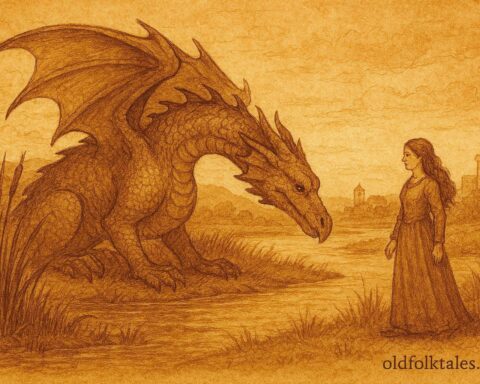
A dragon had come to Sant Llorenç del Munt.
Fear in the Valley
Dragons were not unknown in the legends of Catalonia. Tales of such creatures appeared in stories told beside hearth fires and in songs carried by traveling storytellers.
But those were distant stories.
This dragon was real.
Soon the damage became impossible to ignore. Livestock disappeared more frequently. Shepherds avoided certain slopes of the mountain. Farmers refused to travel after sunset.
The dragon’s cave was believed to lie somewhere among the cliffs above the valley, where jagged rocks formed dark openings in the mountain’s side.
The creature rarely descended fully into the villages, but its presence alone cast a shadow over daily life.
Fear spread quickly among the scattered farms.
Families who had worked the land for generations began to wonder whether they could remain there at all.
The Gathering of the Villagers
At last, the elders of the villages gathered in council. Farmers, shepherds, and tradesmen stood together in the square, discussing what could be done.
Some proposed abandoning the highest pastures entirely.
Others argued that the dragon must be confronted before it grew bolder.
But dragons were not ordinary animals. Few believed a simple group of villagers could defeat such a creature.
As the meeting continued, one man stepped forward.
He was known among the villagers for his strength and determination. Though not a noble knight, he was respected for his courage and loyalty to the community.
He listened quietly while others spoke, then addressed the crowd.
If the dragon continued to live in the mountain, he said, the farms below would never be safe.
Someone would have to face it.
And he would be that person.
The Climb to the Cave
The following morning, before the sun rose fully above the peaks, the brave villager prepared for the journey.
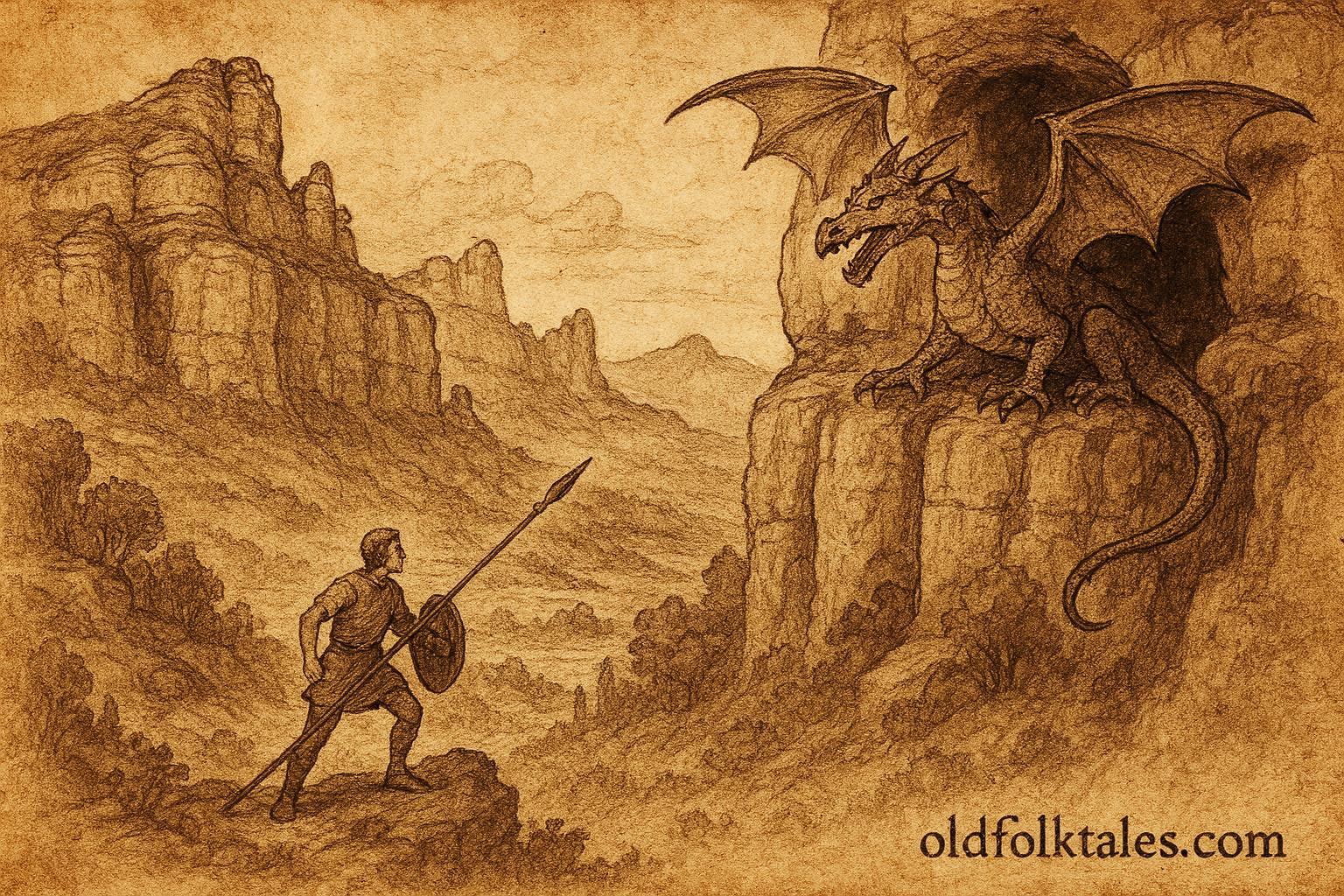
He carried a strong spear and a shield, tools simple but dependable. The villagers gathered to watch him depart, some offering prayers for his safety.
The path toward the dragon’s cave was steep and treacherous.
As he climbed higher into the mountains, the air grew colder and the trees thinner. The rocky slopes twisted into narrow ledges that overlooked deep valleys below.
At times he heard strange echoes bouncing across the cliffs, low rumbling sounds that reminded him of the stories told by the shepherds.
Still, he continued upward.
At last, he reached the caves believed to shelter the beast.
Dark openings yawned between jagged stones, and the ground nearby showed signs of disturbance, scattered bones and clawed marks on the rock.
The dragon was near.
The Confrontation
The hero approached cautiously, listening for movement inside the cave.
For a moment, the mountains seemed silent.
Then a great shape shifted in the darkness.
The dragon emerged.
Its wings unfolded against the stone walls, and its body coiled across the entrance of the cave. Its eyes gleamed in the dim light as it faced the man who had dared to climb into its domain.
The beast roared, the sound echoing through the cliffs and down into the valley far below.
But the hero did not retreat.
With shield raised and spear ready, he stepped forward to confront the creature that had brought fear to his people.
The struggle that followed was fierce.
The dragon struck with powerful movements, its wings beating against the rocks. The hero dodged and fought with determination, refusing to yield despite the danger before him.
At last, through courage and persistence, he delivered a decisive blow that brought the beast down upon the rocky ground.
The dragon’s roar faded into silence.
Peace Returns to the Valley
When the hero returned to the villages below, word spread quickly that the dragon had been defeated.
Shepherds cautiously returned to the pastures. Farmers resumed their work without fear of the creature that had haunted the mountains.
Life gradually returned to the quiet rhythm the valley had always known.
Though the caves of Sant Llorenç del Munt remained dark and mysterious, the dragon no longer dwelled within them.
The villagers never forgot the courage of the man who had climbed the mountain to defend them.
His act became part of local legend, a reminder that even the most terrifying threats can be overcome when someone chooses to stand against them.
The Enduring Legend
Today the mountains of Sant Llorenç del Munt remain a place of rugged beauty in Catalonia. Hikers walk the same rocky paths once used by shepherds and farmers centuries ago.
Among the cliffs and caves, the legend of the dragon still echoes in local storytelling traditions.
Whether the creature truly existed or whether it grew larger in memory over time, the meaning of the story remains clear.
In the face of chaos and fear, courage can restore balance.
And sometimes the protection of a community begins with a single brave step up a mountain path.
Moral Lesson
Even when danger seems overwhelming, courage and determination can protect a community and restore peace.
Knowledge Check
1. Where does the legend of the dragon take place?
In the mountains of Sant Llorenç del Munt in Catalonia, northeastern Spain.
2. What problems did the dragon cause for the villagers?
It attacked livestock and created fear among farmers and shepherds.
3. Where was the dragon believed to live?
In caves high in the rocky cliffs of the mountain.
4. Who confronted the dragon?
A brave local villager who volunteered to defend the community.
5. What does the dragon symbolize in the legend?
Chaos and danger threatening the peaceful life of the valley.
6. What lesson does the story teach?
That courage and determination can overcome even overwhelming threats.
Source: Adapted from Folklore de Catalunya: Rondallística by Joan Amades (1950).
Cultural Origin: Catalonia, Northeastern Spain.