In the flat, misty lands of Flanders, winding canals cut through fields of reeds and wheat. Small villages with brick homes dotted the countryside, connected by narrow dirt roads that twisted between low dikes. By day, the landscape was peaceful, the waters calm, and farmers tending their crops or herding cattle. By night, however, the flat lands became strange and eerie. Shadows stretched across the ground, the wind whispered through the reeds, and travelers often hurried home, wary of the dark.
It was in these very lands that the tales of the Kludde were told, a shapeshifting spirit feared by all who traveled alone after sunset.
The Trickster of the Night
The Kludde, the elders said, had no single form. Sometimes it appeared as a large black dog with fiery eyes. Other nights, it took the shape of a cat that slunk silently between houses. At times, it was no more than a shadow, stretching across the road or wall, moving without source. Its defining feature, however, was always the same: it preyed upon those who walked the lonely paths after dark.
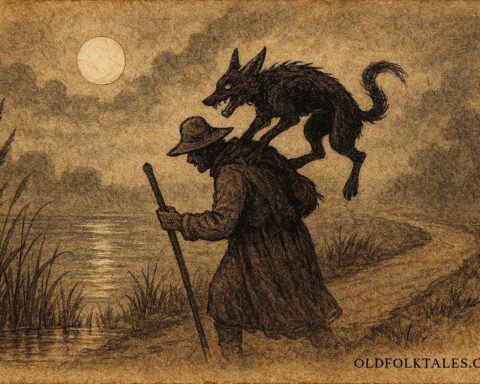
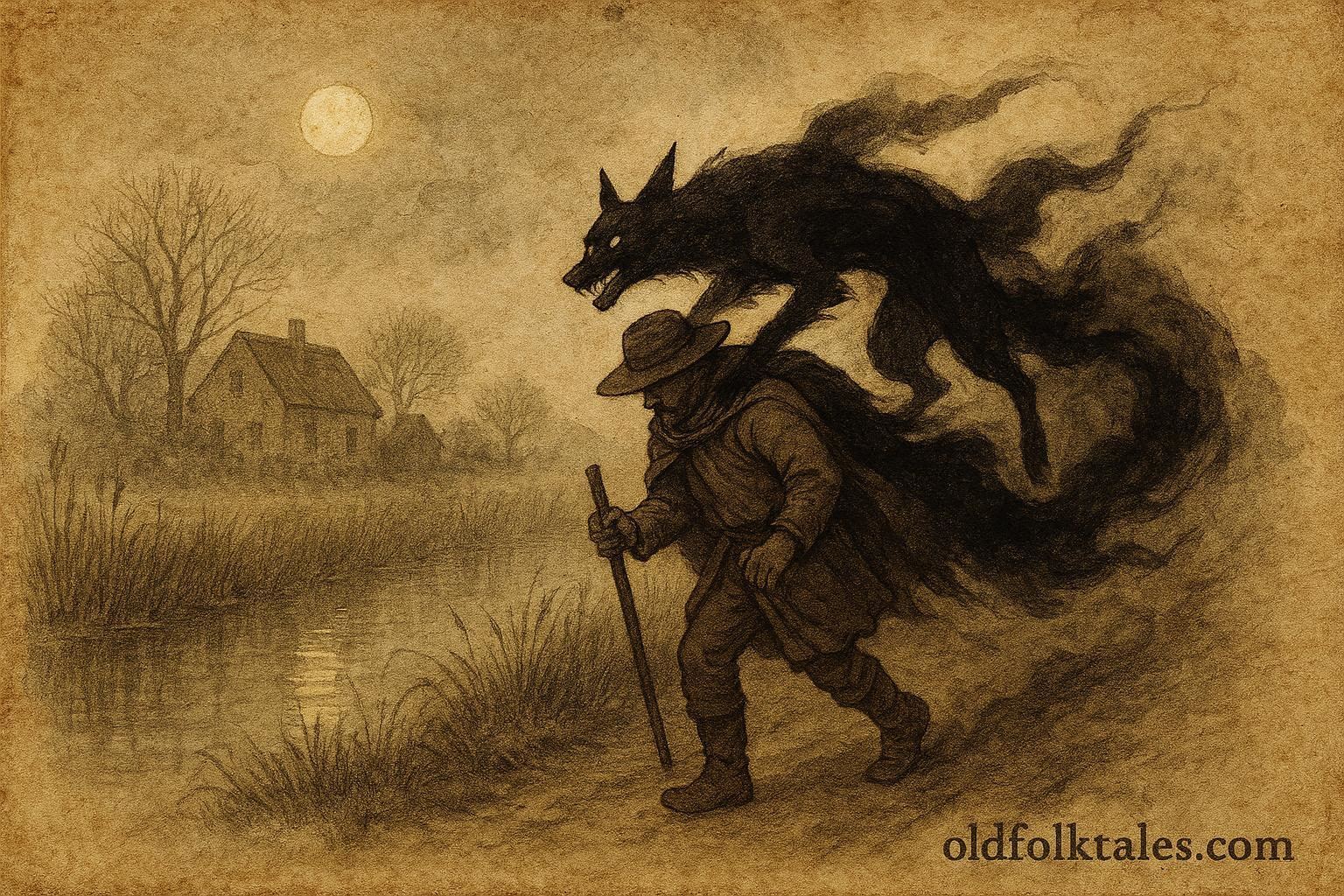
If a traveler met the Kludde, it would leap onto their back with impossible weight, forcing them to carry it until their legs wobbled and they fell exhausted. No amount of pleading, struggling, or cleverness could rid one of the burden once the Kludde had chosen its victim.
The villagers warned: “Never travel alone at night, and never provoke the shadows, for the Kludde watches and waits.”
A Traveler’s Tale
One autumn evening, a young man named Hendrik set out from his village to visit relatives in a neighboring town. The sun had dipped behind the dikes, and a thin fog rose from the fields, curling around the edges of the roads. Hendrik was tired but determined, carrying a small pack with food and a lantern.
As he walked along a lonely stretch of road, he heard a soft growl behind him. At first, he thought it was a dog from a nearby farm. But when he turned, no animal appeared. A chill ran down his spine. He quickened his pace, but the growl persisted, growing louder and heavier with each step.
Suddenly, with the speed of a striking snake, a large black dog sprang onto his back. Hendrik fell to his knees, gasping under the tremendous weight. He struggled, but the creature’s grip was relentless. Its eyes glowed like burning coals, and a low, otherworldly growl rumbled from its throat. The Kludde had claimed him.
Endurance Against the Kludde
Hendrik tried everything he knew to dislodge the spirit. He shook, he stumbled, he even prayed aloud, but the weight only increased. The Kludde shifted forms, sometimes a shadowy figure, sometimes a cat that seemed impossibly heavy, always pressing down on him until his knees scraped against the road.
Hours passed. Hendrik’s arms ached from trying to push it off, his breath came in ragged gasps. Only when he remembered the warnings of the village elders did a plan form in his mind. He paused, closed his eyes, and began to whisper words of humility and respect for the spirits of the land, asking forgiveness for passing through uninvited, for ignoring the power of the unseen forces.
As he spoke with sincerity, the weight began to lift slightly. A faint chill moved away from his back. Slowly, the Kludde released him, vanishing into the fog like smoke. Hendrik collapsed onto the ground, exhausted but alive. He had survived his encounter by acknowledging the power of the night spirits rather than attempting to dominate them.
Lessons in the Lowlands
When Hendrik returned home, he shared his tale with the villagers. They nodded knowingly, for the Kludde had been a part of their oral history for generations.
The elders explained that the Kludde was not evil in the human sense, it was a force of the night that tested respect and courage. Those who traveled carelessly, who ignored the unseen, or who acted out of greed or pride often became victims. Those who approached the dark paths with humility, attentiveness, and respect were sometimes spared.
Children were warned to never venture alone after sunset. Farmers tied bells to their animals at night. And travelers learned to carry prayers, offerings, or charms to appease the spirits that roamed the flat fields after dark.
Enduring Legacy
Over the centuries, stories of the Kludde became part of Flemish folklore. The spirit’s shapeshifting nature and relentless burden symbolized the perils of the unknown and the importance of respecting forces beyond human control.
Even today, tales of the Kludde are recounted during long autumn nights, when fog rolls across the canals, and the flat lands are silent except for the wind through the reeds. Travelers, old and young, are reminded to walk carefully, to honor the unseen, and to respect the mysteries of the Lowlands.
Moral Lesson
The Kludde of the Lowlands teaches that humility and respect for forces beyond our understanding are essential. Bravery alone cannot protect against every danger; wisdom, caution, and reverence for the unseen ensure survival and harmony within the world around us.
Knowledge Check
1. Who is the Kludde in Flemish folklore?
A shapeshifting spirit that appears as a dog, cat, or shadow and burdens travelers who walk alone at night.
2. What region is the legend of the Kludde associated with?
Southern Netherlands and Flanders region of the Low Countries.
3. How does the Kludde punish travelers?
By leaping onto their backs, forcing them to carry its heavy weight until they collapse from exhaustion.
4. What strategy did Hendrik use to survive his encounter?
He approached the Kludde with humility and respect, acknowledging the power of the spirit and apologizing for trespassing.
5. What themes are emphasized in the Kludde stories?
Fear of darkness, consequences of mischief, caution in lonely or dangerous places, and respect for unseen forces.
6. Why did villagers warn against traveling alone after dark?
Because the Kludde could attack those who acted carelessly or disrespectfully, serving as a lesson in vigilance and humility.
Source: Low Countries folklore traditions
Cultural Origin: Southern Netherlands and Flanders region, 16th century CE