In the bustling city of Corinth, where merchants’ voices mingled with the clatter of bronze coins and the laughter of children echoed along stone streets, there lived a young man named Arion. From early childhood, he displayed an extraordinary gift for music. His fingers danced over the strings of the lyre as if the instrument itself whispered ancient secrets, and his voice, clear and resonant, could move even the hardest of hearts.
Arion’s fame grew quickly. Nobles and merchants alike gathered to hear him perform, and soon he was renowned across the Greek world. Stories of his talent reached distant cities, and it was said that when he played, the gods themselves paused to listen.
The Musical Contest
One year, a great contest of music was announced in Sicily, drawing musicians from across the Aegean. Arion, eager to test his skills and to bring honor to Corinth, set out to participate. Among the contestants, he was unmatched. With every note, he painted vivid images: the silver light of the moon glinting on the sea, the rustle of olives in a summer breeze, and the laughter of children playing in sunlit courtyards.
The judges, moved beyond words, declared Arion the victor. They awarded him a prize of gold coins and precious gifts, a fortune he had never seen in his life. Elated and humbled, he prepared for the journey home, carrying both the riches and the fame that now followed him like a shadow.
The Sailors’ Betrayal
Yet not all were pleased by Arion’s success. Among the sailors hired to take him home, whispers of greed grew louder each day. “Why should one man return with such wealth?” muttered the captain one night, eyes glinting in the lantern light. “We can claim the gold for ourselves. None will know, and no one can stop us.”
Fearless in his innocence, Arion remained unaware of their plotting. But as the ship cut through the deep blue of the Ionian Sea, he sensed a subtle shift in their tone. One evening, as the sun dipped below the horizon and painted the waters with fiery streaks, the sailors confronted him. Their hands were rough, and their words sharp as the wind. “Hand over your treasure, or we cast you into the waves.”
Arion’s Prayer
Realizing that no earthly plea would save him, Arion turned to the divine. He clasped his hands and lifted his voice in prayer to Apollo, god of music and protector of artists. Tears mingled with saltwater as he spoke:
“O mighty Apollo, guardian of melody, if my life is to be spared, let your power guide me. Let the sea itself carry me to safety, and let my music remain a light in this world of treachery.”
The sailors, drunk with greed, laughed and jeered, ignoring the prayer. Yet Arion, heart steady with faith, took a bold step. He leapt into the dark waters of the sea, clutching his lyre close as the waves surged around him.
Divine Rescue
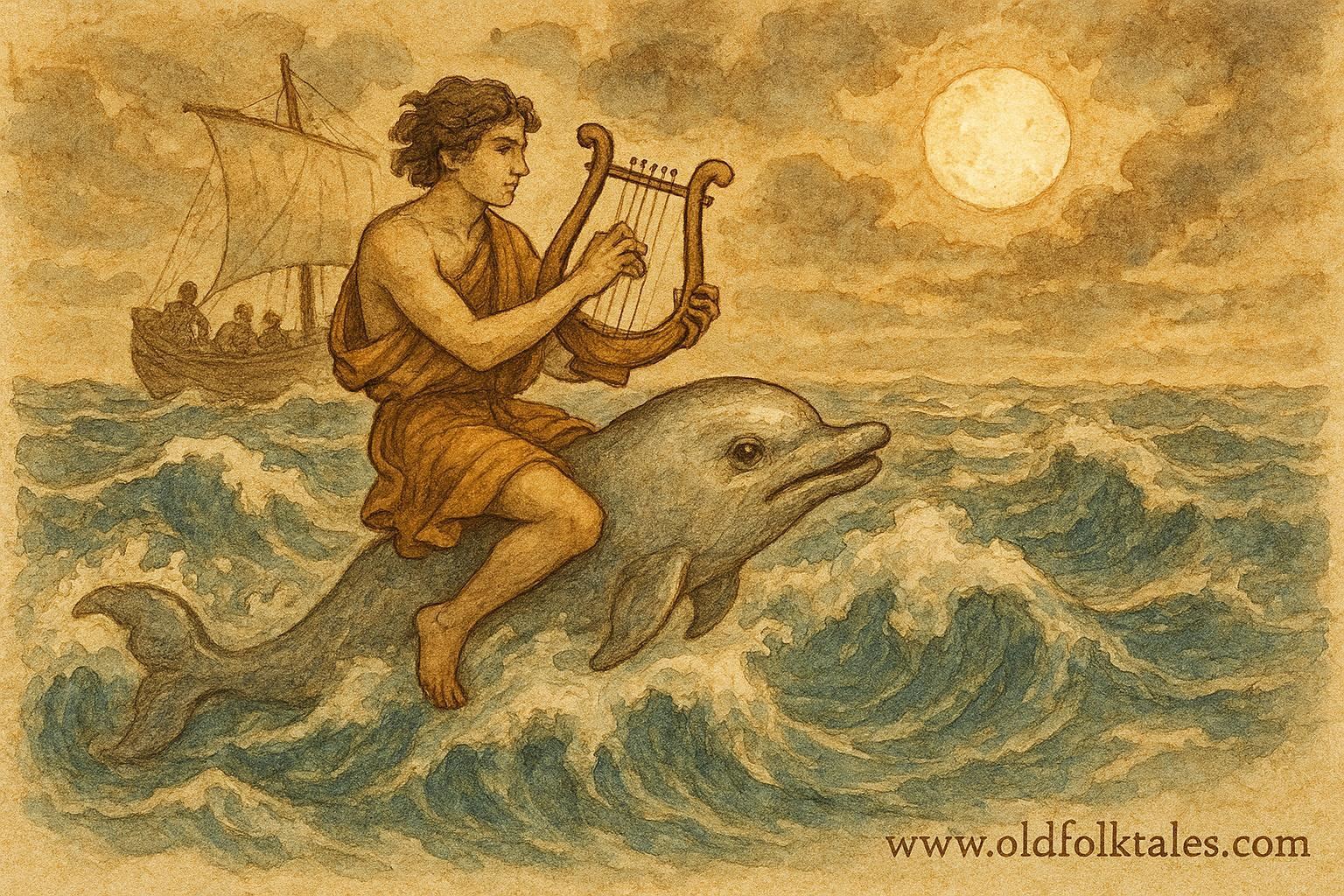
As his body sank beneath the rolling tides, a miracle unfolded. From the depths of the Ionian Sea emerged a dolphin, gleaming silver in the fading light, its eyes intelligent and gentle. The dolphin circled Arion once, twice, and then nudged him onto its back. Steady and strong, it carried him safely through the waves, surfacing under the moon’s gentle glow.
Throughout the night, Arion played his lyre atop the dolphin’s back. The music rose and fell with the rhythm of the sea, harmonizing with the splashes and cries of nocturnal birds. Each note seemed to bless the water, calming it, guiding him toward land. The sea, once a place of fear and uncertainty, became a vessel of deliverance, and the music echoed as a bridge between the mortal and the divine.
Return to Corinth
By dawn, Arion and his miraculous companion reached the shore. Exhausted but alive, he offered thanks to Apollo, praising the gods who watch over those of pure heart. Word of his ordeal spread swiftly. Corinth received him with awe, marveling not only at his survival but at the tales of his music riding across the waves atop a dolphin.
The sailors, confronted by the city magistrates, faced justice for their treachery. Their deceit was punished, and Arion’s reputation as a virtuous and divinely protected musician was cemented. From that day forward, tales of Arion’s lyre and the dolphin that saved him were sung in Corinthian homes, marketplaces, and temples, reminding all who listened that skill, faith, and virtue hold power beyond any treasure.
Discover the spiritual depth and wisdom hidden in the ancient folklore of Eastern and Balkan Europe
Moral Lesson
This story teaches that integrity, talent, and faith in the divine surpass wealth and cunning. True protection and success come not from gold or force, but from virtue, skill, and a heart attuned to higher powers.
Knowledge Check
1. Who was Arion, and what was he known for?
A famed Corinthian musician, celebrated for his extraordinary lyre-playing and voice.
2. What prompted the sailors to betray Arion?
Greed; they wanted to steal his gold prize from the musical contest.
3. Which god did Arion pray to for help?
Apollo, god of music and protector of artists.
4. How was Arion saved from the sea?
A dolphin, sent by the gods, carried him safely to shore.
5. What role did Arion’s music play during his rescue?
His melodies calmed the sea and symbolized divine favor and courage.
6. What cultural tradition does this folktale belong to?
Ancient Greek folklore, Corinthian musical tradition.
Source: Adapted from Herodotus, Histories, c. 5th century BCE
Cultural Origin: Ancient Greece (Corinthian tradition)