High in the forested mountains of Serbia, where mist drifted through ancient pines and the wind carried the scent of wild herbs, there flowed a small but sacred spring. Its waters were clear as glass, cold as melting snow, and said to possess a quiet blessing that nourished the land.
For generations, the nearby village depended upon this spring. It fed the fields, watered the flocks, and provided life to every household. Children laughed along its banks, elders filled clay jars with its water, and farmers thanked the mountains each harvest for its steady flow.
But the villagers also knew something else.
Deep within the rocky cave above the spring lived a dragon, an ancient guardian of the waters.
The villagers did not fear the creature, for it had never harmed them. Instead, they treated the spring with reverence. No one polluted its waters, and offerings of bread or fruit were sometimes left near the cave entrance as a quiet sign of gratitude.
So long as respect remained, the dragon slept peacefully and the spring never failed.
But one terrible summer, everything changed.
The Coming of the Drought
The year began with promise. Spring rains nourished the fields, and the orchards blossomed with fragrant flowers.
Yet by midsummer the skies turned harsh and cloudless. Day after day the sun burned the earth, drying rivers and shrinking ponds. Crops withered under the relentless heat.
At first the villagers trusted the mountain spring to sustain them, as it always had.
But slowly, so slowly they almost did not notice—the flow of water began to weaken.
The once lively stream became a thin trickle.
By late summer, the spring barely filled a single bucket.
Fear spread throughout the village.
Without the spring, the fields would die, the animals would perish, and winter would bring hunger.
The elders gathered beneath an old walnut tree to discuss what must be done.
“Perhaps the dragon has grown angry,” one elder suggested quietly.
“Or perhaps it has abandoned the spring,” another said.
A young man named Petar listened carefully to the conversation. He was a shepherd, known for his calm nature and thoughtful mind.
Finally he spoke.
“If the dragon guards the spring,” Petar said, “then we must speak with it.”
The elders gasped.
“No one approaches a dragon,” one warned.
“But we cannot allow our village to die without seeking the truth,” Petar replied.
The Journey to the Spring
At dawn the next morning, Petar climbed the steep path that wound toward the mountain cave.
The land around the spring looked different now.
Grass had turned brittle and yellow. The small pool beneath the rocks had shrunk to a shallow basin. Even the birds seemed quiet, as though waiting for something.
Petar approached the cave slowly.
From within the darkness came a deep, slow breathing.
The dragon was there.
Though fear pressed heavily against his chest, Petar remembered the stories told by his grandfather: dragons of the mountains were not always monsters. Many were ancient guardians of rivers, lakes, and springs.
They demanded respect, but not violence.
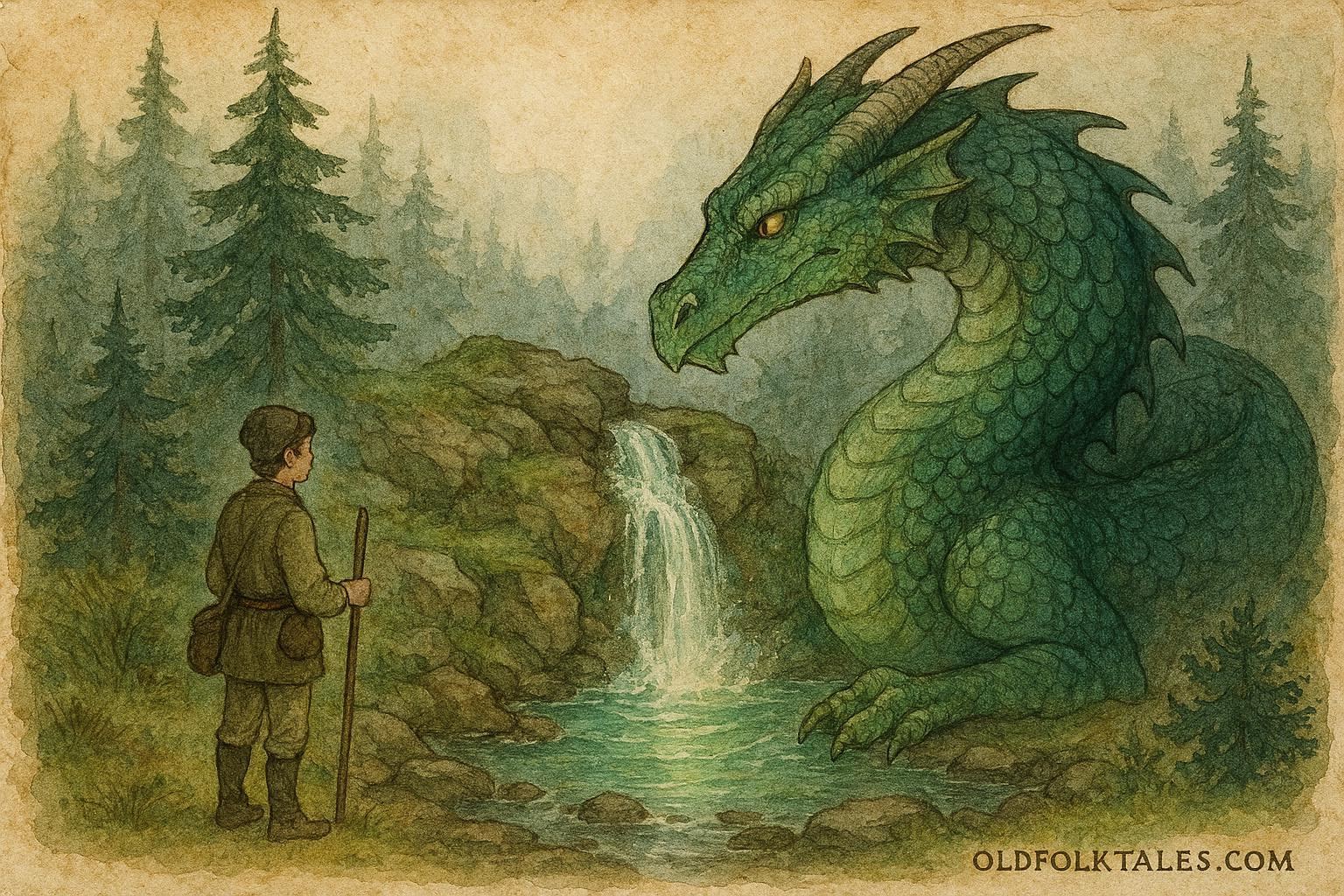
Petar knelt beside the water and spoke respectfully.
“Guardian of the mountain spring,” he called softly, “I come not with weapons but with gratitude.”
For a long moment there was only silence.
Then the ground trembled slightly.
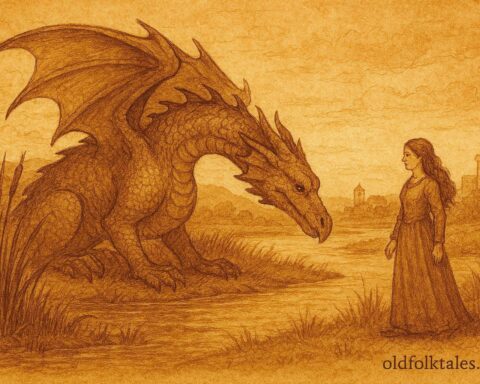
From the shadows of the cave emerged the dragon.
The Guardian Revealed
The creature was enormous.
Its scales shimmered like dark emerald stone, and its eyes glowed with an ancient golden light. Large wings folded against its back, and its long tail coiled among the rocks.
Yet despite its size and power, the dragon did not attack.
Instead it studied the young shepherd carefully.
“You speak politely for one of your kind,” the dragon said in a voice deep as thunder rolling across mountains.
Petar bowed his head.
“The village depends on this spring,” he said. “But the water is disappearing. We feared you might be angry with us.”
The dragon’s golden eyes softened slightly.
“I am not angry,” it replied.
“The mountain itself is troubled.”
The Hidden Cause
The dragon lifted one great claw and pointed toward the distant slopes.
“High above this spring,” it explained, “a group of men has cut deep into the forest and dug into the earth for stone and minerals. Their tools have disturbed the underground streams that feed this water.”
Petar frowned.
“But those men are not from our village,” he said. “Traveling merchants and miners arrived only this year.”
The dragon nodded.
“They care nothing for the balance of the mountain. They break the earth without thought.”
Petar realized the truth immediately.
The drought was not simply the work of nature.
It was caused by careless human actions.
A Choice of Paths
“Can the spring be saved?” Petar asked.
“Yes,” said the dragon.
“But not through battle.”
The creature lowered its massive head until its glowing eyes met Petar’s.
“You must convince your people, and the outsiders, to restore the mountain. The forest must be protected, and the underground waters allowed to flow freely again.”
Petar thought carefully.
“If we drive the miners away with violence,” he said, “the conflict may only bring more harm.”
The dragon smiled faintly.
“You understand the wisdom of balance,” it said.
“Speak to them. Show them what their actions are doing.”
A Village United
Petar returned to the village and told the elders everything.
At first some doubted his story, but the evidence of the dying spring could not be ignored.
The villagers traveled together to the mining site high in the hills.
There they saw deep trenches carved into the earth and trees cut down across the slopes.
Petar spoke calmly to the miners.
“The mountain’s water is disappearing,” he explained. “Your digging has broken the underground streams.”
Some miners laughed at first.
But when the villagers showed them the dried fields and empty wells below, a few began to understand the seriousness of the situation.
Finally the leader of the miners agreed to stop the excavation and move their operations farther away.
The villagers helped restore the damaged land, planting new trees and sealing the broken channels that had diverted the water.
The Return of the Spring
Weeks passed.
The villagers worked tirelessly to heal the mountain.
Then one morning, just as the first autumn rains began to fall, a wonderful sound echoed through the valley.
Water.
The spring was flowing again.
Clear water bubbled from the rocks and spilled into the pool below, stronger and brighter than before.
Children danced with joy while farmers filled their buckets.
Petar returned once more to the cave above the spring.
The dragon watched the flowing water with quiet satisfaction.
“You chose wisdom instead of violence,” it said.
“And because of that, both the village and the mountain live.”
Petar bowed respectfully.
“We only listened to what the mountain was telling us.”
A Lasting Lesson
From that day forward, the villagers remembered the lesson of the dragon guardian.
They treated the forests and streams with even greater care, knowing their survival depended upon the balance of nature.
And sometimes, when mist rolled across the mountain at sunrise, people claimed they saw the dragon gliding silently above the spring, still watching, still guarding the sacred water.
Moral Lesson
The Dragon of the Mountain Spring teaches that harmony with nature is essential for survival. Courage does not always mean fighting—it often means listening, understanding, and working together to restore balance.
Knowledge Check
1. What does the dragon guard?
A sacred mountain spring that supplies water to the village.
2. Why does the spring begin to dry up?
Miners disturb the underground streams that feed the water.
3. Who confronts the dragon?
A brave young villager named Petar.
4. How does Petar solve the problem?
Through respectful conversation and cooperation rather than violence.
5. What lesson does the village learn?
Nature must be respected and protected to maintain balance.
6. What role does the dragon play?
It serves as the guardian of the mountain and protector of the spring.
Source: Serbian oral mythic traditions recorded in Balkan folklore studies. Mid-19th century folklore collections
Cultural Origin: Slavic mythological tradition from Serbia